Xingang Pan 1,2 Ayush Tewari 3 Thomas Leimkühler 1 Lingjie Liu 1,4 Abhimitra Meka 5 Christian Theobalt 1,2
1Max Planck Institute for Informatics 2Saarbrücken Research Center for Visual Computing, Interaction and AI 3MIT 4University of Pennsylvania 5Google AR/VR
Abstract
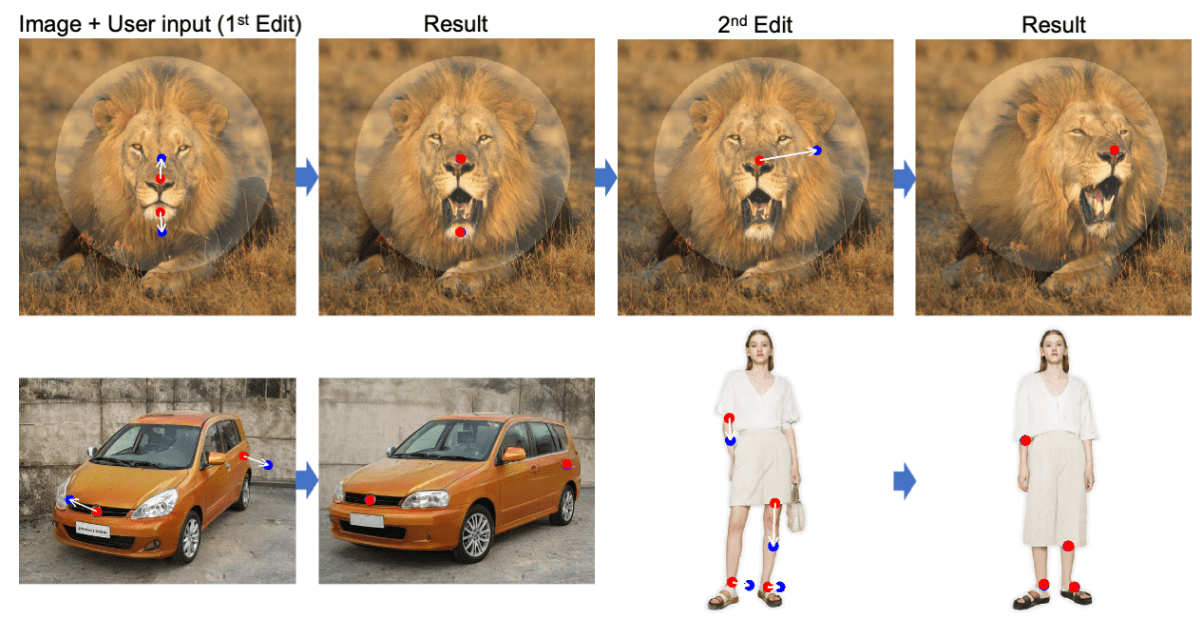
Synthesizing visual content that meets users' needs often requires flexible and precise controllability of the pose, shape, expression, and layout of the generated objects. Existing approaches gain controllability of generative adversarial networks (GANs) via manually annotated training data or a prior 3D model, which often lack flexibility, precision, and generality. In this work, we study a powerful yet much less explored way of controlling GANs, that is, to "drag" any points of the image to precisely reach target points in a user-interactive manner, as shown in Fig.1. To achieve this, we propose DragGAN, which consists of two main components including: 1) a feature-based motion supervision that drives the handle point to move towards the target position, and 2) a new point tracking approach that leverages the discriminative GAN features to keep localizing the position of the handle points. Through DragGAN, anyone can deform an image with precise control over where pixels go, thus manipulating the pose, shape, expression, and layout of diverse categories such as animals, cars, humans, landscapes, etc. As these manipulations are performed on the learned generative image manifold of a GAN, they tend to produce realistic outputs even for challenging scenarios such as hallucinating occluded content and deforming shapes that consistently follow the object's rigidity. Both qualitative and quantitative comparisons demonstrate the advantage of DragGAN over prior approaches in the tasks of image manipulation and point tracking. We also showcase the manipulation of real images through GAN inversion.
Results
An entrepreneur with over a decade of experience in AI, Cloud, and HPC. He is currently a DevOps Architect and the founder of Data Phoenix, an influential media voice for the AI industry, with a strong focus on community building and open source.