

Next upHack for Humanity: San Francisco (powered by Google Gemini)
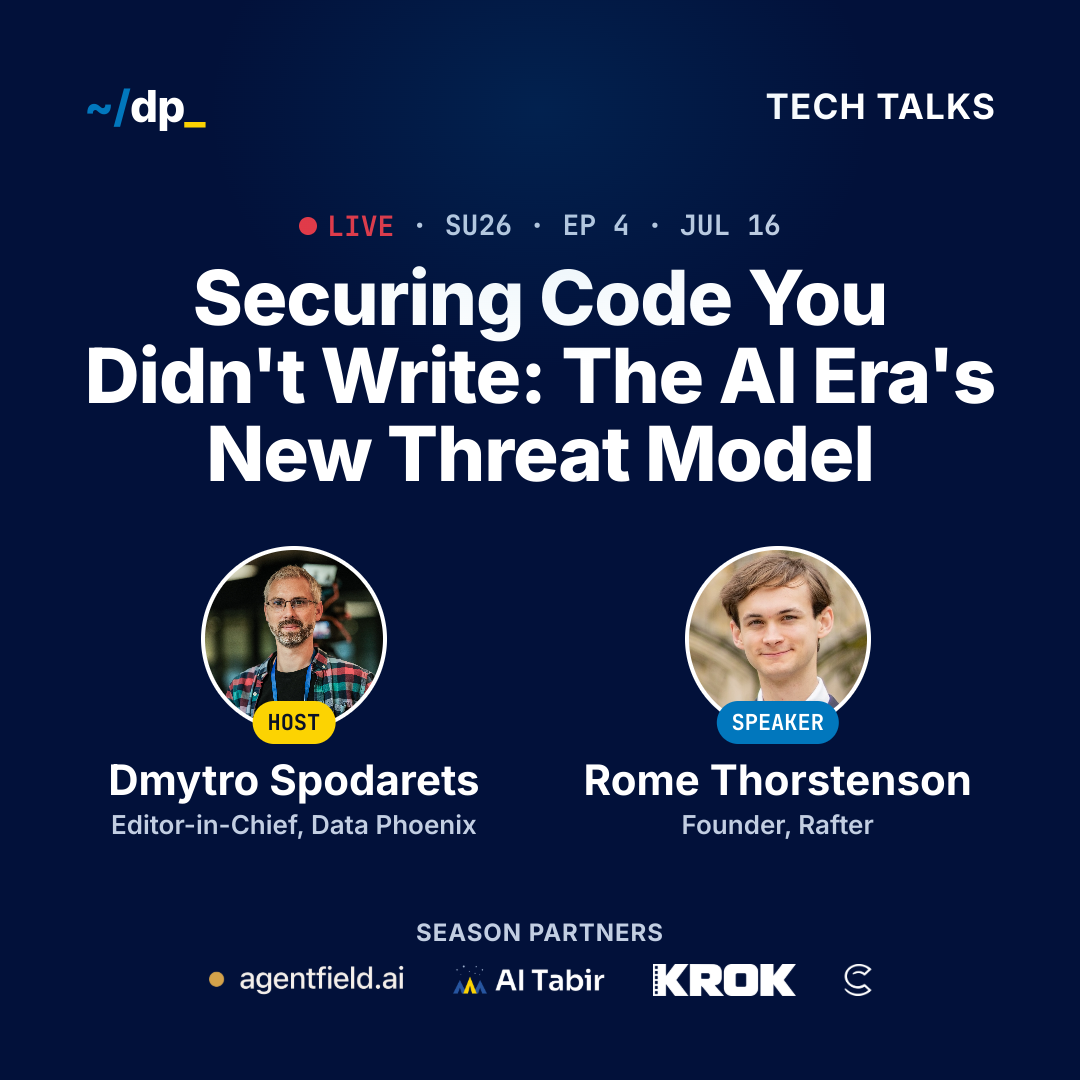
Securing Code You Didn't Write: The AI Era's New Threat Model

Securing Code You Didn't Write: The AI Era's New Threat Model

Thursday, July 16, 2026
10:00 AM PDT – 11:00 AM PDT · Pacific Time
Online
Online · link sent after registration

This event has ended. Browse the upcoming events or catch recordings on /videos.

About this event

Anyone can ship a working app in an afternoon now. The AI writes the code, picks the dependencies, configures the infrastructure, and wires up the tools — and software security hasn't caught up.

The coding agent, and everything it trusts — its instructions, its tools, its context — has become part of the software supply chain. Attackers are already exploiting the shift: poisoned configuration files that steer the agent, prompt injection that erases the line between data and commands, and insecure MCP deployments that turn tool access into command execution.

This talk explains what changed in the threat model, why auditing dependencies is no longer enough, and what practical security looks like when no team can hand-review every line of AI-generated code. We'll decode three recent attacks, trace the recurring weakness behind them — prompt injection that no current model reliably resists — and show how security can move into the coding agent's own feedback loop.

You'll leave with a concrete model of AI-era software risk, and a practical way to catch vulnerabilities before they reach production or compromise agents.

Key Highlights

  • The new software supply chain: how coding agents, instruction files, MCP tools, and third-party dependencies have become one interconnected attack surface
  • Three real incidents, decoded: a malicious-package campaign that concealed instructions in agent configuration files; a prompt-injection vulnerability class affecting several major coding tools; and an MCP-related flaw associated with roughly 200,000 exposed instances
  • Why prompt injection is the hard one: not a bug to patch but a property of how models work — and it generalizes. The same failure that poisons a coding agent now hits clinical AI, where recent research found the leading detectors miss most real attacks
  • The collapse of tool trust: why "we trust our tools" is no longer a sufficient control, and the injection-resistance metrics builders actually need
  • The vibe-coding blind spot: shipping production apps you didn't write and can't feasibly audit line by line
  • Closing the loop: giving the coding agent immediate, security-aware feedback so problems get caught and fixed as code is written — not after it ships

Speakers

Rome Thorstenson is the founder of Rafter, which is building the security layer for AI-generated software. Rafter brings security into the coding agent’s own feedback loop, helping builders detect and fix vulnerabilities from planning to production to ship secure by design.

He started Rafter after watching a friend ship a vibe-coded application to real users with serious security gaps that neither the builder nor the AI had caught. Rafter's vision is simple: anyone should be able to turn an idea into working software, without choosing between speed and security.

A Yale graduate and AI researcher, Rome has spent more than a decade building software. At Rafter, he's working to make security a native part of AI-assisted development — not another specialized process builders have to bolt on after the code is already written.


Launch partner

AgentField

AgentField is open-source infrastructure for building autonomous software factories and the AI backends that power them. It gives multi-agent systems a single control plane for orchestration, governance, and provenance - so every action your agents take is policy-checked and accountable, with no glue code and no editable logs. Apache 2.0, with SDKs in Python, TypeScript, and Go.

Partners