Ai2 releases HiRO-ACEv2 for 3 km extreme-weather simulation
Ai2 released HiRO-ACEv2, a two-stage climate emulator for 3 km rain, wind and pressure fields, with model weights and supporting code available.
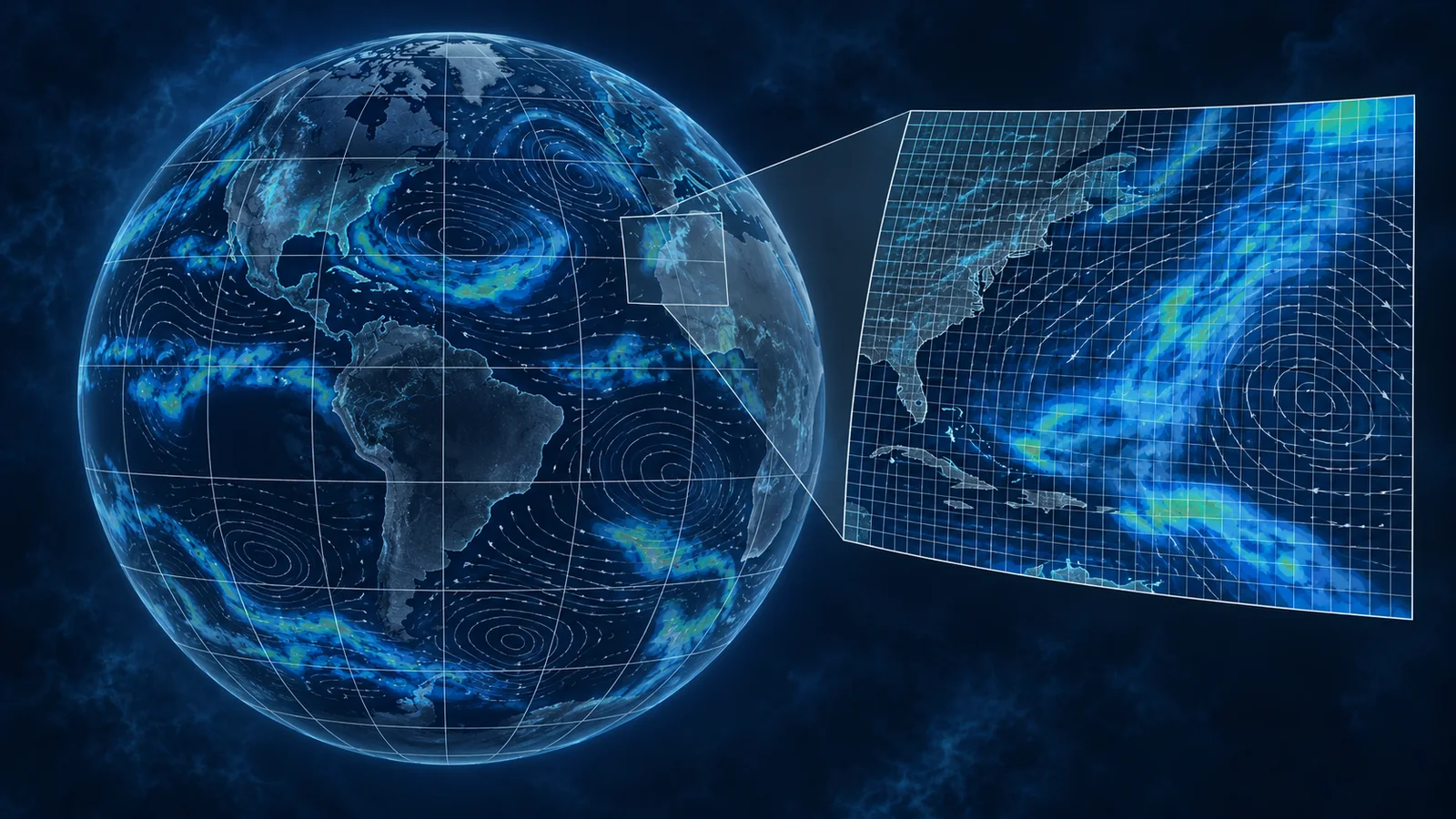
Ai2 released HiRO-ACEv2, a climate-emulation system that generates precipitation, 10-meter eastward and northward winds, and sea-level pressure at about three-kilometer resolution. The technical report says model weights and supporting code are available. The release follows Ai2’s AstaBrief 8B model for scientific reports earlier this month.
HiRO-ACEv2 works in two stages. ACE2S-X-SHiELD first produces coarse atmospheric states at 100-kilometer resolution every six hours. A separately trained diffusion model called HiROv2 then adds regional detail at roughly three-kilometer resolution. In this system, downscaling converts those coarse states into finer local fields. The updated system expands on the precipitation-only HiRO-ACEv1 by producing all four fields together.
In an evaluation by the Ai2-led author team, HiROv2’s global annual distributions were within 3% of X-SHiELD at the 99.9999th percentile for every output field when it downscaled coarsened X-SHiELD inputs. The authors also reported less than one terajoule of root-mean-square error and no significant bias in integrated kinetic energy across held-out tropical cyclones. These are the team’s results against the simulation used to train the emulator, not an independent benchmark or a comparison with observed weather.
Ai2 estimated that generating one year of global three-kilometer data uses about 0.3% of X-SHiELD’s inference energy, or roughly 300 times less. The report puts global downscaling at about 2.75 days on one NVIDIA B200 GPU. It says an eight-B200 run is about 33 times faster in wall-clock terms than X-SHiELD running on 27,648 AMD EPYC 9654 CPU cores.
Both stages were trained on coarse and high-resolution data derived from the same 11-year X-SHiELD simulation, with 2014 through 2022 used for training and 2023 held out. The preprint says the strongest reference storms tended to have their maximum wind speeds underpredicted. It also records low biases at wind speeds of roughly 35 to 80 meters per second and sea-level pressures below about 925 hectopascals in free-running simulations.
HiROv2 currently works only with the X-SHiELD-tuned ACE2S model, so it cannot produce fields consistent with ERA5 reanalysis or a warmer future climate. The paper also says independently generated timesteps lack temporal consistency, while the current output set does not include near-surface air temperature or frozen precipitation.
More news

Black Forest Labs releases FLUX 3 Image Klein weights

Apple study finds tool-discovery gains shift with task complexity
Apple researchers swap free-form agent reasoning for candidate selection