Apple spotlights Normalizing Trajectory Models for four-step image generation
Apple’s October research spotlight brings new attention to Normalizing Trajectory Models, an exact-likelihood approach for generating images in a small number of steps.

Apple has put new attention on Normalizing Trajectory Models in an October research spotlight. The method is designed to retain exact-likelihood training while cutting image generation to a handful of sampling steps. The research first appeared as a preprint on May 8; Apple’s live page shows only the month of publication, not an October 8 day-level date.
The six researchers — Jiatao Gu, Tianrong Chen, Ying Shen, David Berthelot, Shuangfei Zhai and Josh Susskind — say the model matches or outperforms strong image-generation baselines in four steps. That performance claim comes from the paper’s authors and has not been independently replicated in the supplied evidence.
Normalizing Trajectory Models, or NTM, addresses a problem that arises when diffusion-style generation is compressed from many small denoising steps into a few large ones. Conventional systems commonly approximate each reverse step with a single Gaussian distribution. The authors argue that the approximation becomes less accurate across a coarse transition because the possible earlier images can form a more complex, multimodal distribution. The work addresses a different setting from Apple’s study of distribution errors in confidence-ordered discrete diffusion.
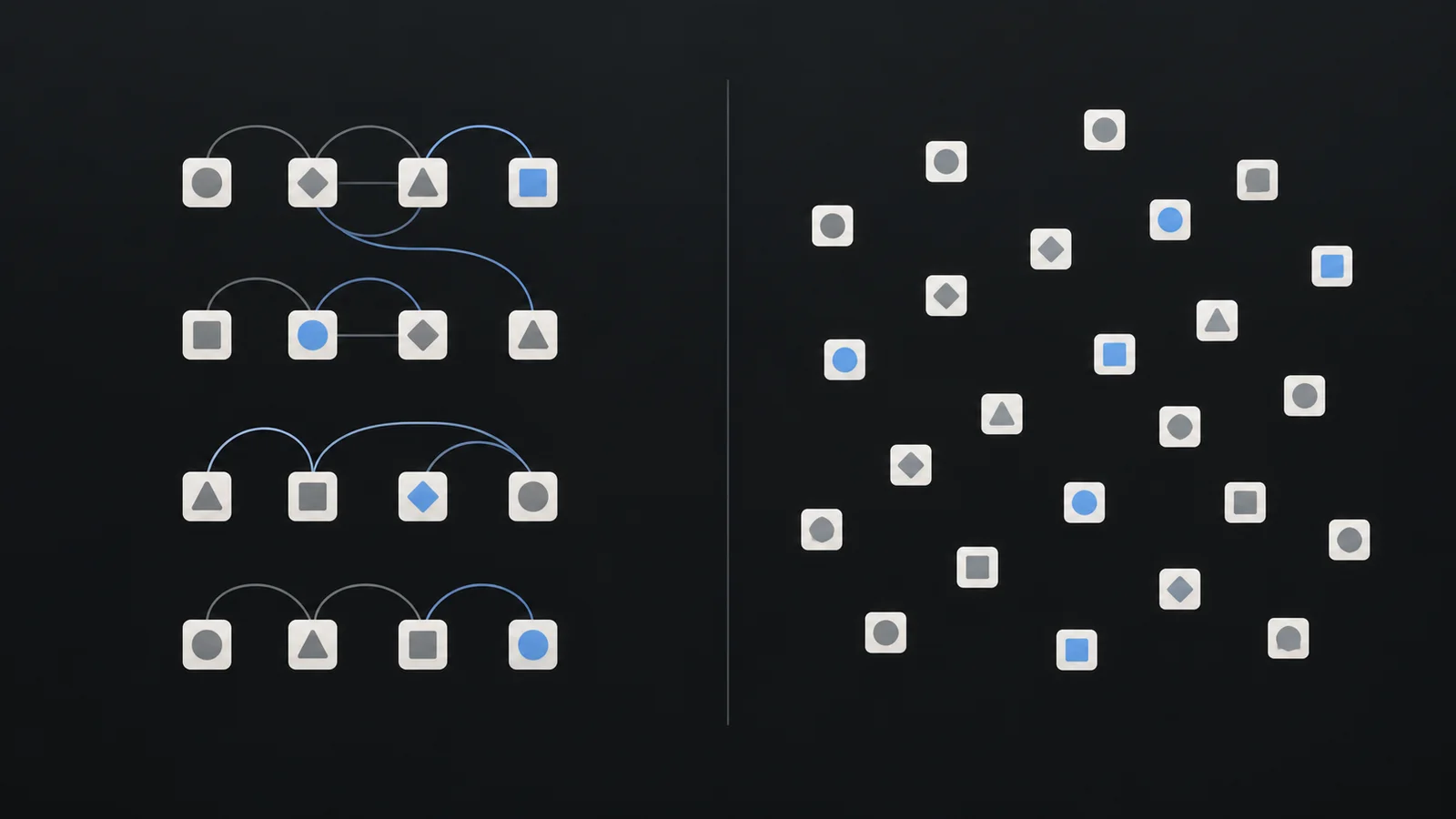
Instead, NTM represents every reverse transition as a conditional normalizing flow. An invertible “transporter” maps the image state into a space where a Gaussian predictor can model the next transition. Because the mapping can be reversed and its change in density calculated, the system can optimize the exact conditional log-likelihood. The architecture can be trained from scratch on stochastic trajectories or initialized from a pretrained flow-matching model by starting the transporter as an identity mapping.
The likelihood formulation also supplies a score function for refining a generated trajectory. The researchers use that signal to train a lightweight denoiser, condensing the refinement into one forward pass after the predictor and avoiding the full flow inversion and iterative trajectory-denoising route.
In the paper’s four-step text-to-image tests, the researchers report GenEval and DPG-Bench scores of 0.82 and 79.64 for a 256-by-256 model trained from scratch. A 512-by-512 model initialized from a pretrained flow-matching backbone scored 0.76 and 83.38 on the same benchmarks. The authors also report that the faster predictor-plus-denoiser path generated 1.88 images per second, compared with 0.20 for the full normalizing-flow and trajectory-denoising path, with an LPIPS distance of 0.121 between outputs.
According to the paper, those results came from models trained on an internal text-image dataset of about 70 million pairs that included CC12M. Both evaluated settings used a batch size of 1,024 across 64 Nvidia H100 GPUs. The inspected material does not disclose a complete breakdown of the internal corpus.
The authors identify several limits: position and attribute binding remained difficult for the finetuned model, one-step generation produced severely degraded output, and experiments at higher resolutions were left for future work.
More news

Black Forest Labs releases FLUX 3 Image Klein weights

Apple study finds tool-discovery gains shift with task complexity

Apple researcher, Johns Hopkins team let AI agents decide when to compact context