ASU and Ampere researchers outline defect-aware chiplet matching
DT-MATCH pairs repairable chiplets through batched optimization or randomized search, with author-reported tests highlighting a trade-off between yield and speed.
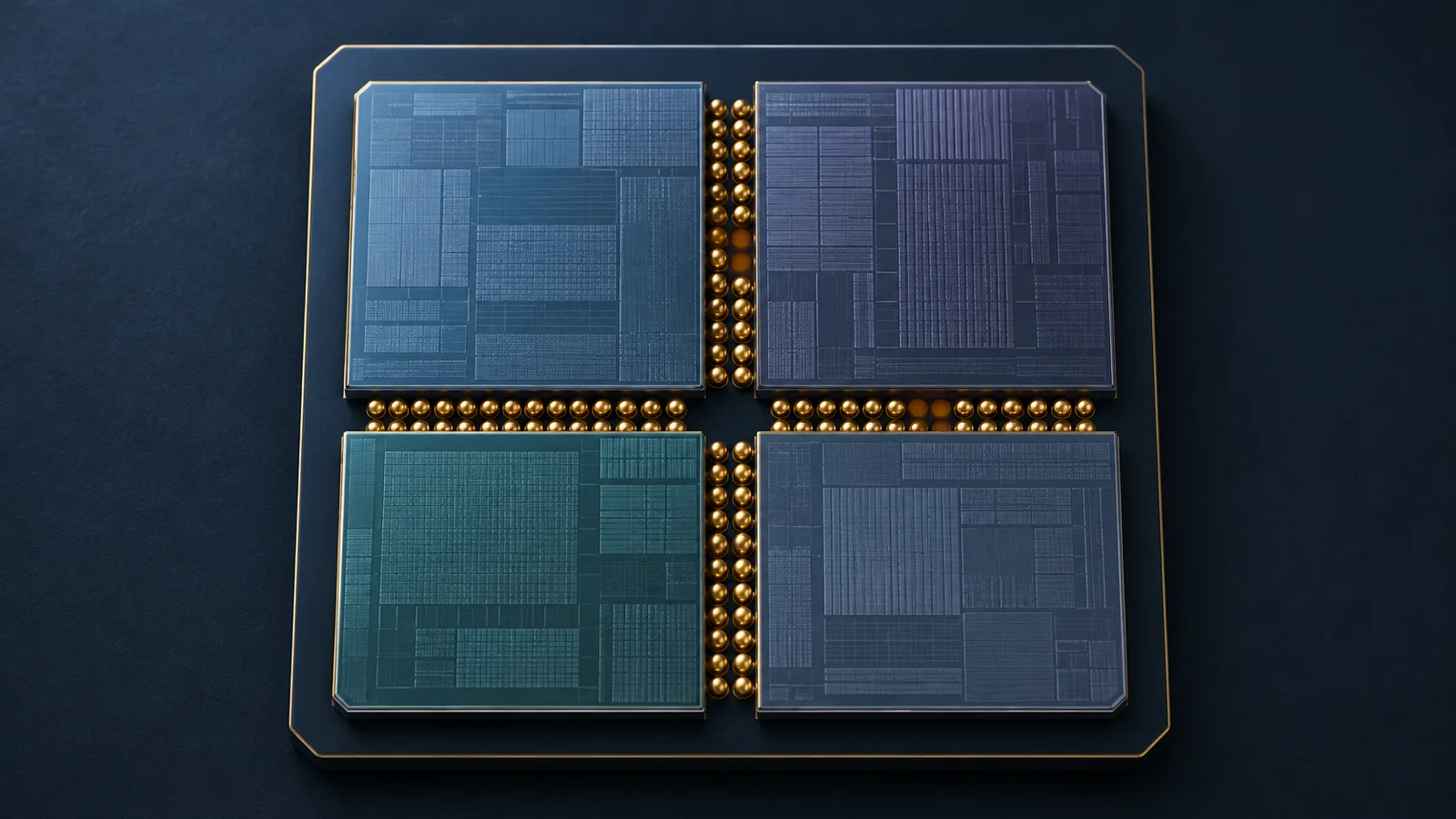
Researchers at Arizona State University and Ampere Computing have proposed DT-MATCH, a framework for pairing chiplets with repairable interface defects while accounting for chip type, wiring and spare-lane constraints. In the DT-MATCH paper, the authors describe two practical approaches: a batched integer linear programming method geared toward stronger solution quality and a randomized GRASP method built to run faster at larger scales.
The authors’ results illustrate the trade-off. On benchmarks based on AMD Instinct MI300A and MI300X topologies, they report that GRASP was often two to five times faster than batched ILP, while usually delivering yields only a few percentage points lower. The figures come from experiments with generated defect inputs, not independently reproduced yield gains or results from a live manufacturing line.
DT-MATCH begins with a finite inventory of tested chiplets and seeks to assemble as many functionally complete systems as possible. The model accounts for the role each chiplet must fill, defective lanes at individual interfaces, spare lanes shared across interfaces, the requirement that each physical chiplet be used only once, and 180-degree rotation when a symmetric chiplet allows it. Before matching, both approaches group identical faulty-lane patterns and prune impossible role assignments. The paper describes that preprocessing as preserving feasible solutions.
The ILP approach divides the inventory into rolling-horizon batches and periodically repairs earlier choices. It approximates a monolithic global ILP instead of solving that exact formulation across the full inventory, but preserves more of the global optimization structure than the heuristic. The authors report that its median yield on the two AMD-derived benchmarks differed from monolithic ILP by less than 1%. They also report lower runtime and tractability in cases where the monolithic version did not converge within the stated time limit.
GRASP, short for greedy randomized adaptive search procedure, builds matches through randomized choices guided by chiplet scarcity rather than a global optimization model. In the paper’s tests, that design made it faster and easier to scale, but it does not guarantee optimal yield. The implementation used five GRASP iterations. The ILP implementation ran in Python with Gurobi’s default parameters and batches of 150 chiplets.
The evaluation covered four designs: the two published AMD-derived topologies and two proprietary industrial designs labeled D1 and D2. For each benchmark and tested inventory size, the researchers generated lane faults from a Poisson distribution with a mean of one, then created 20 inventories with different random seeds. D1 and D2 are not fully disclosed, and the defect maps were generated rather than drawn from production. The experiments therefore do not establish performance on measured factory data.
The paper’s largest economic figures come from a cost-per-good-system model. At a maximum assembly count of 1,000, the authors report that batched ILP reduced modeled costs by 23.1% for D1 and 40.0% for D2 compared with random matching. These percentages represent modeled savings derived from simulated yields, not observed manufacturing cost reductions.
More news

PyTorch cancels 2.15.1, targets December 17 for 2.16.0

DOE designates Idaho lab computing center as nuclear-energy user facility

vLLM adds opt-in FlyDSL MonoKernel decode for five models