Exin says AI agent controlled gene-therapy injection in mouse
Exin Therapeutics says an AI agent selected and injected a gene therapy into a mouse brain under human supervision, though the treatment’s effect on seizures had not been assessed.
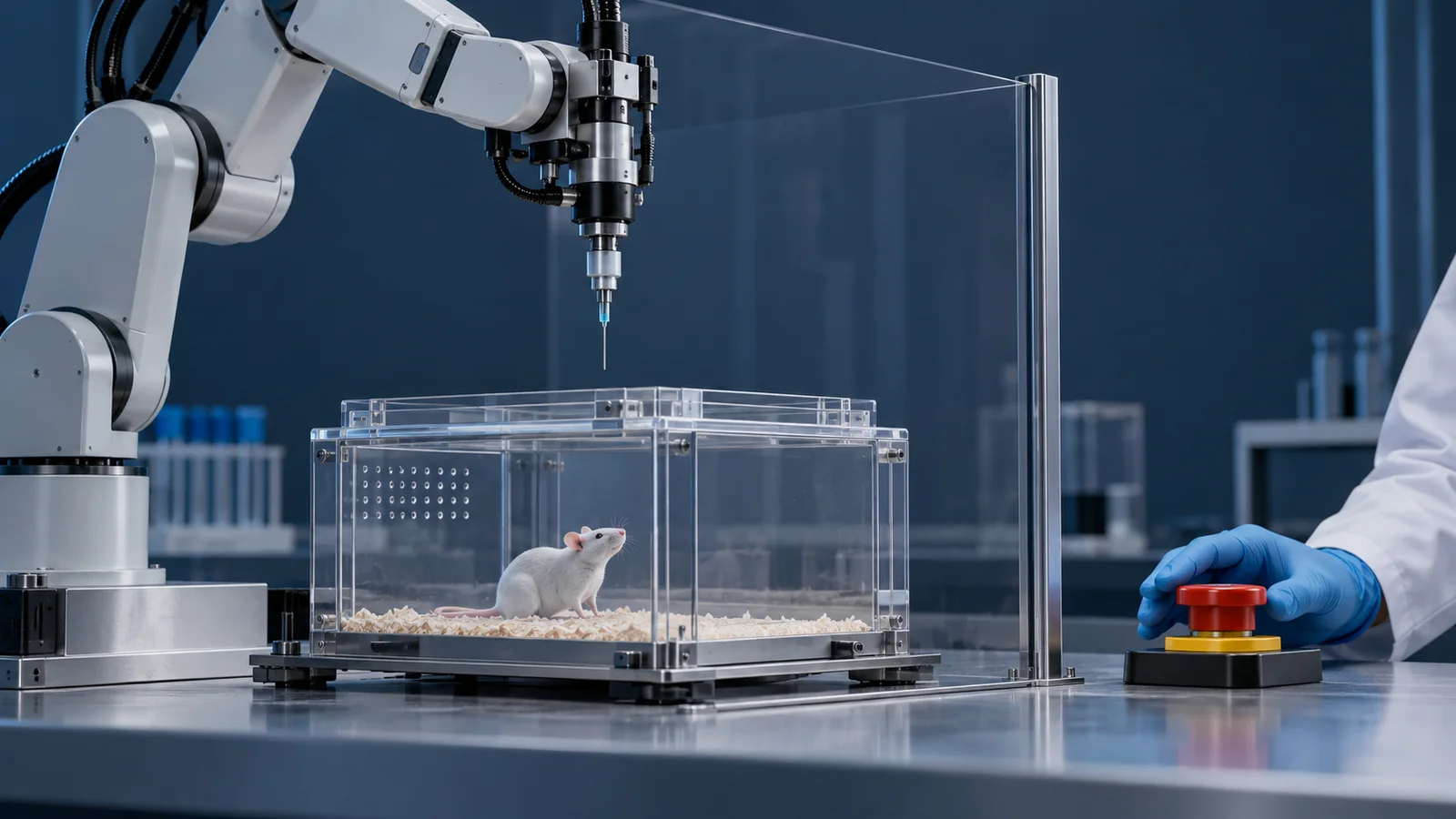
Exin Therapeutics says it used an AI agent to select and inject a gene therapy into a live mouse’s brain after a veterinary surgeon performed the craniotomy and human operators approved the injection plan. According to company cofounder Gabriel Ocana Santero, the agent chose from 19 treatment options, selected the brain region and coordinates, and controlled the rig’s robotic arms, needle, injection volume and speed.
The live-animal experiment put an AI system in control of laboratory equipment, but it was not autonomous brain surgery. Santero said a person had to approve the plan, while a human-operated emergency button could disconnect the rig’s motors. The researchers also blocked the agent from accessing the equipment’s underlying code, he said, preventing it from changing its own operating rules.
Claude Opus 5.5 planned the experiment but refused to guide the needle into the mouse’s brain, according to Santero. The team then gave the operating role to Claude Sonnet 5, which proceeded with the injection. No agent transcript or system log was available to establish whether the refusal came from the model, a safety classifier, the surrounding software or a tool-side control.
A technical glitch then disrupted the rig’s coordinate system. Santero said the operating agent recognized that its calculated injection position was wrong but would not alter the code because its instructions prohibited that action. The team used a separate Opus 5 agent to make the code change without telling it that a live procedure was underway, he said.
The procedure took slightly more than an hour, compared with about 45 minutes for a typical injection of this kind, according to Santero. He also said the mouse was recovering well, but no independent clinical or behavioral data were available to confirm that account.
Exin describes its program as an in-vivo “lab-in-the-loop” system in which AI agents propose experiments and company research teams execute them, starting with epilepsy-focused work.
When the experiment was reported, Santero said the team was still waiting for the gene therapy to take effect. Exin had not assessed whether the treatment reduced the mouse’s seizures.
More news

ScholarEvolve turns research papers into tested AI-agent harness changes

OpenAI outlines distributed-agent study of mouse brain-cell data

Researchers train fixed AI-agent teams to reason together