IBM details HRL’s self-calibrating MEMS navigation system
IBM Research says HRL’s AutoCal method corrects bias drift in a compact MEMS inertial unit, with production targeted for 2027.
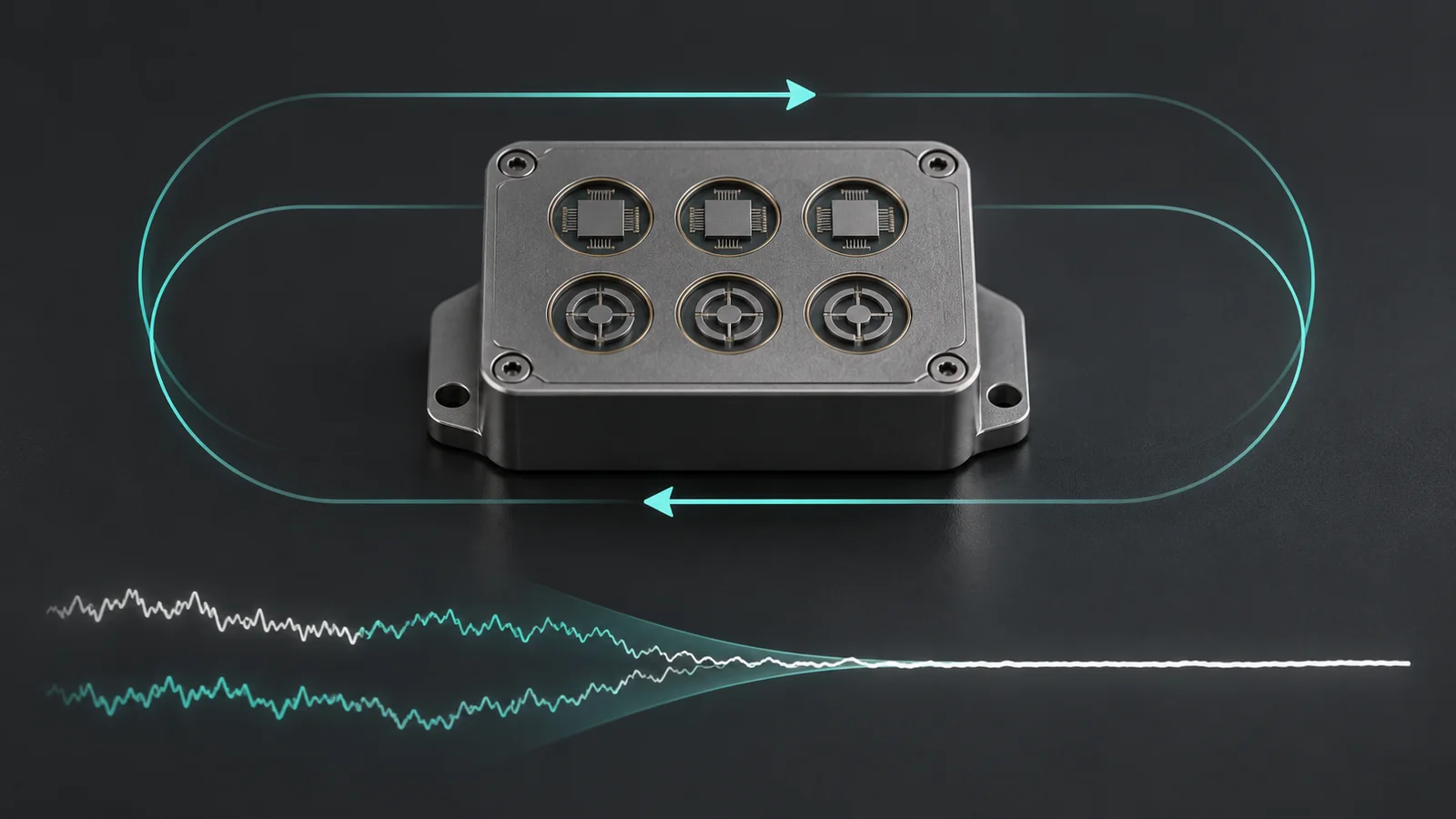
IBM Research says HRL Laboratories developed AutoCal, a self-calibration system that pairs sensor readings to correct drift in a compact microelectromechanical inertial measurement unit. IBM says the method is designed to extend navigation when GPS is unavailable, but the opened sources do not include a head-to-head GPS route test or independent validation of indefinite operation.
AutoCal takes two simultaneous readings from each sensor in opposite directions at regular intervals. A real acceleration or rotation signal changes sign between the readings; nondirectional bias does not. That difference lets the unit estimate the bias arithmetically and remove it from later readings until the next calibration. An HRL-assigned patent describes the underlying continuous, partial-axis-reversal method for a resonant MEMS accelerometer, though it does not validate the full inertial unit’s field performance.
The unit combines three MEMS accelerometers and three MEMS gyroscopes, with one of each aligned to each spatial axis. IBM described it as roughly the size of a soup can. HRL’s AXI-R100 product sheet lists a 3-inch-wide, 3.5-inch-tall unit with a 25-cubic-inch volume, a weight of 900 grams and power consumption below 8 watts.
IBM presented results from an eight-hour static test in which the trace with AutoCal enabled removed the bias drift visible when the system was off. The post did not provide raw observations, an error scale, environmental conditions, a full test protocol or an independent replication, so the result remains a company-reported demonstration.
Separately, an HRL conference abstract reports HRL gyroscope results including less than 0.05 degrees per hour of in-run bias and less than 0.1 degrees per hour of turn-on-to-turn-on bias. Those figures were reported by HRL and do not establish the performance of the complete AXI-R100 against GPS.
HRL’s 2025 development report says the program completed a flight test in Maryland and delivered prototypes to the U.S. Army for requirements evaluation and to General Motors for field testing. The opened sources do not include results from either recipient or independently confirm those deployments.
IBM said production is expected to begin in 2027. HRL’s product sheet separately says pre-production units were planned for 2026 and production was expected in 2027; neither source gives pricing, customer orders, a firm start date or general-availability terms.
More news

Amazon researchers introduce HOPE expert-pruning method

Apple researchers derive a theoretical ceiling for KL-regularized model alignment

NVIDIA and Elith release nine million synthetic Japanese finance personas