Liquid AI releases d1 models for single-pass edge decisions
Liquid AI has released the open-weight d1-3B and experimental d1-omni-600M, which return structured decisions in one forward pass instead of generating text token by token.
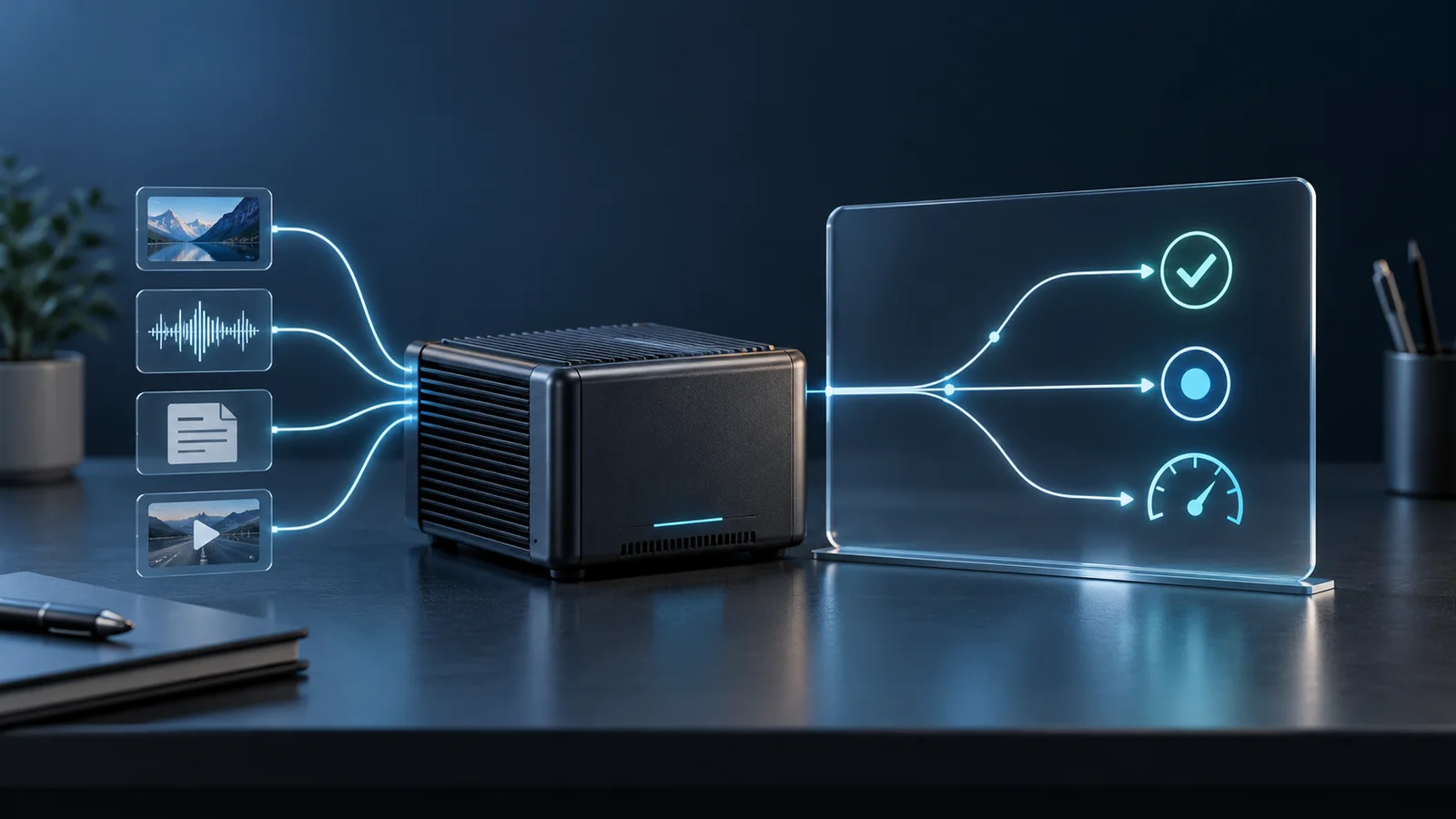
Liquid AI has released d1-3B and the experimental d1-omni-600M, two open-weight models that return structured decisions in a single forward pass rather than generating text token by token. Both checkpoints are available on Hugging Face and are designed for structured decision tasks on edge hardware.
Given a state and named questions, the models return typed outputs such as yes-or-no probabilities, choices or scores. Liquid AI says they use zero output tokens: instead of repeatedly decoding a free-form response, each model selects within the answer structure supplied by the developer in one pass.
The d1-3B model has 3.12 billion parameters and is based on LFM2.5-VL-3B. It accepts text, JSON, images or combinations of those inputs. Liquid AI has also used that base model for an experimental DSpark speculative-decoding drafter. The d1-3B model card lists a 32,768-token context window.
The d1-omni-600M checkpoint has 587 million parameters and accepts text paired with either images or one audio clip; it does not accept images and audio together. Liquid AI describes the smaller model as an experimental early research checkpoint and limits audio clips to 30 seconds, with audio training focused on English speech requests.
Liquid AI reports Decision Index v0.2.1 public-split scores of 48.57 for d1-3B and 15.95 for d1-omni-600M. The company says it ran the official scorer itself and did not submit those results to the leaderboard. Across the seven text benchmarks listed in its release, Liquid AI reports mean scores of 82.9 for d1-3B and 78.4 for d1-omni-600M, versus 81.1 for Decider 4B and 77.1 for Decider 2B. The results have not been independently reproduced in the sources reviewed.
For warm, single-question d1-3B calls, Liquid AI reports latency of 8 milliseconds on an NVIDIA RTX 4090, 9 ms on an AMD MI325X, 30 ms on an Apple M5 Pro, 16 ms on a Jetson AGX Thor, 26 ms on a Jetson AGX Orin 64 GB and 50 ms on a Jetson Orin Nano. The company says the GPU figures are medians from 20 bfloat16 runs with one request processed at a time, while the Jetson measurements were made with NVIDIA. It published no inference measurements for d1-omni-600M because that checkpoint remains under development.
NVIDIA’s Jetson AI Lab provides local PyTorch run guides for d1-3B and d1-omni-600M on Jetson AGX Thor, Jetson AGX Orin 64 GB and Jetson Orin Nano. Liquid AI says it has not reported a dedicated audio decision benchmark because it considers such benchmarks an open problem.
More news

Mistral launches Large 4 in public preview
Xiaomi releases MiMo-V2.6-Pro-RL open-weight multimodal model
Google releases EmbeddingGemma 2 for on-device multimodal search