NVIDIA says AI agents steer and analyze Allen Telescope Array data
NVIDIA says Breakthrough Listen and the SETI Institute have put AI agents into daily operations at the Allen Telescope Array, while independent evidence for the newer control layer remains limited.
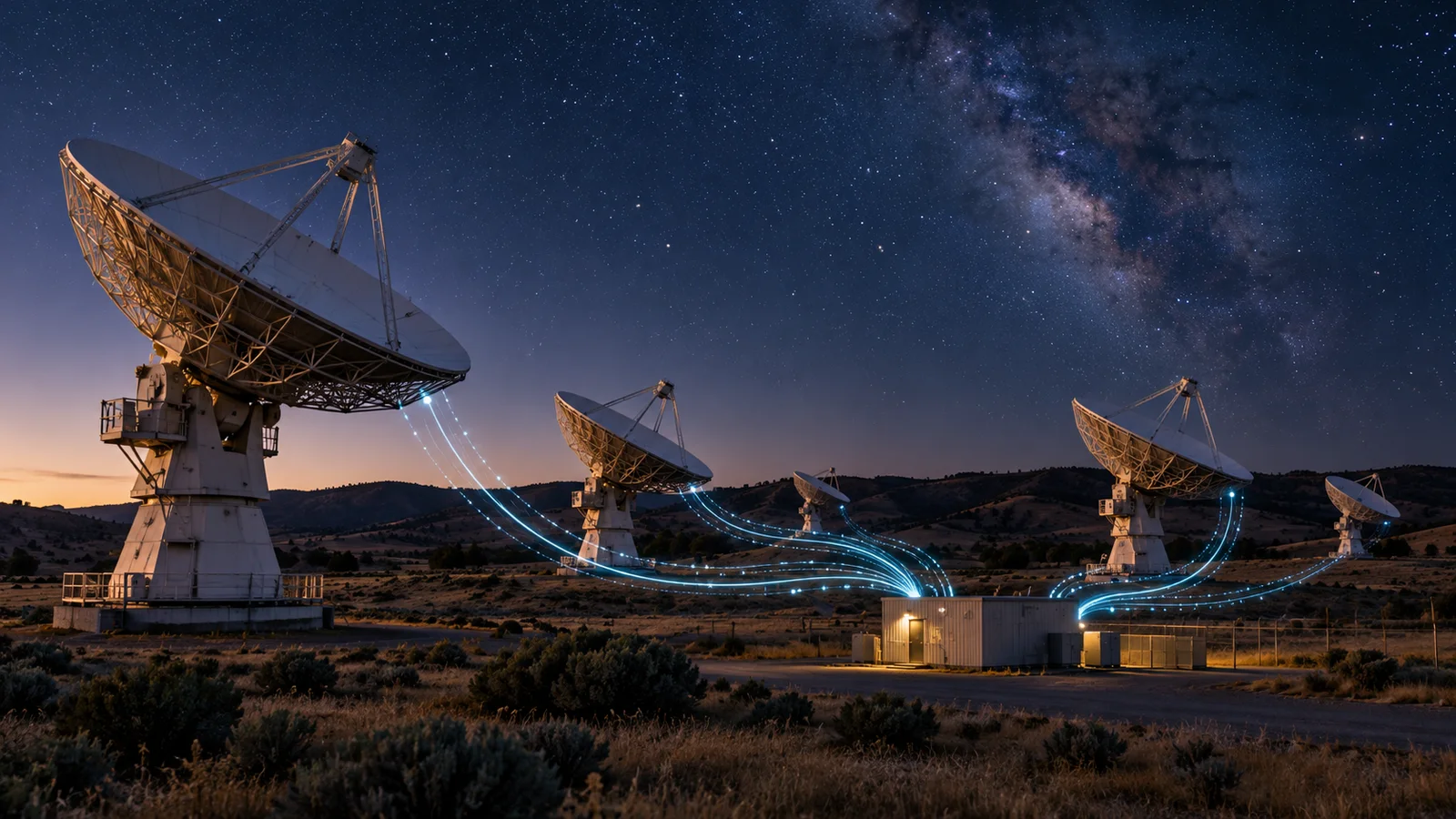
NVIDIA said Breakthrough Listen and the SETI Institute have integrated AI agents into daily work at the Allen Telescope Array, allowing researchers to direct observations and process incoming radio data through natural-language requests. The company says the system can steer antennas, calibrate the instrument, repair data errors, run models on live streams and plot results.
The deployment puts an agent interface into the operating loop of a 42-antenna scientific instrument. NVIDIA says the setup handles as much as 2.4 terabits per second on RTX PRO 6000 Blackwell GPUs, with inference running on premises. That throughput figure and the complete agent-control workflow have not been independently benchmarked in the opened evidence.
The system combines several layers. NVIDIA’s DAQIRI library moves high-bandwidth sensor data into GPU memory; the SETI Institute’s CyberEther framework performs signal processing; and a web-based orchestrator called Nexus tracks instrument state, compute resources and processing pipelines. NVIDIA says Nexus also lets agents monitor packet loss, inspect live spectrograms and rewrite processing blocks from prompts. The stack is designed to analyze telescope data as it arrives instead of first storing the stream for later review.
The newer agent layer builds on an earlier real-time pipeline with peer-reviewed results. A 2025 peer-reviewed study of the deployed pipeline, published in Astronomy & Astrophysics, documents an end-to-end deep-learning system deployed at the array using NVIDIA Holoscan. The authors reported sustained processing of 86 gigabits per second and a runtime of 0.024 seconds for every four seconds of observation, which they described as a 600-fold speedup over the array’s SPANDAK benchmark.
On synthetic injections, the paper’s authors reported a 7% accuracy gain and a nearly tenfold reduction in false-positive rate compared with SPANDAK. Those are the research team’s test results, not an independent replication. The paper also notes reduced sensitivity for low-signal and extreme-dispersion events and recommends running the neural system alongside classical methods during commissioning to calibrate those selection effects.
During roughly 77 minutes of observations on Feb. 10, 2025, the earlier pipeline recovered known giant pulses from PSR B0531+21 in the Crab Nebula in real time. NVIDIA characterizes that result as the first real-time AI detection of a pulsar, but the paper itself describes recovery of known pulses and does not establish the broader historical first. The detected source was a known natural pulsar, not an extraterrestrial technosignature.
The collaboration predates the agent interface. Breakthrough Listen documented a 2024 pilot that streamed Allen Telescope Array data through GPUs in real time while observing the Crab pulsar across a 5 GHz band. NVIDIA separately said that trial used 28 antennas and processed nearly 100 gigabits per second over 15 hours.
The SETI Institute describes the array at Hat Creek in Northern California as a 42-antenna radio telescope used for searches for extraterrestrial intelligence and for radio astronomy, including pulsar and fast-radio-burst observations. NVIDIA says the agent deployment can compress work that would otherwise take weeks or years into hours, but its announcement gives no defined workload or baseline for that comparison. It also does not disclose the deployed agent model, tool-permission boundaries, human-approval controls, error rates or operational incident history.
NVIDIA says the team is evaluating open models, including NVIDIA Nemotron, for observatories that need local data processing, rapid turnaround or possible offline operation.
More news
NVIDIA details agentic AI deployments across French industry

Cloudera launches NVIDIA-based AI Blueprints and expands partner ecosystem

NVIDIA expands Hyperion in European mobility and robotaxi programs