NVIDIA says open 5G and 6G tools surpassed one million downloads
NVIDIA says downloads of its open-source 5G and 6G research tools have passed one million as researchers apply the software to semantic communications, neural receivers and energy management.
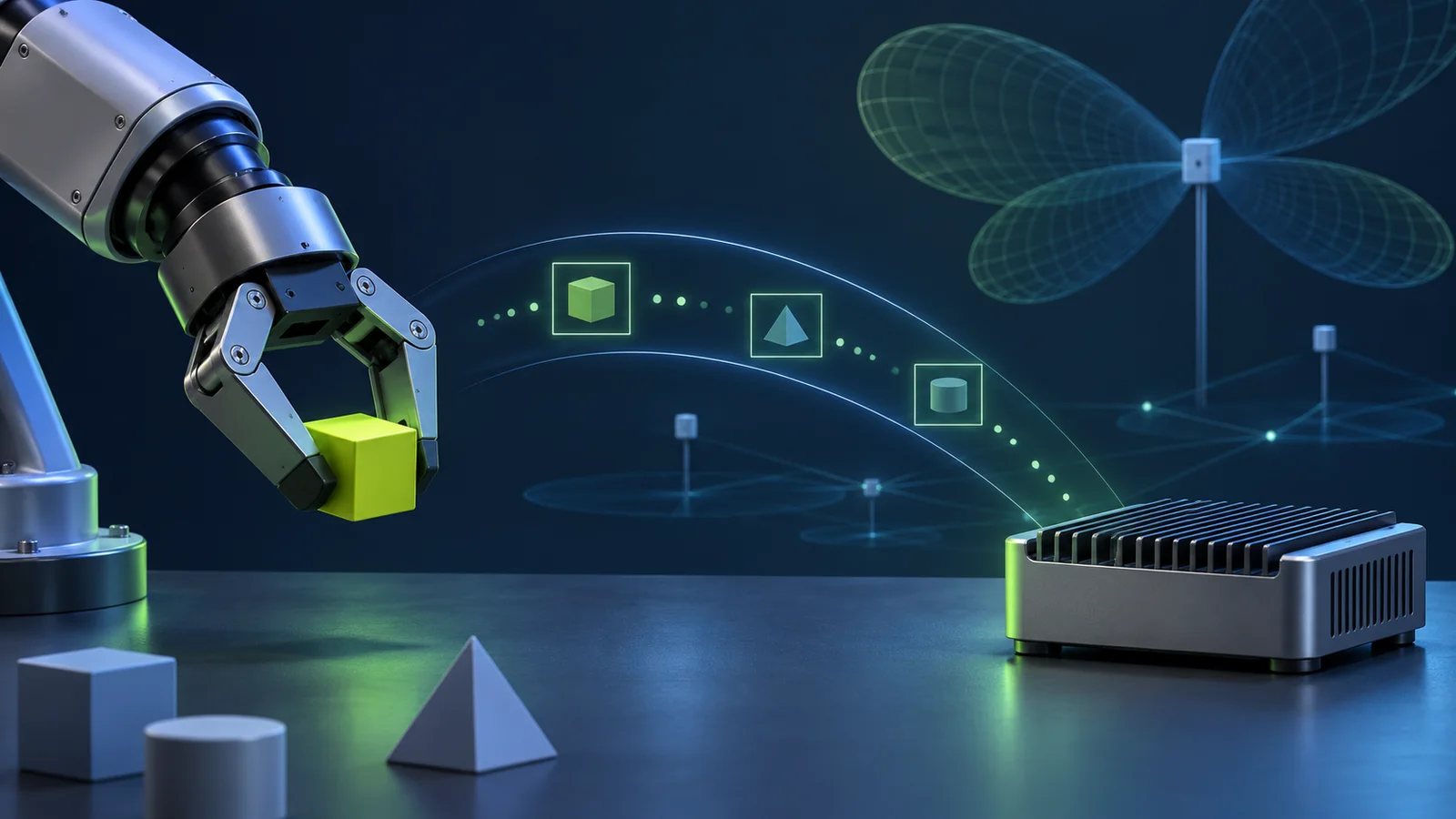
NVIDIA said its open-source 5G and 6G research tools have surpassed one million downloads, a company-reported adoption milestone for software used to test AI-native wireless systems.
The company said global developer adoption of NVIDIA AI Aerial and Sionna grew tenfold over the past year and that more than 8,000 research and academic institutions use the platforms. NVIDIA did not disclose how it counted downloads, adoption or institutions, and the supporting studies do not independently verify those figures.
NVIDIA disclosed the figures while highlighting projects in semantic communications, learned signal reception and network energy management. The work runs on controlled 5G systems, testbeds or simulations and is framed as research relevant to prospective 6G networks. None of the cited projects demonstrates deployment on a commercial 6G network.
A King’s College London-led preprint describes a 5G testbed linking a camera-equipped robot arm to a Jetson AGX Orin edge server. Instead of periodically sending raw images, the system transmitted compact, task-relevant representations such as 3D bounding boxes and 2D or 3D scene graphs. This approach, called goal-oriented semantic communication, aims to send the information needed for a task rather than all captured data.
The researchers evaluated fruit-packing and cube-stacking tasks over 20 independent runs per framework and introduced faults including dropped objects and incorrect placements. They reported reductions of up to 52.6% in task-completion time and improvements of up to 45% in task-success probability compared with periodic raw-image transmission. The paper is an arXiv preprint, and the opened record does not establish peer review or production deployment.
In a separate test, SoftBank integrated a Transformer-based neural receiver into NVIDIA Aerial’s 5G Layer 1 and evaluated it over the air with a commercial smartphone in a shield room. A neural receiver uses a trained model for signal-processing steps that conventional systems handle with fixed algorithms. SoftBank’s model replaced channel estimation, interpolation, equalization and soft demapping, while both receiver paths used the same downstream descrambling, rate-recovery and LDPC-decoding stages.
SoftBank said mean uplink Layer 1 throughput was higher for the neural receiver at all 15 interference settings tested. At one setting, it reported 47.9 Mbit/s versus 29.9 Mbit/s for the conventional receiver, a 60.5% gain. The result came from a single-layer uplink test in a shield room and does not establish performance in field deployments or across all radio conditions.
An ETH Zurich and NVIDIA preprint also tested whether receiver models could be adapted to particular indoor sites. The authors reported that fine-tuning a model-driven neural receiver reduced dataset block-error rate from 0.351 to 0.237 in a small laboratory and from 0.463 to 0.240 on an office floor. The paper identifies one author with NVIDIA and acknowledges company sponsorship. It also says the reference receiver achieved a lower block-error rate than the fine-tuned model-driven receiver in both environments.
A University of Leeds-led paper applied AI to energy management. Its system used a long short-term memory model to predict radio-unit load 10 minutes ahead, classified expected demand with confidence estimates and guided base-station sleep decisions. A digital twin provided a repeatable environment for testing and safety validation before control actions were exercised on a 5G network-in-a-box testbed.
In a controlled four-base-station urban scenario, the authors reported a 45.6% reduction in radio access network power, equal to 6.03 kWh per day, with zero outage events. The result is specific to the study’s digital-twin and testbed framework and does not demonstrate savings on a production network.
The public Aerial repository provides GPU-accelerated components for building 5G and prospective 6G radio access network software. Sionna supplies open-source simulation tools for communications research. Both repositories list the Apache License 2.0.
More news

Nvidia discusses credit guarantees for Nscale’s Anthropic data center
Oracle and NVIDIA make Vera Rubin NVL72 and Vera CPUs available on OCI

NVIDIA says Kazakhtelecom deployed 880 GPUs, plans more than 2,000