RECLAIM uses robot attention feedback to counter adversarial vision patches
A preprint details a training-free defense that uses a robot policy's attention and action responses to locate and treat adversarial image patches during manipulation. Its claimed recovery comes from unreplicated simulated benchmark rollouts, not physical-robot tests.
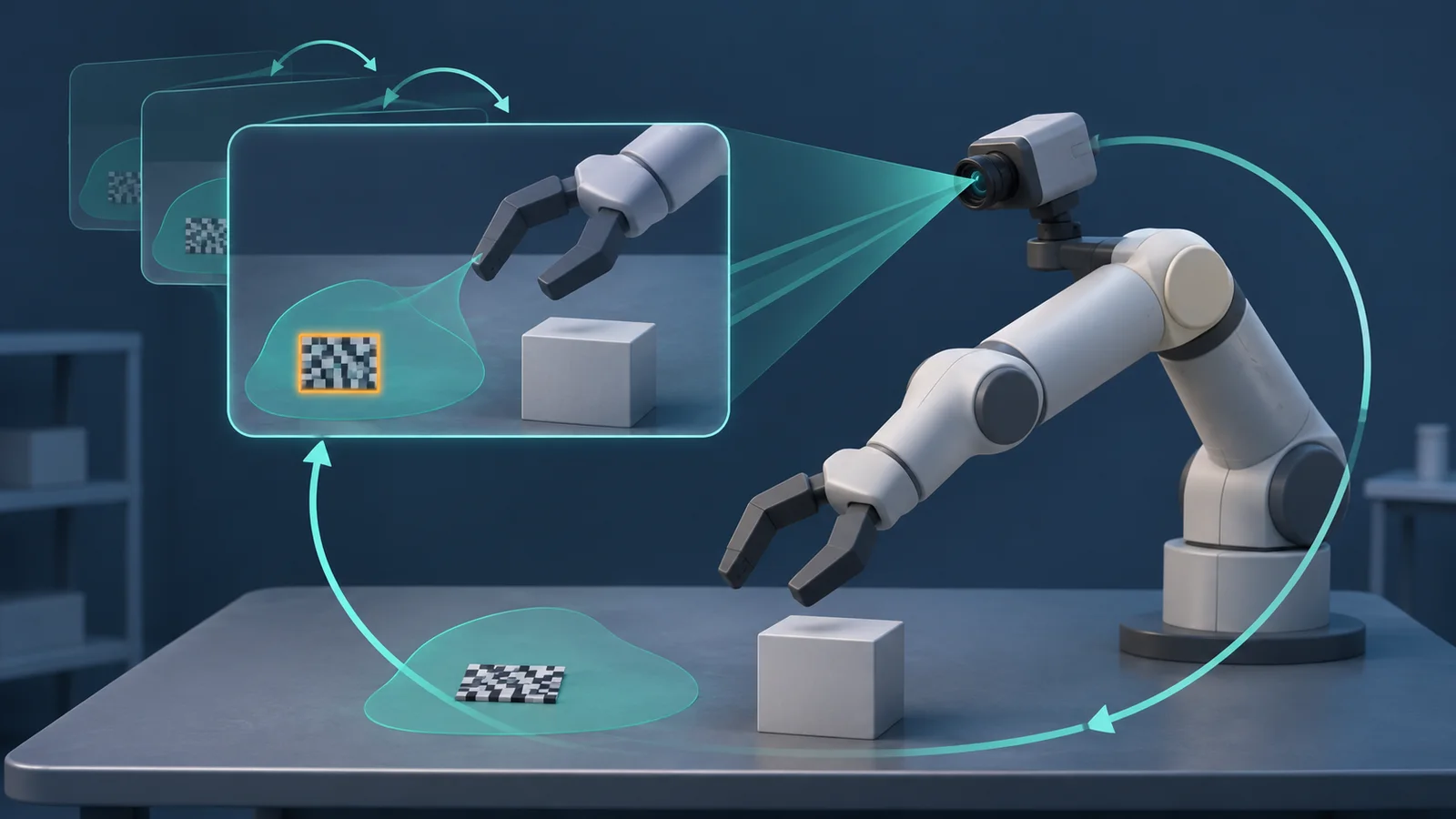
Researchers at Beijing University of Posts and Telecommunications and Beihang University introduced RECLAIM, a training-free defense designed to help vision-language-action robot policies recover from adversarial image patches during manipulation. It runs at inference time, leaves the underlying policy frozen and uses the policy’s attention and action responses to choose local image edits.
In the authors’ unreplicated evaluation, RECLAIM raised aggregate rollout success for a frozen OpenVLA policy under the UADA patch attack from 0% without a defense to 52.92%. The authors also reported at least one successful rollout on 95% of the 40 evaluated tasks and a rise from 0% to 70% rollout success on the LIBERO-Object suite. These results come from simulated benchmark rollouts in the preprint. The paper does not report testing RECLAIM on a physical robot, the work has not been independently replicated, and the arXiv record does not identify a peer-review acceptance.
Adversarial patches are localized visual patterns intended to redirect a model’s predictions. In a robot control loop, one bad action can change the scene seen by the next camera frame, allowing an initial visual error to cascade. RECLAIM counters that risk through three linked stages.
The defense first accumulates attention that persists across frames, projects the known arm and gripper geometry into the image, discounts attention explained by the robot itself and turns the remaining connected regions into patch candidates.
It then tries several local treatments for each candidate, including gray replacement, blurring, median-based edits and inpainting. The system screens edits for reduced attention inside the candidate region and a usable action prediction, then requires different edit families to produce similar attention patterns outside that region. It ranks eligible treatments mainly by attention reduction, with lower action uncertainty used as a secondary signal. If no treatment clears those checks, RECLAIM passes the original image to the policy.
Finally, the system stores recently selected region-treatment pairs and reevaluates them as the robot moves and the scene changes. Those remembered options compete with newly detected regions at later full decisions, while lighter geometry and action-validity checks run between them. In the authors’ ablation, removing this temporal component reduced rollout success from 52.92% to 4.17% and increased policy queries per control step from 2.107 to 9.572. Those figures are also unreplicated author results.
The tests used OpenVLA, a 7-billion-parameter open-source vision-language-action model, on 10 tasks from each of the four LIBERO robot-manipulation suites. The study ran 80 clean rollouts and 240 rollouts for each patch condition under matched initial states and patch placements. With unchanged defense settings, the authors reported aggregate success of 52.92% under UADA, 53.75% under EDPA, 54.58% under RFAS and 38.33% under UPA, compared with undefended rates of 0%, 3.33%, 0% and 8.75%, respectively.
The authors measured a mean decision time of 548.90 milliseconds per control step on RTX 4090 GPUs, compared with 265.17 milliseconds without a defense and 2,419.64 milliseconds for their accelerated PAD implementation. RECLAIM also introduced costs on non-adversarial inputs in the same unreplicated tests: aggregate clean rollout success fell from 68.75% without the defense to 67.50% with it, including a drop from 50% to 30% on the longer-horizon LIBERO-Long suite.
More news
MuJoCo 4.0.1 corrects solver bug from major release

Z-sight joins robot action generation with latent world modeling
IFR ranks South Korea first in 2026 robot-density release