Recursive releases Flint open-weight coding model for local hardware
Recursive released Flint, a 39.8-billion-parameter, open-weight coding model whose sparse design targets local hardware.
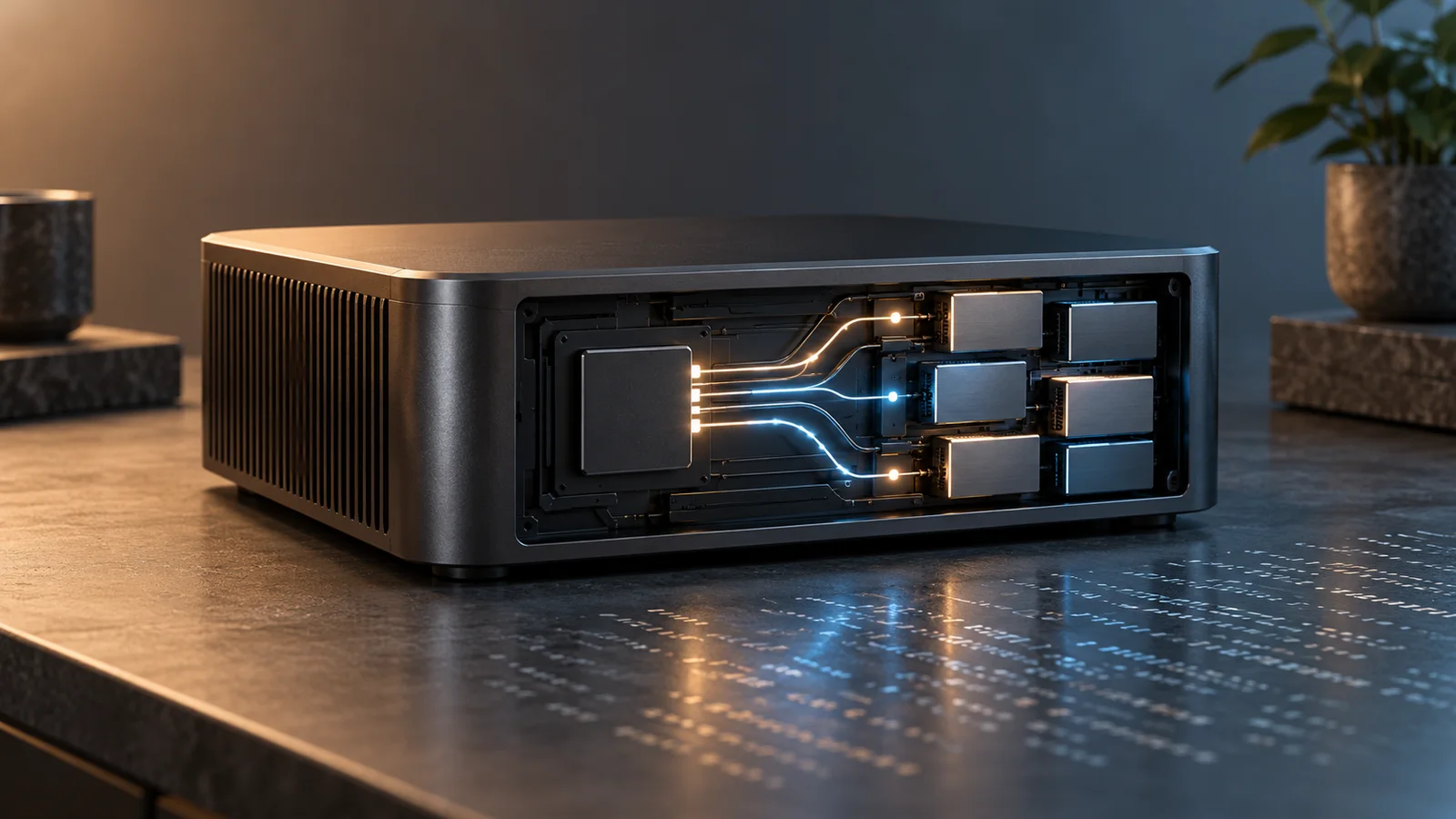
Recursive has released Flint, an open-weight coding model designed to run on local hardware, with weights available under the Apache 2.0 license. The model is built for coding-agent tasks including navigating repositories, fixing bugs, adding features, writing tests and making multi-step tool calls.
Flint has 39.8 billion parameters, but activates about 2.5 billion for each token. Its mixture-of-experts design routes each input through a small subset of specialized components, reducing the computation needed at each step. The approach also places Flint alongside another sparse model built for local agent workloads. The model card says the roughly 80 GB BF16 checkpoint can run on one NVIDIA H200 or B300 GPU per replica. Recursive also offers separate quantized versions for NVIDIA and Apple Silicon systems.
In its own evaluations, Recursive reported scores of 54.9% on Terminal-Bench 2.1, 89.7% on SWE-bench Pro v2 and 74.2% on SWE-bench Verified. The company says the figures are average pass@1 results over at least five attempts, though setups vary across comparisons. No opened independent source reproduced the scores. Recursive also says its optimized engine exceeds 125 tokens per second on an M4 Pro MacBook Pro and 150 tokens per second on a 64 GB NVIDIA RTX Spark at short context lengths. Those speed figures were not independently validated in the opened evidence.
Recursive says its Eureka Machine helped develop Flint by proposing and testing ideas across data, optimizers, training recipes, architecture, quantization and inference. The company describes the system as an automated research loop that implements experiments, evaluates the results, pursues several directions in parallel and combines promising approaches. The opened sources do not independently audit which outputs were adopted or how much human intervention occurred.
A launch-day reviewer with access to Flint used it for a few days on a Mac with 48 GB of memory. The reviewer asked it to build a command-line to-do list, a research-scanning program and a simple website. According to that account, Flint completed the self-selected requests, but the limited hands-on assessment involved one machine and was not a controlled benchmark.
Recursive warns that Flint can generate faulty code or inappropriate tool calls and says consequential code should be tested. Its release advertises context up to 512,000 tokens while recommending 256,000 or less. The model card, however, documents a 262,144-token configuration, leaving the maximum supported setup unclear.
More news

Reflection AI releases Beam weights under Apache 2.0

Black Forest Labs releases FLUX 3 Image Klein weights

Microsoft completes pre-training of 2.8-trillion-parameter MAI-Base-2