SIA traces upstream risks across the U.S. chip supply chain
An SIA report links more than three-quarters of the chipmaking input categories it analyzed to at least one highly vulnerable upstream input.
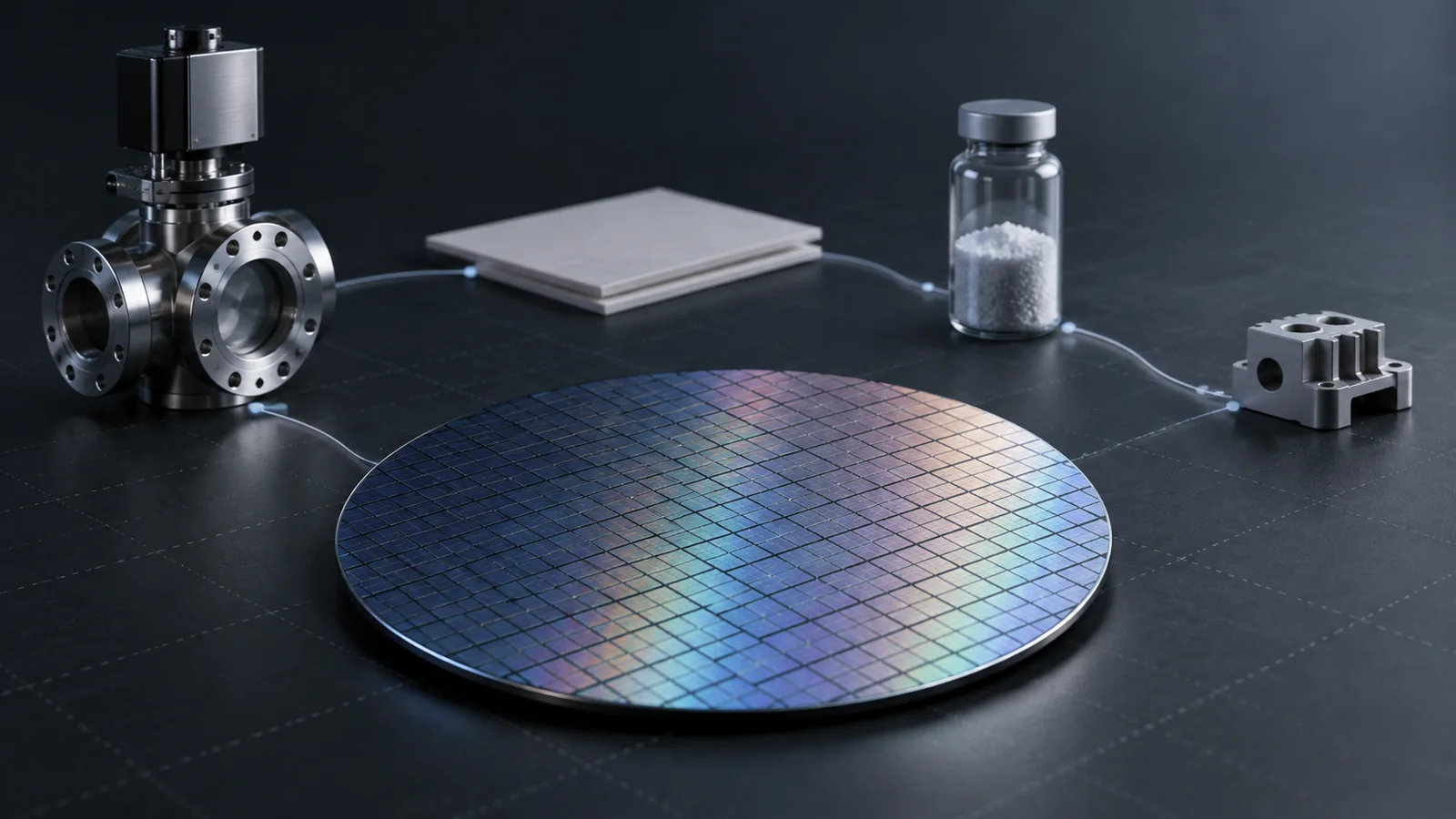
The Semiconductor Industry Association released a supply-chain report that links more than three-quarters of the chipmaking input categories it analyzed to at least one highly vulnerable upstream dependency. The industry group mapped a non-exhaustive set of 200 key Tier 1 inputs—the products bought directly by chipmakers—along with nearly 100 upstream categories covering raw materials, engineered materials and equipment subcomponents.
That map shows how an interruption several steps removed from a chip fab could still affect the manufacturing base behind U.S. AI infrastructure. SIA estimates that suppliers headquartered in the United States, Europe and Japan account for 95% of the roughly $27 billion in Tier 1 equipment and materials that U.S. semiconductor companies consume each year. Measured instead by where those products are made or assembled, the combined share falls to 68%. The share attributed to China, Israel, Southeast Asia, South Korea and Taiwan rises from 5% to 32%.
The exposure grows below the direct-supplier level. SIA’s report initially classified 21 Tier 1 inputs as highly vulnerable. Once upstream dependencies were traced, more than three-quarters of the analyzed Tier 1 categories connected to at least one highly vulnerable sub-tier input, and more than half depended on two or more. Before those sub-tier links were included, 11% of Tier 1 categories were rated high vulnerability and 38% medium vulnerability.
One example reaches AI hardware directly. The report identifies Ajinomoto build-up film substrates, which route dense electrical connections in advanced packages used for AI accelerators, as a Tier 1 category that Japan supplies at about 75%. It also says deposition, sputtering and ion-implantation tools depend on pumps, vacuum robots and transfer valves that are often highly specialized, built to custom dimensions and sourced from a single supplier.
Government data independently supports the broader concern over concentrated inputs. U.S. Geological Survey data for 2024 puts China’s shares at 99% of primary gallium production, 82% of mined tungsten, 82% of natural graphite, 71% of mined rare earths and 87% of rare-earth processing. A 2023 Bureau of Industry and Security assessment said semiconductor manufacturing requires hundreds of materials with stringent quality requirements, while concentrated supply and import dependence leave those inputs prone to disruption.
SIA describes the analysis as a selective, proprietary macro-level map developed with contributions from McKinsey and informed by industry benchmarks, company disclosures, public sources and industry experts. The public report leaves out the underlying commodity-level data, vendor list, weights and category-by-category vulnerability scores. It also does not estimate the production lost to a disruption, the time needed to recover or the cost of substitution.
In an accompanying policy statement, SIA calls for targeted domestic capacity and inventories, stronger supply chains with allies, greater mining and processing capacity for critical minerals, long-term purchase commitments, and sustained research funding for materials and recycling. The proposals are the trade group’s recommendations, not adopted U.S. policy. SIA says building meaningful domestic supply for some upstream inputs can take a decade or more, followed by three to four years to qualify a new supplier or material for semiconductor-grade use.
More news
US chip and AI-infrastructure stocks slide after inflation report
SK hynix commits $38 billion to two new AI-memory fabs

TSMC posts record Q2 profit and adds $100 billion to its Arizona buildout

Micron lifts planned US chip investment to more than $250 billion through 2035
 Dmytro Spodarets·Jul 9, 2026