An agent can create an order, crash before saving its progress, then create the same order again after a restart. A retrieval change can make a support assistant's answers worse even when the model hasn't changed.
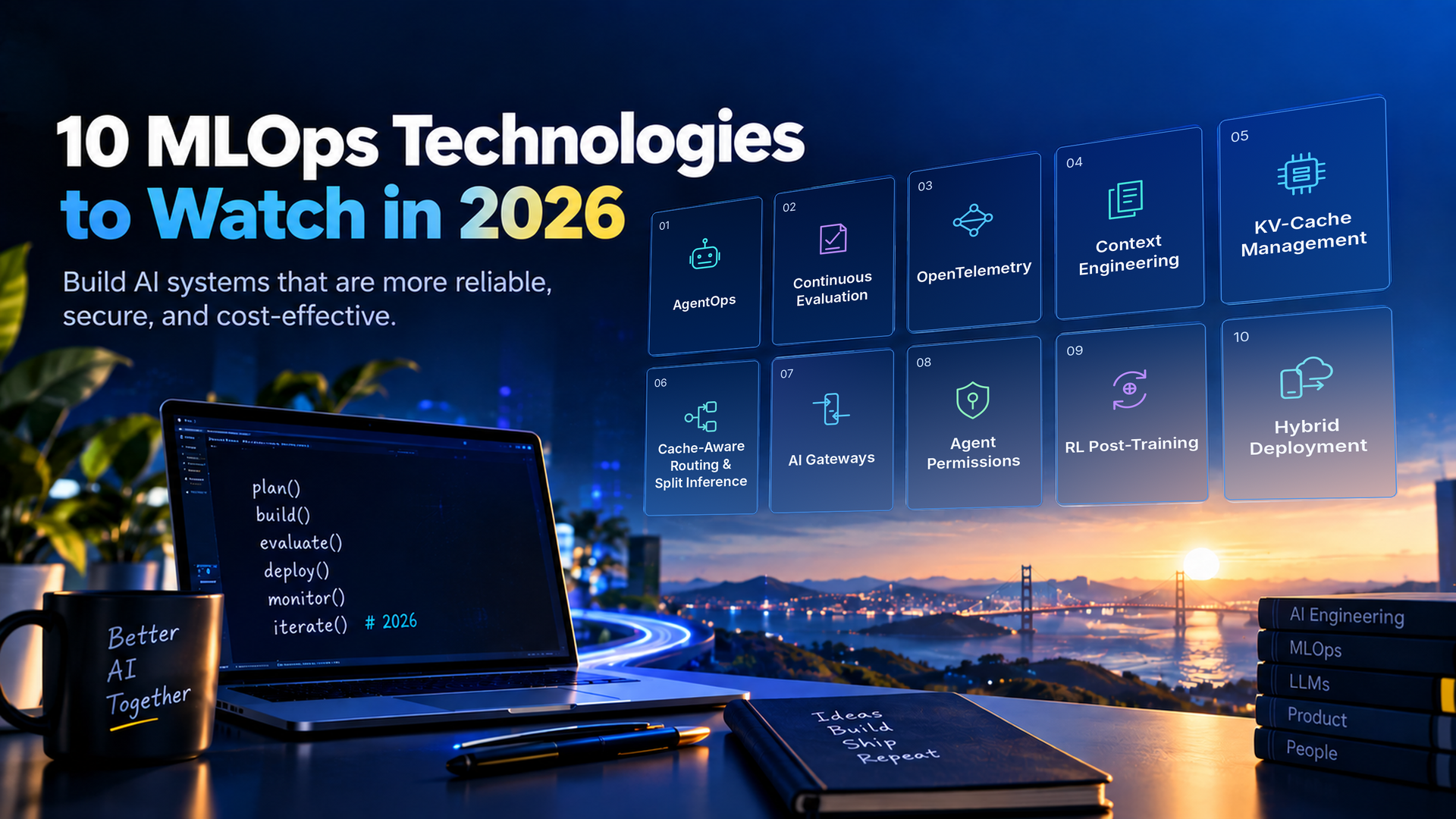
For 2026, our watchlist focuses on the infrastructure needed to test, operate, and debug these systems. It spans MLOps, LLMOps, and AgentOps, with particular attention to agents and LLM serving.
1. AgentOps: durable execution for long-running agents
An agent that pauses for approval may have to resume after its worker restarts or its code changes. For long-running workflows, recovery behavior deserves as much scrutiny as tool-calling accuracy.
Watch in 2026: Pay attention to how frameworks handle saved-state migrations when a paused run resumes on newer code.
Where to look: LangGraph supports checkpoint-based persistence and pauses for human review, with database-backed checkpointers for recovery across process restarts.
The catch: Checkpointing alone doesn't prevent duplicate external side effects, so write operations still need idempotency or deduplication.
2. Continuous evaluation in the release pipeline
Prompt and model changes can introduce quality regressions even when API checks still pass. Bringing task-level evaluation into code review and deployment should make those failures easier to catch before release.
Watch in 2026: Follow tools that turn production failures and human feedback into regression tests, with CI checks against explicit quality thresholds.
Where to look: MLflow provides tracing, evaluation, and custom scorers that teams can use to implement these checks.
The catch: The scores only help if the test cases reflect real use and model-based judges are checked against human assessments.
3. OpenTelemetry across the AI stack
When two frameworks report different fields for the same model call, dashboards and alerts need extra translation code. Shared conventions could reduce that work as teams combine models, agent frameworks, and observability backends.
Watch in 2026: The key signal is whether instrumentation libraries agree on attributes and propagate trace context across retrieval, tools, and serving.
Where to look: OpenTelemetry's GenAI work covers conventions for model and agent telemetry, with agent conventions still evolving.
The catch: An OpenTelemetry exporter alone won't make two integrations compatible or keep sensitive prompts out of their traces.
4. Context engineering with versioned state
Retrieved documents, stored memories, and conversation summaries can change an agent's behavior without changes to its system prompt. Context tooling needs to make those changes testable and traceable.
Watch in 2026: Look for tools that compare context-building strategies on the same tasks and record which documents and memories were used.
Where to look: Anthropic's guide to context compaction and memory covers runtime decisions, while MLflow's application versioning covers packaged code and artifacts.
The catch: Rolling back application code won't restore a live index or memory store unless that data has its own versioning or recovery mechanism.
5. KV-cache management for long-context inference
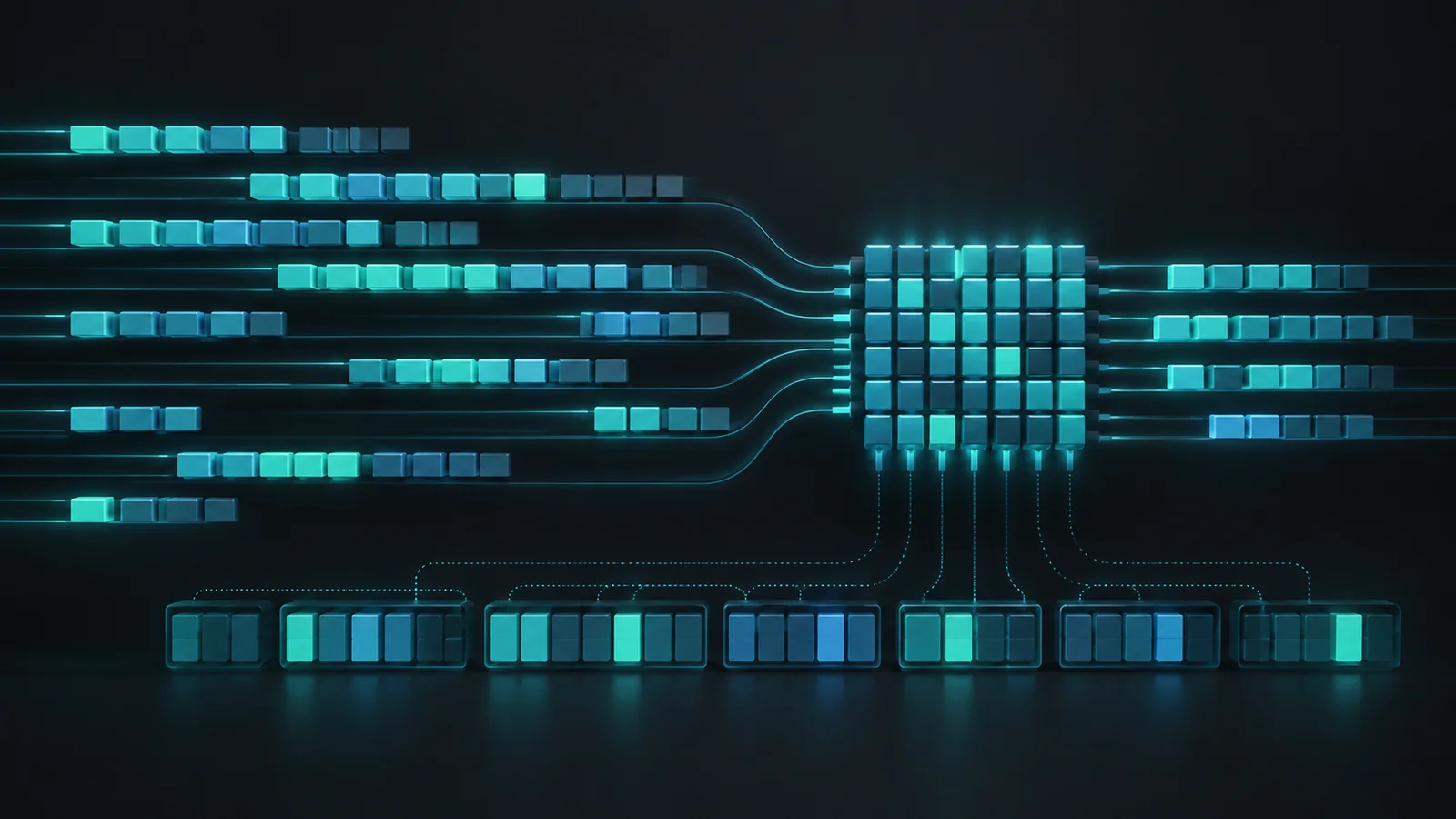
Long agent sessions often resend the same instructions and much of the same conversation history. Without cache reuse, the serving engine has to process those shared inputs again.
Watch in 2026: Track how reuse, eviction, and offloading of attention key-value (KV) caches affect time to first token and throughput under long-context load.
Where to look: vLLM combines request scheduling with prefix caching, and its LMCache integration supports CPU offloading and cache sharing.
The catch: Prefix caching avoids reprocessing matching input prefixes but doesn't directly speed up the generation of new output tokens.
6. Cache-aware routing and split inference
With multiple serving replicas, the next available worker may not have the cache entries a request could reuse. Separating prompt processing (prefill) from token generation (decode) adds another scheduling decision: which resources to assign to each stage.
Watch in 2026: Look for routing that balances queue depth against cache locality, with separate scaling of prefill and decode workers.
Where to look: llm-d builds on vLLM and Kubernetes for inference-aware routing and disaggregated serving.
The catch: Splitting prefill from decode adds cache transfers and worker pools to manage, so compare the full deployment at the same latency target.
7. AI gateways: routing by quality and cost
A cheaper model can make a task more expensive if it needs extra retries or hands work to a larger model. Useful routing should account for successful task completion, not just the price per token.
Watch in 2026: Follow routing policies evaluated on real tasks and per-application budgets that include retries and fallback calls.
Where to look: Envoy AI Gateway offers a common provider API, provider authentication, and token-based rate limits as building blocks.
The catch: Comparing models on quality requires task-level evaluation data, and token rate limits aren't the same as spending caps.
8. Agent permissions at the tool boundary
An agent with access to customer data needs permissions tied to the user and the requested operation. A broad service credential can give it more access than that user should have.
Watch in 2026: Watch how tool gateways preserve user identity and bind approvals to the exact resource, action, and arguments.
Where to look: The Model Context Protocol (MCP) authorization specification covers HTTP-based access to MCP servers, while Open Policy Agent (OPA) can evaluate application-level rules.
The catch: OPA returns a decision, which the service or gateway must enforce before allowing the action.
9. Reusable infrastructure for RL post-training
Reinforcement learning (RL) post-training has to coordinate response generation, reward calculation, training, and weight updates. For teams running these workloads, reusable orchestration could remove some of the custom code each experiment needs.
Watch in 2026: Follow asynchronous rollout generation and weight synchronization, especially how systems balance GPU utilization against the use of samples generated by older policies.
Where to look: The experimental torchforge project combines PyTorch-native distributed coordination with training and inference components for these workflows.
The catch: Evaluate throughput alongside held-out task performance, rather than assuming higher training rewards mean a better model.
10. Hybrid deployment across devices and the cloud
Hybrid applications can handle some requests on-device and send others to a cloud model. Deployment includes deciding when to switch, what data may leave the device, and how local models get updated.
Watch in 2026: Look for explicit local-to-cloud routing and staged model updates with a tested rollback path across supported devices.
Where to look: ExecuTorch provides a PyTorch-native runtime and deployment tools for mobile and embedded devices.
The catch: A working runtime still leaves you responsible for cloud handoff, update delivery, and testing latency, memory use, and battery drain on target devices.
What would count as progress?
For API-based products, watch how evaluation, tracing, context management, and permissions fit into the release workflow. For self-hosted models, compare serving changes at fixed latency targets and realistic concurrency. Post-training and edge deployment matter when the product requires them.
When a project announces an improvement, look for a benchmark or failure case that matches your workload.

An entrepreneur with over a decade of experience in AI, Cloud, and HPC. He is currently a DevOps Architect and the founder of Data Phoenix, an influential media voice for the AI industry, with a strong focus on community building and open source.