Amazon launches Ring Drone Cam and Rover Cam security robots
Amazon announced Ring Drone Cam and Rover Cam for autonomous indoor patrols, but the drone’s planned January release still depends on FCC authorization.
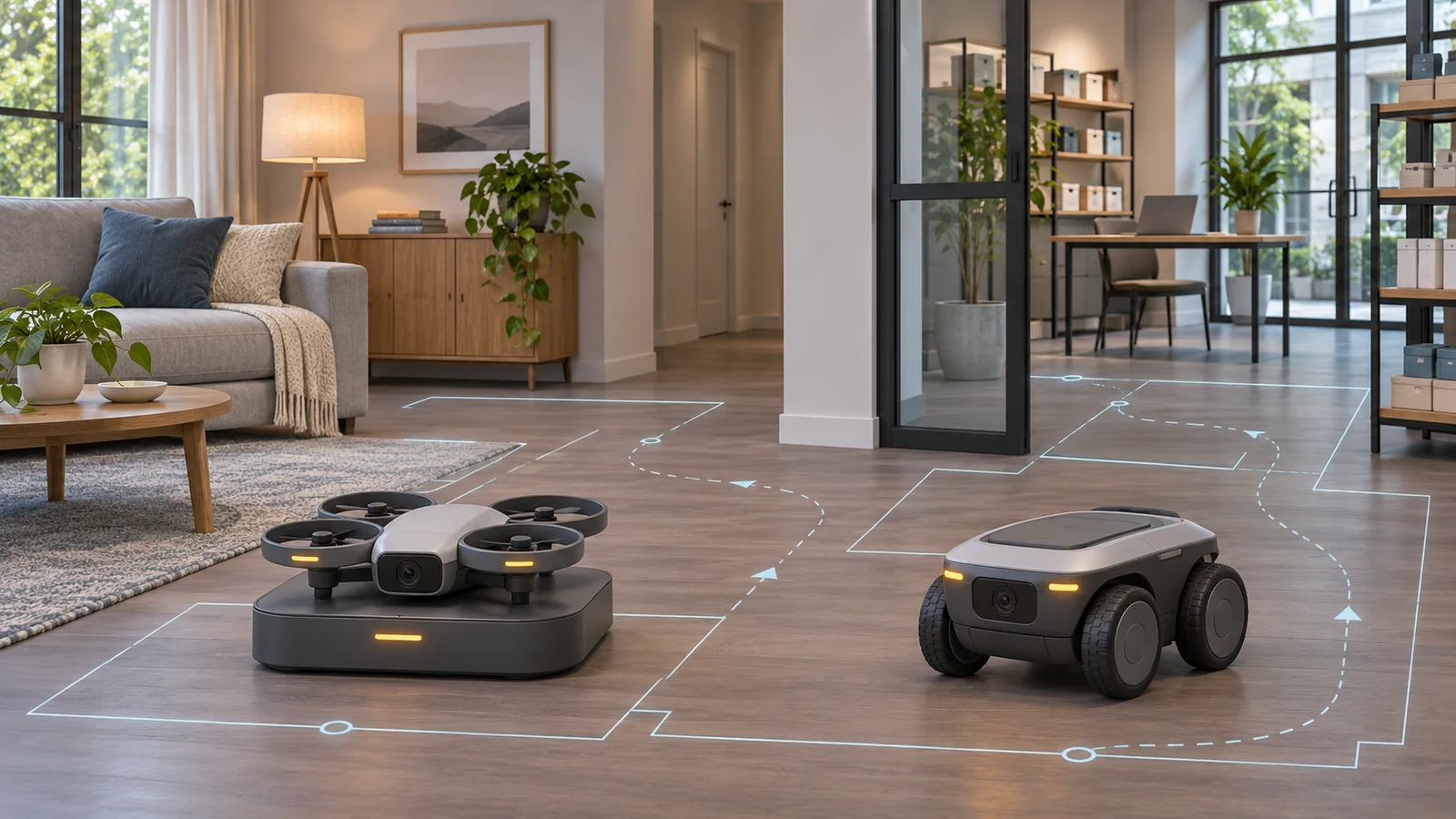
Amazon announced two mobile Ring security cameras that it says can map indoor spaces and follow autonomous patrol routes: the $249.99 Ring Drone Cam for homes and the $999.99 Ring Rover Cam for businesses. Ring says Rover Cam will ship in the United States on December 16, 2026, while Drone Cam is planned for January 27, 2027.
The drone’s release is conditional. Amazon and Ring state that Drone Cam has not received the authorization required by Federal Communications Commission rules and cannot be offered for sale or lease, or sold or leased, until that authorization is obtained. Ring’s product page offered availability notifications when checked, while Rover Cam was available for preorder.
Both devices use an Amazon system called AI Pilot. The company says cameras, specialized vision models, onboard sensors and cloud processing work together to build a floor plan, suggest patrol points, plan routes and avoid obstacles. A Drone Cam owner starts mapping by carrying the device through a home; Rover Cam can explore a business on its own. The announcement follows Amazon’s launch of five Alexa devices with broader home sensing two weeks earlier. Amazon has not disclosed the model architecture, training data, map-retention terms or how inference is divided between the devices and the cloud.
Drone Cam is an indoor-only flying camera with 2K square video, a 148-degree horizontal and vertical field of view, LED spotlights and no microphone, speaker or siren. Ring rates flight time at up to eight minutes with a new, fully charged battery under controlled conditions. These specifications and navigation claims have not been independently tested in the opened evidence.
Ring says the drone records only while flying and stops when docked. Users can launch manual patrols from the Ring app, but scheduled patrols and cloud video history of up to 180 days require a compatible Ring subscription.
Rover Cam is designed to map and cover as much as 5,000 square feet on one indoor floor. Ring says it can record in up to 4K while moving, conduct 360-degree room scans and detect people while docked. It also includes two-way talk, a remotely activated siren and a light tower. Ring limits it to dry, indoor, single-floor spaces. Its coverage, image quality and navigation performance also remain vendor specifications rather than independent measurements.
The rover does not record continuously, according to Ring. It records when it detects people while docked and whenever it is moving or in Live View. A privacy mode retracts the camera mast, while Amazon says Sleep Mode switches off the microphone. Lights and the device screen indicate recording activity.
If deployed, the mobile cameras would extend Ring’s video capture beyond fixed viewpoints to routes through indoor homes and businesses. Their use would add floor maps, cloud-assisted navigation and moving recordings to the data handled by Ring. Amazon says video from both devices will use Throw Away the Key Encryption, or TAKE, which temporarily makes encryption keys available inside a secure cloud enclave for enabled intelligent features before deleting them. Optional end-to-end encryption remains a separate mode.
In 2023, the Federal Trade Commission charged Ring with failing to restrict employee and contractor access to customer videos and with inadequate security safeguards. The agency said hackers accessed stored videos, live streams and account profiles belonging to about 55,000 U.S. customers. Those allegations were resolved through a stipulated order and concerned Ring’s earlier practices, not the new robots.
More news

Amazon reports $94.8 billion increase in property spending tied mainly to AI
Amazon launches five Alexa devices with broader home sensing

NVIDIA broadens Isaac robotics stack with runtime, datasets and humanoid reference platform