Apache Airflow 3.4.0 adds bounded task loops and AI agent workflows
Apache Airflow 3.4.0 adds bounded task loops, experimental DAG authoring in four non-Python formats, and stable LLM and agent task APIs with human approval controls.
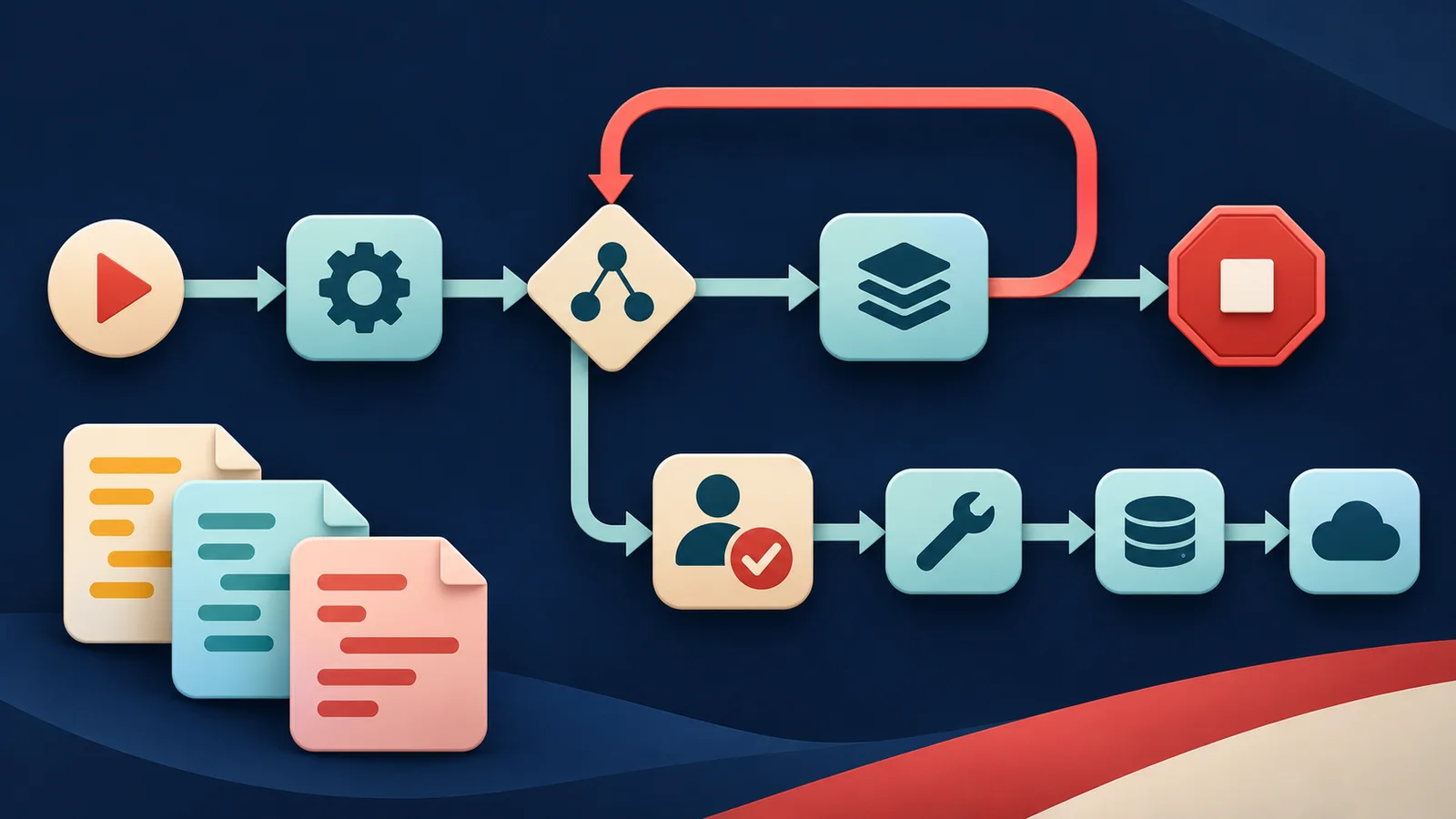
The Apache Airflow project released version 3.4.0 with bounded task loops, whole-DAG authoring outside Python, and LLM and agent tasks that can pause for human approval. The November 6 release gives teams new ways to express iterative and AI-assisted workflows, but the official material does not establish production adoption or independent performance gains for the new features.
Task Loops, defined under AIP-111, let a decorated task group repeat sequentially at runtime. A required max_iterations value puts a hard ceiling on the loop, while an optional until condition is checked after the body runs, so every loop executes at least once. An iteration can consume the previous iteration’s result, and Airflow creates the next iteration only when the loop continues rather than adding a dependency cycle to the DAG. The loop documentation says loops cannot be nested, mapped as a whole, or placed inside a mapped task group, although mapped tasks can run within an iteration.
AIP-85 adds a pluggable DAG Importer that lets the DAG processor recognize formats beyond Python and invoke the matching runtime. Airflow 3.4 ships SDK-based DAG authoring for TypeScript, Go and Java, plus a native YAML format. The 3.4.0 release notes classify the importer framework and language SDKs as experimental, meaning their APIs may change. The project says TypeScript artifacts need Node.js 22 or later and Java artifacts need a Java runtime on DAG processors and workers; compiled Go artifacts do not need an additional language runtime.
The third change is the Common AI provider, which the project says reached general availability as version 1.1.0 alongside Airflow 3.4.0. Its stability documentation lists @task.llm and LLMOperator for model calls, along with @task.agent and AgentOperator for tool-using agents, as stable APIs. The provider’s human controls cover three points in a run: approving an LLM task’s output, returning an agent response with reviewer feedback for another round, and pausing before a marked tool call until a person approves or rejects it. Those controls are described in the provider’s feature map.
The release materials draw narrower boundaries around some advanced AI functions. They present step-level replay on retry, sandbox toolsets and code mode as experimental previews rather than evidence that the broader agent workflow is production-proven.
Apache also says it tested the 3.4.0 upgrade migration against a 300-million-row XCom table. That is a project-reported migration test, not an independently reproduced benchmark for Task Loops, non-Python DAGs or Common AI workloads. The opened official sources provide no deployment counts, customer case studies, or independent measurements of scheduling throughput, reliability, runtime overhead, cost savings, or model-task cost for these additions.
More news
Polars brings distributed queries to existing Ray clusters

MotherDuck says its Azure service is live in two regions

ClickHouse launches managed observability service in public beta