Apple researchers detail split-and-scale method for higher-capacity latent 3D
Apple’s split-and-scale method reuses a pretrained tokenizer across smaller 3D regions, with author-reported gains in detail and lower training memory than a larger LiTo baseline.
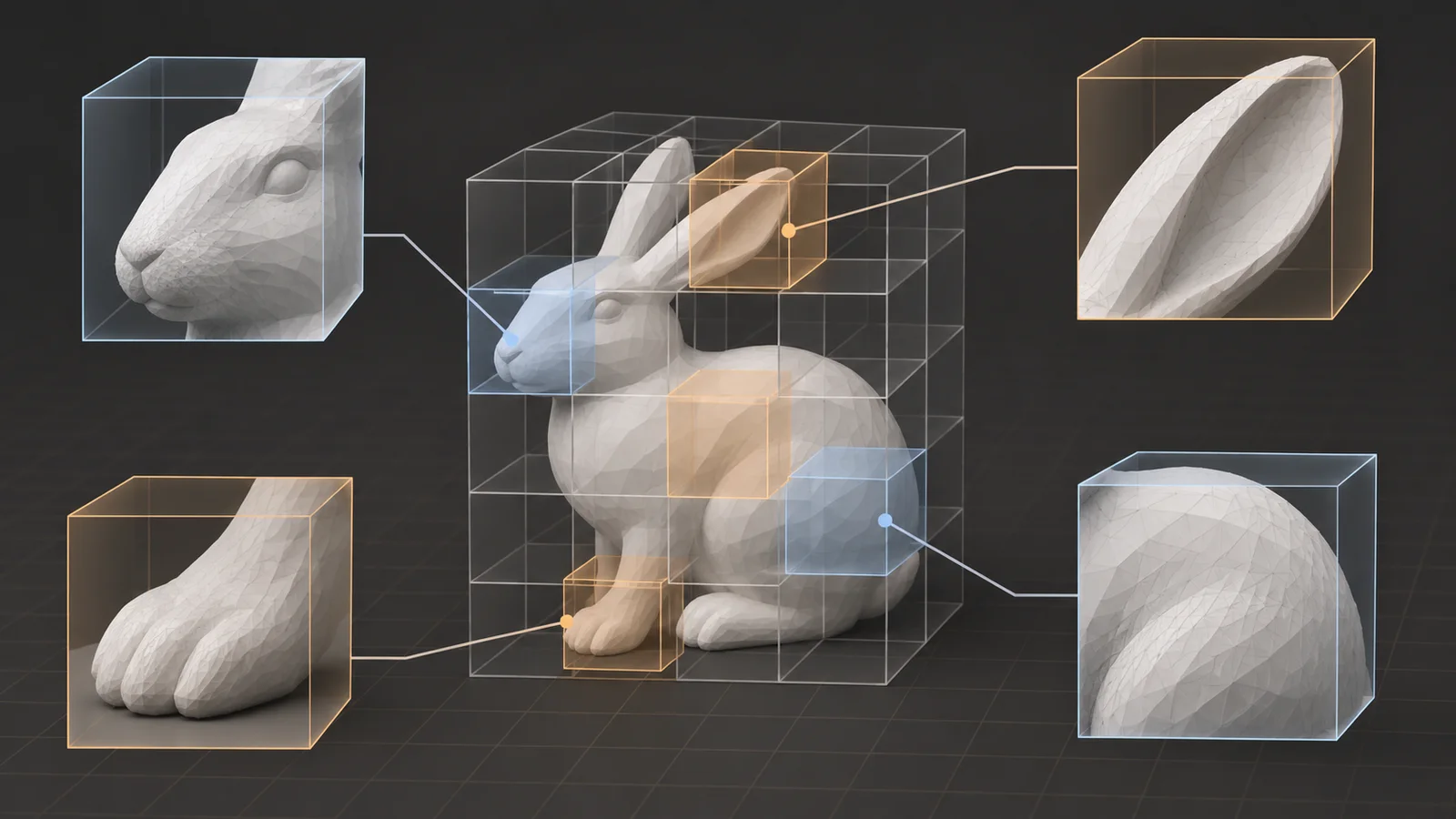
Apple researchers have presented split-and-scale, a method that reuses a pretrained 3D tokenizer across smaller spatial regions. Instead of training a tokenizer around the full inference-time token count, the approach applies the same tokenizer at smaller scales to increase representation capacity during inference. The paper was accepted to NeurIPS 2026.
In the authors’ experiments, a model trained with about 14,000 tokens used 73.51 GB of peak memory. A LiTo model trained with 32,768 tokens used 145.58 GB. The split-and-scale setup fit on one 80 GB A100 or H100 GPU; the larger LiTo baseline did not. The results have not been independently reproduced.
The method divides a 3D scene into non-overlapping voxels and skips those that are empty. Each occupied voxel is shifted and rescaled to the tokenizer’s original coordinate range, processed independently with the same encoder and trained query count, and decoded. The system then reverses the coordinate transform and reassembles the scene.
According to the authors, normalizing a region of width 1/n to the full coordinate range lowers the spatial frequency shown to the encoder by a factor of n. The unchanged network can therefore represent detail n times finer within that region. Because scenes are surface-dominated, they estimate that the number of occupied regions grows roughly with n squared, rather than the n cubed regions in the full volume.
In a reconstruction test of 200 selected objects, split-and-scale with 32,768 inference latents recorded an LPIPS score of 0.091 and a flow-decoder Chamfer distance of 2.09 × 10^-3; lower values indicate better results. LiTo trained with 8,192 tokens and expanded to 32,768 at inference recorded 0.106 and 2.74 × 10^-3. A LiTo model trained directly with 32,768 tokens produced a lower LPIPS score of 0.084, but used the reported 145.58 GB of peak memory.
The objects were drawn from the 1,000 test-set objects with the highest TRELLIS aesthetic scores. The authors note that TRELLIS and TRELLIS-2 had trained on that test set, limiting the interpretation of cross-method comparisons.
For image-conditioned generation, the team trained an autoregressive model on four-by-four-by-four splits, averaging about 32,768 tokens per object. Its FID and KID comparisons with LiTo-8192 were mixed across input and novel views. The paper also reports subtle seams at voxel boundaries, rising Gaussian counts with greater subdivision, and occasional repeated, asymmetric or floating geometry.
More news

Reson8 releases Rumble-2-Flash speech model under Apache 2.0

Cohere previews timestamped video search in Compass

MBZUAI researchers constrain speech decoding to restore Arabic diacritics