Cohere previews timestamped video search in Compass
Cohere is previewing Video Intelligence in Compass with design partners, adding timestamped retrieval of precise video moments alongside related enterprise documents.
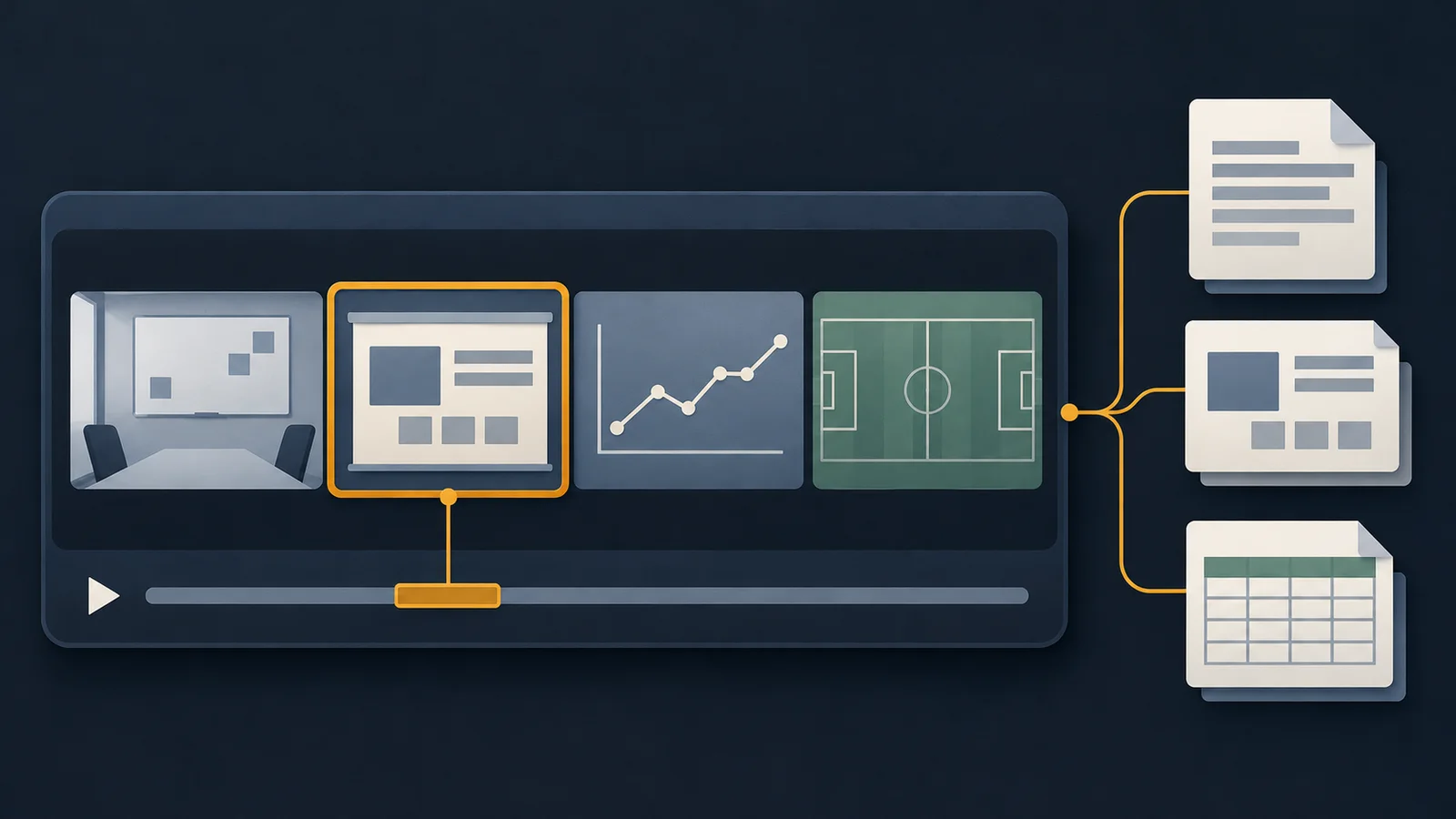
Cohere has introduced Video Intelligence in Compass, a design-partner preview for searching spoken and visible video content. Selected organizations can use it to retrieve the moment the system deems relevant with a timestamp. Cohere is recruiting organizations to test and shape the capability; it has not announced general availability or public pricing.
The preview extends Compass beyond document retrieval, bringing video moments, pages, slides and spreadsheets into one permission-aware index. Cohere says results can include a timestamped clip, transcript, visual description and link to the original footage, so users can inspect the source without searching through an entire recording.
Rather than divide a video into fixed clips before a query arrives, the system determines the relevant start and end times at search time. Cohere says this approach can handle questions about events that unfold over a sequence, such as a decision made during a meeting or an action in sports footage, where a transcript or isolated frame may not contain the full answer.
Applications and agents can retrieve video and documents through the same search workflow. Cohere also says agents can connect through the Compass MCP server to use information shown on screen, including slides, charts and demonstrations, as well as spoken content.
Cohere claims Video Intelligence ranked first on average against seven video embedding models across 11 datasets and 11,133 queries. It says the system’s nDCG@10 score—a measure of how well the top 10 results are ordered—was 4.4 points higher than the strongest alternative.
The company also claims leads of 2.4 points over Amazon Nova Multimodal Embeddings on six public benchmarks, 5.1 points over Gemini Embedding 2 on sports footage and 2.0 points over Qwen3-VL-Embedding-8B on enterprise-knowledge video. Official materials for those three models confirm that they accept video, but they do not independently verify Cohere’s comparisons.
The announcement does not identify the six public datasets or five internal datasets, publish per-dataset scores, specify the evaluated model versions and configurations, disclose statistical variance or provide reproducible evaluation code. The ranking and reported margins therefore remain vendor claims.
Design partners can deploy the preview in Cohere’s managed cloud or in their own environment, test it with their own footage and queries, and work with Cohere engineers. Cohere has not specified supported video formats, maximum duration, indexing throughput, query latency or operating cost.
More news

MBZUAI researchers constrain speech decoding to restore Arabic diacritics
Alibaba launches Qwen4-Max multimodal model across six regions

CMU researchers give everyday objects expressive OATs avatars