AWS releases 38 open-source agent skills for healthcare and life sciences
AWS has released 38 MIT-0 agent skills that package reusable procedures for healthcare and life-sciences work, including genomics, drug discovery, claims operations and medical imaging.
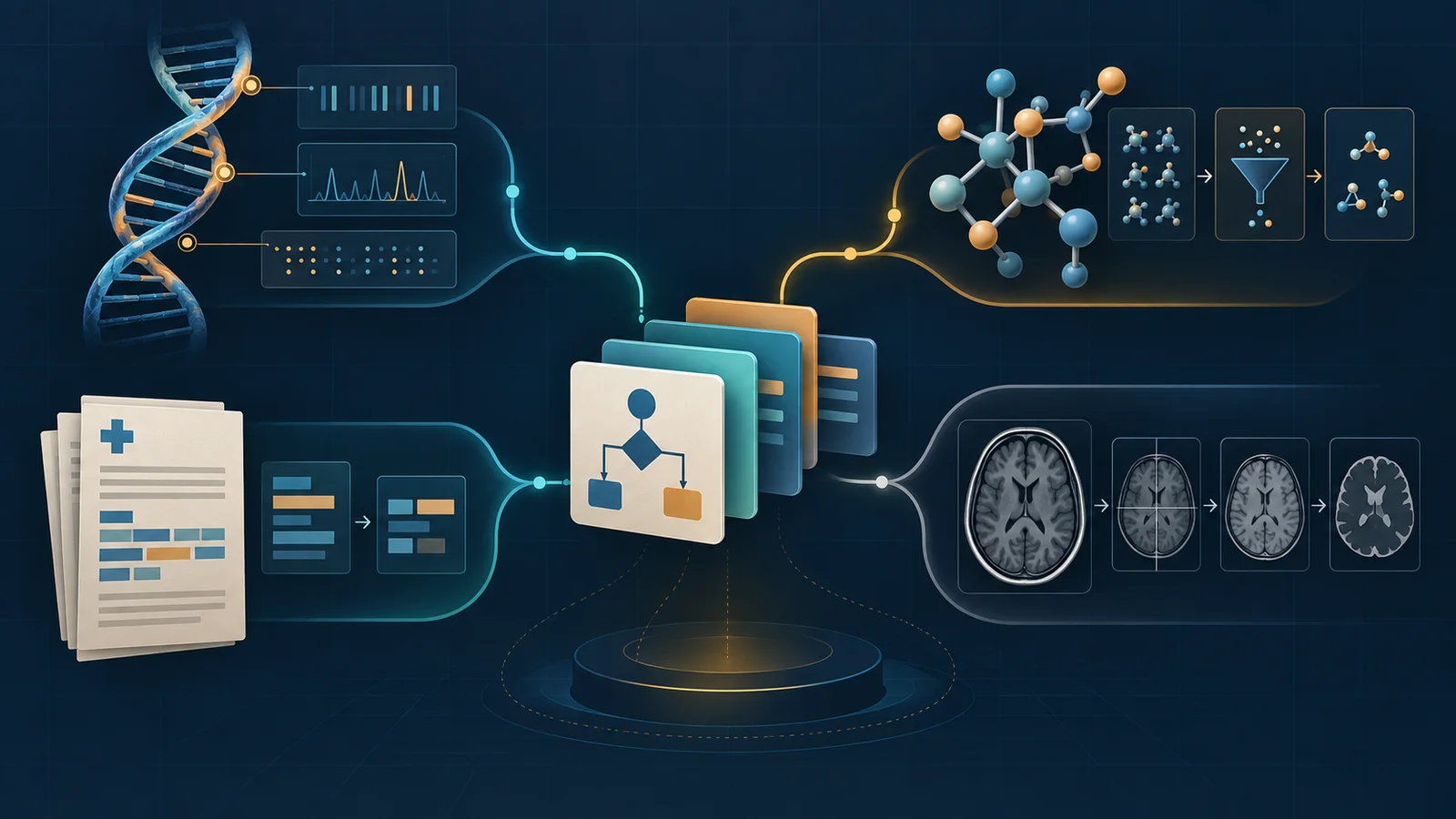
AWS released 38 open-source agent skills for healthcare and life sciences, packaging reusable procedures for genomic interpretation, drug repurposing, claims operations and medical-image preparation. Developers can reuse and modify the procedures under the collection’s MIT-0 license. The September 16 release spans 11 domains.
The collection separates reasoning skills, which encode methodologies and decision frameworks, from pipeline skills, which supply tool-specific commands, parameters and code templates. Each skill centers on a SKILL.md file with metadata and Markdown instructions under the broader Agent Skills specification. The v0.1.0 release is the stable reference for the 38 launch skills. It is distinct from six open-source Hugging Face deployment skills for SageMaker that AWS released separately.
In genomics, the variant-interpretation skill first separates germline from somatic analysis. It then checks gene-disease validity, population frequency and evidence categories before combining criteria and requiring a final sanity check and documentation. The underlying ACMG/AMP consensus guidelines define a five-category system for germline variants and recommend interpretation by qualified clinical laboratories.
The drug-repurposing skill chooses among target-based, phenotype-based and hybrid routes. It calls for evidence from multiple drug and target databases, checks whether a mechanism acts in the required direction and ranks the evidence. It also instructs the agent not to make clinical-development recommendations when the evidence is only computational.
For claims operations, a billing-rules skill covers rule-based review and fraud-pattern analysis. The risk-adjustment skill maps ICD-10 codes to hierarchical condition categories, resolves hierarchies, calculates risk-adjustment factors and identifies coding gaps. CMS separately publishes 2026 mappings and model software for risk-adjustment work.
The radiology-preprocessing skill lays out a structural-imaging sequence of reorientation, N4 bias correction, skull stripping, registration and intensity normalization. It includes command and parameter examples for ANTs, FSL and HD-BET. The independent N4ITK paper supports N4 as a bias-field-correction method, but does not validate AWS’s full workflow.
AWS also published its own 410-prompt evaluation. The company says it generated prompts with Claude Sonnet 4.6, compared responses with and without all 38 skills across several harness configurations, and used Claude Opus 4.7 as a pairwise judge on five dimensions. AWS reported that the skill-assisted condition won 69.5% of comparisons in a symmetric Kiro CLI run and 85.9% in a Strands SDK run. Its reported critical-thinking win rates were 78.0% and 85.1%, respectively. The research for this article identified no independent evaluation of the collection.
AWS’s report says harness artifacts materially affected the measurements, an asymmetrically isolated Kiro run was confounded, and ten prompts per skill were too few for reliable individual-skill rankings. The release materials also conflict on taxonomy: the announcement and v0.1.0 release describe 11 domains, and the release lists 18 reasoning and 20 pipeline skills. The technical report instead lists 12 domains and a 17-to-21 split. The repository’s current main page now lists 42 skills, while the v0.1.0 release lists 38.
More news

AWS simplifies SageMaker Studio onboarding for new customers

AWS adds Meta’s Muse Spark Open to SageMaker JumpStart

AWS adds HyperPod Spaces controls to SageMaker Studio