Black Forest Labs releases 7B FLUX 3 Action robotics model
Black Forest Labs released FLUX 3 Action, a 7B open-weight model that jointly predicts robot actions and future video, with downloadable weights for testing and fine-tuning.
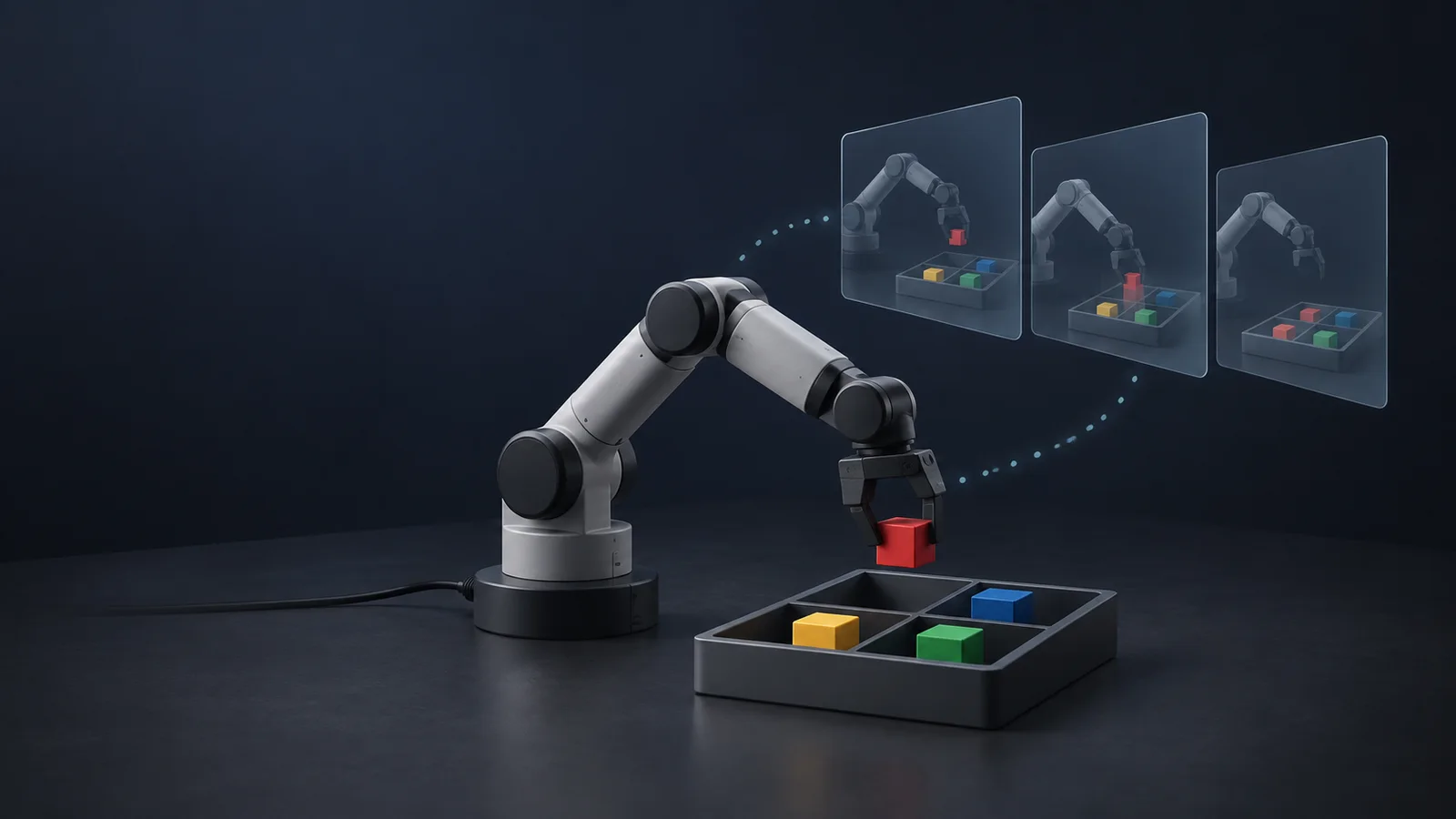
Black Forest Labs released FLUX 3 Action, a 7-billion-parameter open-weight model designed to control robots by predicting actions and future video together. The September 23 release includes downloadable base, DROID and SO-101 model packages, giving developers weights they can test and fine-tune instead of relying only on a hosted service.
The model takes camera observations, robot state and a text instruction as inputs. Its world-model approach to robotics jointly denoises video and action tokens, pairing a visual prediction of what should happen with the commands intended to make it happen. Predicted video can be omitted during control.
The released DROID policy outputs 32 absolute joint commands at 15 hertz. At that frequency, the 32-action output spans about 2.13 seconds; a controller can execute a subset, observe again and replan, according to the model card and implementation details.
The weights are distributed under the FLUX Kommunity License v1.0, while the accompanying flux-action code has a separate license. The release is open-weight, not an unrestricted public-domain release.
FLUX 3 Action led NVIDIA’s public RoboLab-120 leaderboard when checked on September 27. It recorded 515 successes in 1,200 trials, or 42.9%, compared with 36.8% for the 16-billion-parameter Cosmos3-Nano-Policy entry. RoboLab-120 evaluates 120 tabletop tasks in simulation, so the result does not independently establish reliability on physical robots.
Black Forest Labs says FP8 versions of its base and guidance-distilled checkpoints ran 1.52 to 3.95 times faster than Cosmos 3 Nano across the consumer, workstation and data-center GPUs it tested. The real-time-factor figures come from the company and were not independently reproduced under matched hardware, precision and serving settings in the opened sources.
The company also published selected demonstrations of an SO-101 arm policy adapted with about 200 teleoperated episodes. It said the policy handled unseen objects and changes in camera position, and recovered from a mistake. The opened sources did not include an independent replication of those physical-robot demonstrations.
The DROID model card says the model does not enforce limits on joint velocity, force or workspace. It directs deployers to add those limits, keep a hardware emergency stop available, and validate the system in simulation or behind safety constraints before operating near people.
More news
Moonshot launches Kimi K3.1 Pro, plans weights for November 4
IBM adds multilingual 2B model to Granite Speech, updates two checkpoints
DeepSeek updates V4.1 Flash with 1017 refresh