Dharma AI says learned model improved internal fine-tuning time estimates
Dharma AI says a model trained on 272 internal H200 fine-tuning runs estimated job duration more accurately than compute-only baselines, though the underlying paper and data are not yet available.
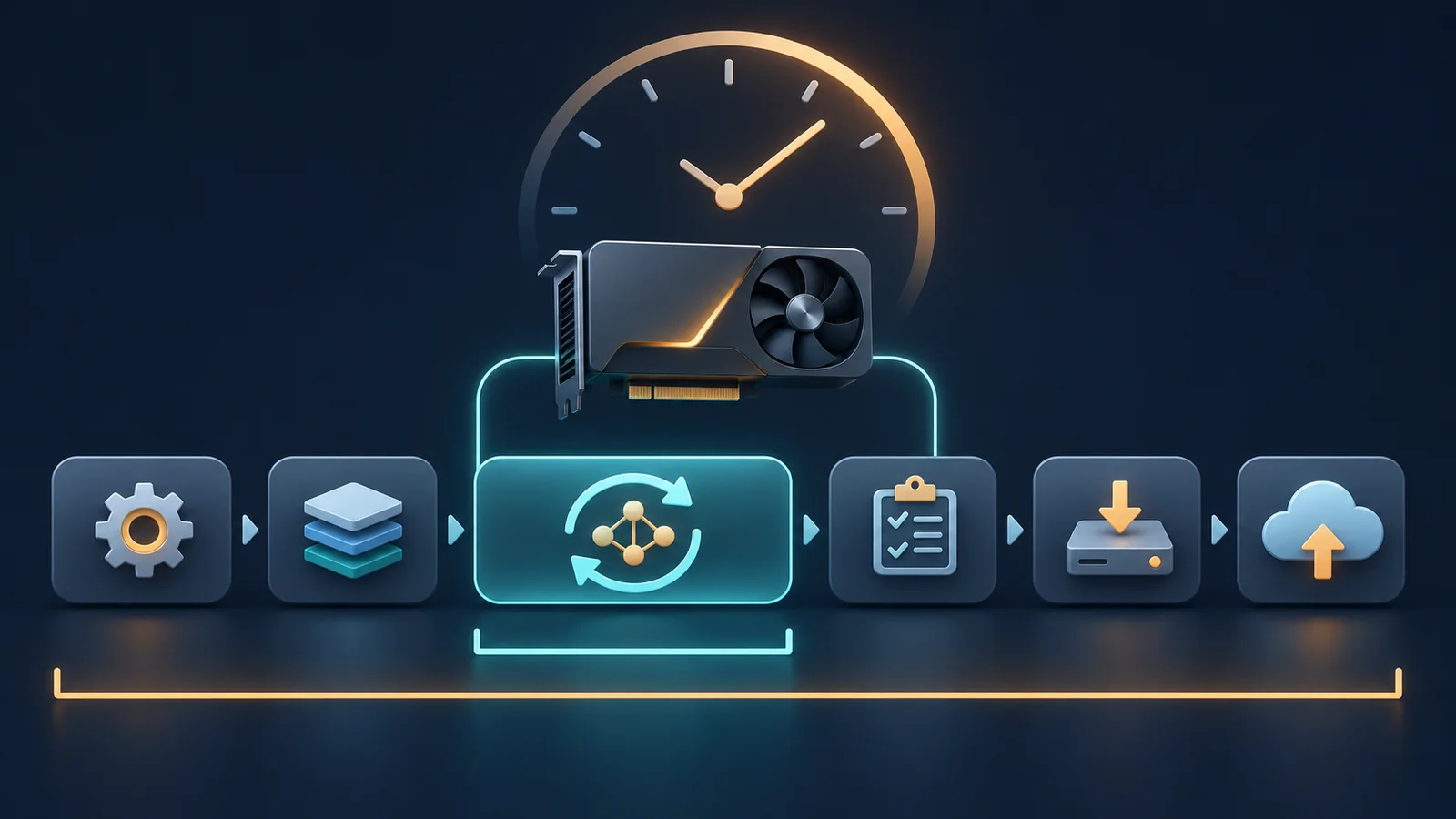
Dharma AI said a learned model estimated the end-to-end duration of 272 internal supervised fine-tuning jobs more accurately than compute-only approaches, according to a preview of a forthcoming paper. The company reported that its CatBoost regressor achieved a mean R-squared of 0.98 and a mean absolute error of 1.71 hours in stratified five-fold cross-validation, compared with 0.31 and 12.41 hours, respectively, for its best listed FLOP baseline.
The pre-dispatch estimate addresses the gap between calculating time in a model’s optimization loop and scheduling a complete job on shared infrastructure. Dharma defined end-to-end duration as the period from GPU allocation through completion, excluding queue time but including setup, model loading, tokenization, evaluation, checkpointing, final uploads and contention for shared input-output resources.
Dharma said the 272 runs totaled about 7,382 GPU-hours and covered model families of up to 15 billion parameters, using both LoRA and full fine-tuning. Every run used one, two or four NVIDIA H200 GPUs from shared pools of eight to 32 GPUs across as many as four nodes. The company said the fitted predictor is calibrated to that infrastructure and should not be expected to transfer numerically to other GPU generations without retraining.
The 24-feature predictor used only information available before dispatch, including the submitted configuration, model metadata, dataset size, GPU allocation, evaluation volume, checkpoint quantities and per-GPU token volumes. It did not use runtime logs or partial progress.
By comparison, Dharma’s compute-only baseline used parameter count, token count, GPU count, peak throughput and assumed model FLOPs utilization. The company also tested Calculon, an analytical transformer-performance model designed for high-level codesign, but said that step-oriented estimate did not capture much of the full job’s elapsed time.
Dharma reported a median absolute error of 0.51 hours across the 272 out-of-fold predictions, with 80% within 2.20 hours and 90% within 4.31 hours. Errors were wider among the 13 runs longer than 60 hours: the median absolute error was 5.19 hours and the 90th-percentile error was 18.51 hours.
The figures are issuer-reported results from an internal workload and have not been independently reproduced. Dharma did not publish the job-level data, fold assignments or trained model artifact, and the preview did not measure whether using the predictor improved utilization, idle time, throughput or scheduling outcomes. It also excluded RLHF, DPO and RLVR workloads. The company said the full paper will provide the feature formulas, selection procedure, search spaces and final hyperparameters.
More news
Oumi expands Frontier AI Engineer into agent development

Snowflake puts Cortex Training into public preview
OpenAI resumes frontier-model training without live internet access