Google outlines three building blocks for autonomous wet labs
Google Research reported closed-loop aptamer experiments, a compute-efficient protein-binder workflow and traceable robot controls, while full integration remains future work.
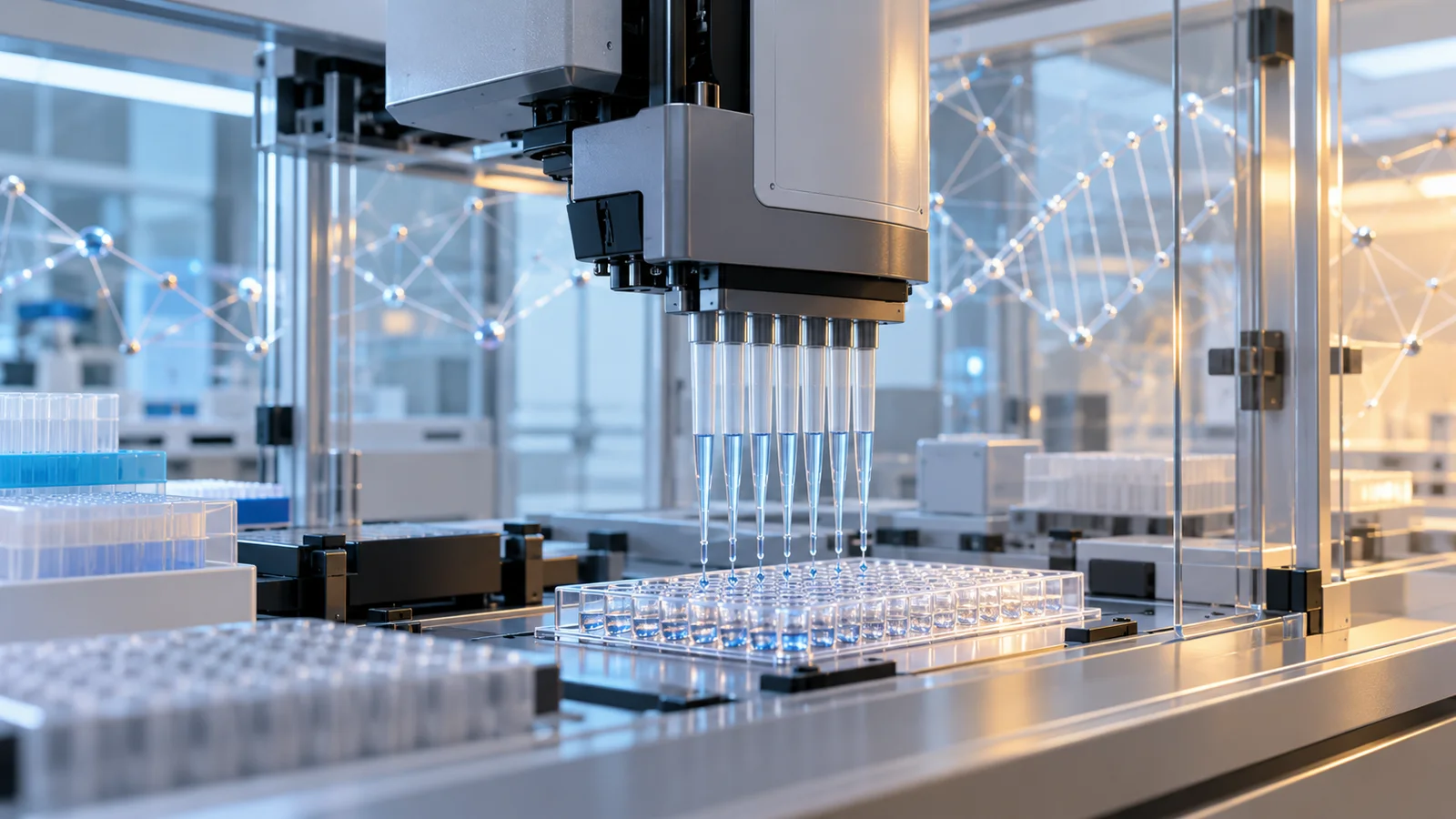
Google Research presented three projects it describes as building blocks for human-directed autonomous wet labs: a closed-loop aptamer workflow, an agent-guided protein-binder pipeline and a robot-control framework called VERID. The three demonstrated systems remain separate. Google said combining VERID’s automation with closed-loop protein discovery is its next step.
The aptamer project completed three physical design-test-improve rounds against alpha-thrombin and myoglobin. In each round, agent-designed DNA sequences were synthesized and screened, then the sequencing results were returned to the system for the next cycle. Google reported statistically significant, bead-corrected on-target hit rates of 42.1% for alpha-thrombin and 33.5% for myoglobin by round three, after the workflow changed its design rules in response to different experimental failures.
In the aptamer study, fixed primer overhangs disrupted folding for many first-round alpha-thrombin designs. Later rounds added clamped stems, lifting the reported hit rate from 0% to 26.0% and then 42.1%. For myoglobin, the second round favored G-quadruplex motifs that often bound nonspecifically. The system then capped those motifs, subtracted bead binders and shifted toward other structures. Google reported that specificity recovered from 19.1% to 72.4%, while the bead-corrected hit rate rose from 3.7% to 33.5%. Each pooled synthesis, selection and sequencing cycle took about 10 days.
The protein-binder project used a technique called epitope excision, which trims a target protein to the local binding region during computational structure prediction. For a campaign targeting fibroblast activation protein alpha, Google reported an 88% reduction in GPU hours—not a universal speedup across every target. Under the same compute cap, the company reported a 9.33% computational hit rate for the human-agent workflow, versus 5.06% for a scientist working alone. A subsequent screen of a 5,000-member yeast-display library recovered 571 enriched unique sequences. Four representative enriched clones had apparent dissociation constants of 3.0 to 9.1 nanomolar. The paper says further soluble-binder, specificity and inhibition tests remain to be done.
VERID, described in a separate technical report, maintains a digital twin of a laboratory workcell, including its geometry, liquid volumes, reagent identities and pipette-tip inventory. It simulates protocols before sending them to a liquid-handling robot, while synchronizing state, commands, telemetry and video for debugging. Its reported physical case studies used deionized water and food coloring, not biological samples. In paired self-play challenges, a later solver inherited sample-blind operating lessons from an earlier multi-cycle run while reconstructing blinded dye mixtures. Its mean prediction loss was 58 millinats, compared with the earlier run’s final loss of 307, which the paper described as a greater-than-fivefold improvement.
Google said the work used non-infectious systems without gain-of-function risk, screened designed sequences, simulated robot protocols before execution and required people to authorize sequences, verify protocols and supervise runs. The company also pointed to unresolved reliability and monitoring problems, including how to prevent agents from exploiting experimental shortcuts and verify multi-step wet-lab protocols.
More news

Google Research lays out unresolved privacy and security risks for AI agents
Google Research open-sources EnvHarness to reshape agent training environments
Researchers train fixed AI-agent teams to reason together