Google opens Deep Review worldwide for technical document analysis
Google has opened Deep Review worldwide with free and API-linked access. Evidence for its rigor, however, comes from Google and predecessor trials, not an independent test of the released system.
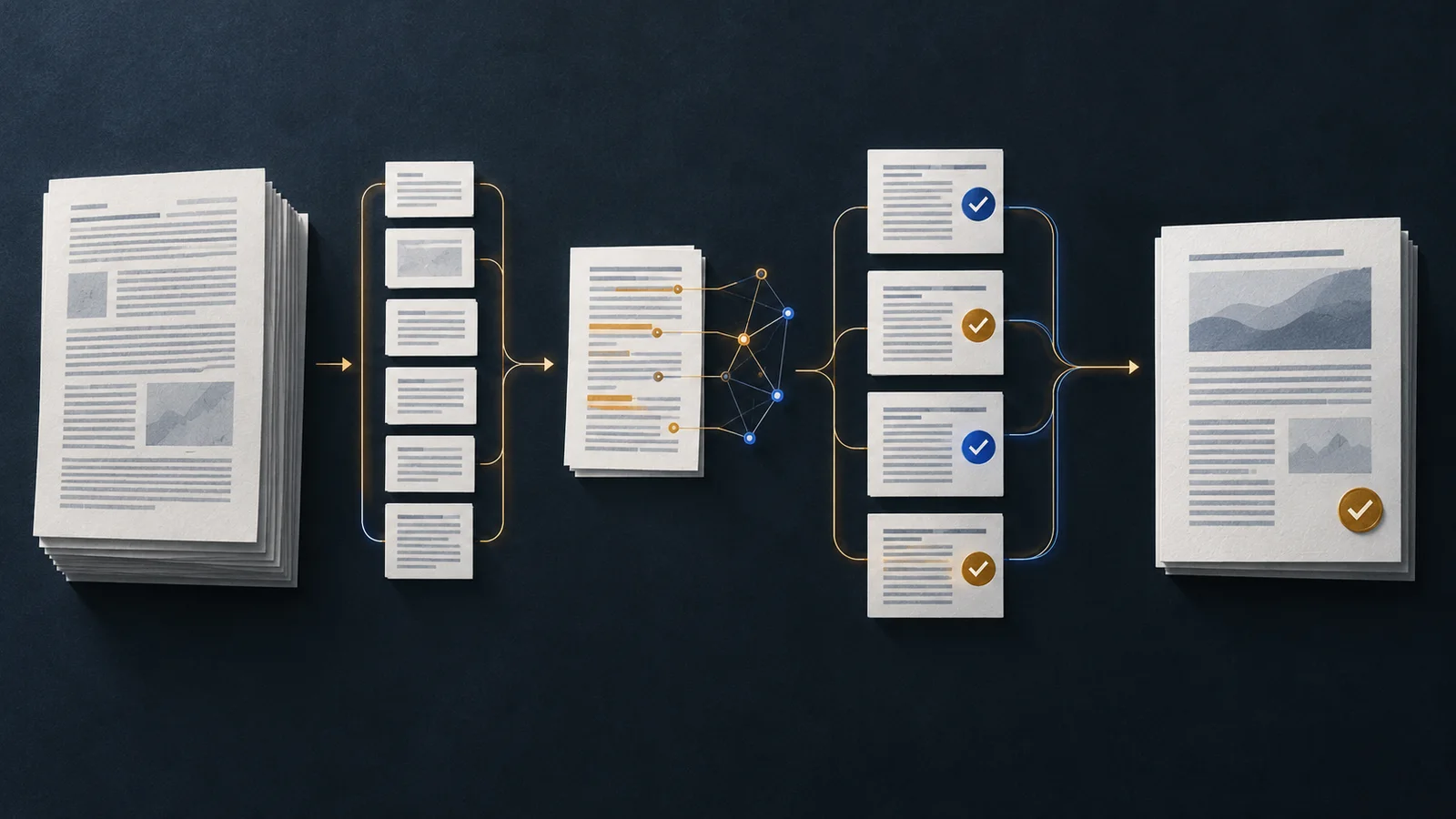
Google Research released Deep Review worldwide on October 14. Google describes Deep Review as an agentic system that divides technical documents into sections, reviews them in parallel and combines the findings into one report. Google says its final stage checks consistency across sections and uses external grounding or search to investigate possible hallucinations.
Google says each user gets two complimentary document reviews per week. It says users can connect a Gemini API key for higher limits and programmatic access through the Deep Review API, though the announcement does not disclose those limits or pricing. Google says the initial release accepts PDF and plain-text files. It says multi-file input is planned but not yet available.
Google describes a four-stage workflow. First, a segmenter divides the input into logical, potentially overlapping sections that collectively cover the document. The second stage assigns different compute budgets and inference paths based on each section’s density and complexity. Specialized agents then review the sections in parallel while retaining the full document as context. Finally, the synthesis stage merges their reports, checks cross-section consistency, may rerun logical checks and grounds suspected errors against external information.
Google says uploaded documents are not used to train, fine-tune or improve its models. It also says documents are stored for one year so users can view them in the Deep Review interface. Google Research has separately examined privacy and security risks for AI agents, but that work does not evaluate Deep Review.
The announcement is less clear about native Google Docs and presentation support. Its overview references those document types, while the format section limits initial inputs to PDF and plain text.
Google describes Deep Review as the successor to its experimental Paper Assistant Tool, which provided optional feedback before conference submission and operated outside formal peer review. Google says Paper Assistant pilots covered more than 16,000 opted-in manuscripts across STOC 2026, ICML 2026, NeurIPS 2026 and ICLR 2027. ICML documented its program and NeurIPS described a separate optional deployment, but the opened conference records do not independently establish Google’s aggregate count.
A Google-authored preprint about Paper Assistant reported 89.7% detection accuracy, compared with 55.2% for a zero-shot Gemini 3.1 Pro baseline, on a filtered subset of 26 math and computer-science papers containing 29 equation or proof errors. The result applies to the predecessor and a narrow evaluation, not the publicly released Deep Review system. The preprint also says its specialized automated grader was audited by one author and that its scores are not directly comparable with the original benchmark results.
The preprint records failure modes including hallucinated dates, outdated knowledge, PDF parsing problems and incorrect claims that valid proofs or arguments were flawed. ICML said 73.3% of 869 surveyed participants rated Paper Assistant’s feedback very or mostly helpful, but that self-reported measure was not an independent accuracy test. NeurIPS warned that the tool could flag correct statements or miss genuine flaws and placed responsibility for verifying its feedback on authors.
More news

Google rolls out Universal Cart across Search and Gemini in the US

Snowflake adds Gemini 4 Argon to Cortex AI in public preview
Google launches offline AI Edge Foresight note-taking app for Mac