Google DeepMind releases AlphaGenome 2 for cell-specific DNA analysis
Google DeepMind released AlphaGenome 2 for cell-specific DNA-effect predictions, but limits direct outputs to non-commercial research and bars their use in clinical decisions.
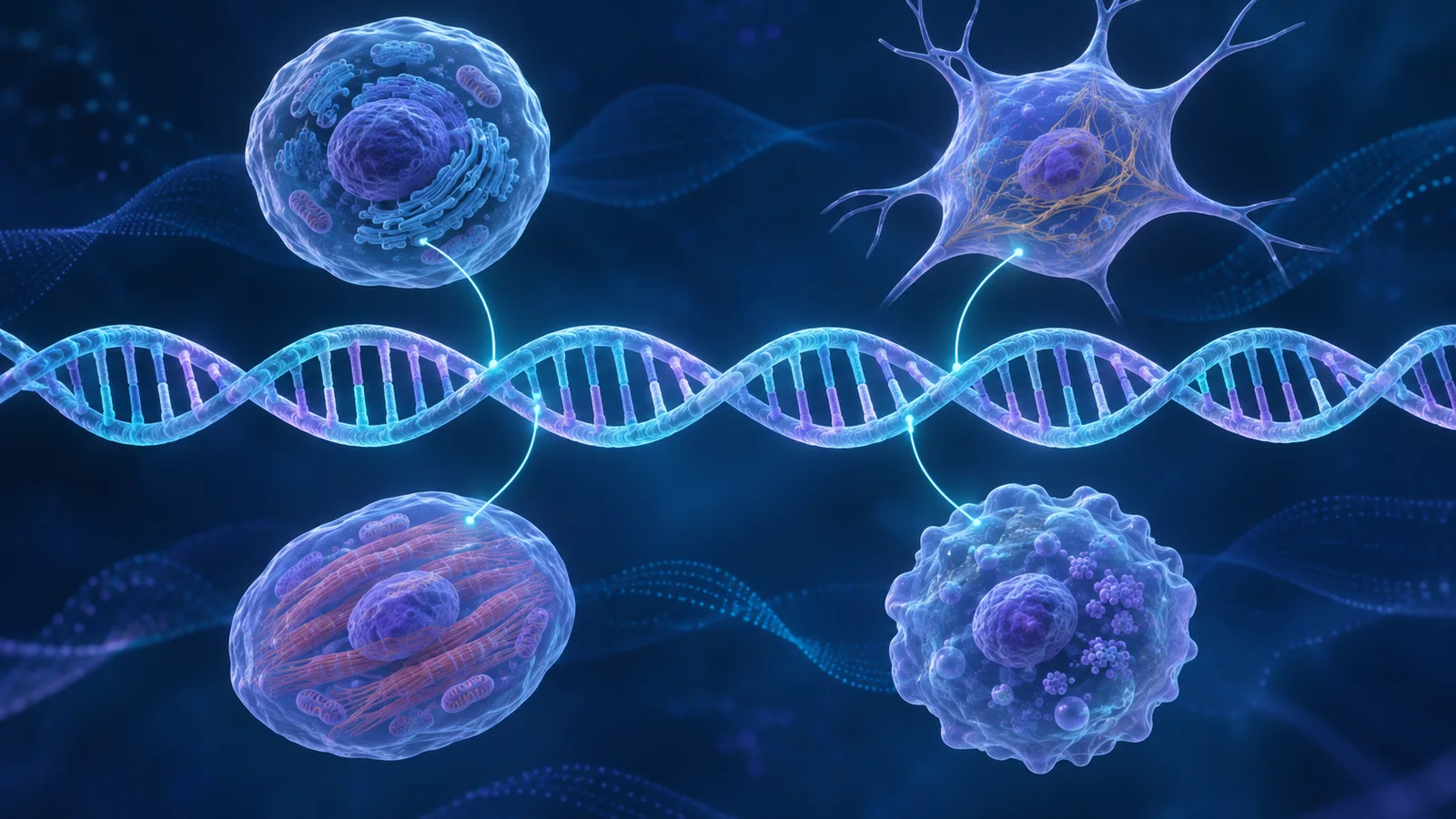
Google DeepMind released AlphaGenome 2, a DNA sequence model that predicts how genetic variants affect a specific human cell type or state. Rather than produce results across many biological conditions at once, it lets researchers compare how the same DNA sequence may behave in different cells.
The model is available through the AlphaGenome API for non-commercial research. Commercial research access remains in private preview. DeepMind says AlphaGenome 2 is for research only and has not been validated or approved for clinical or diagnostic use.
The original AlphaGenome generated fixed parallel outputs across bulk tissues and cell lines. AlphaGenome 2 instead processes one biological condition — a tissue, cell type or cell state — at a time, supplying that condition alongside the DNA sequence throughout the model.
Researchers can select a reference condition or condition the model on their own human single-cell RNA-sequencing data. Google’s documentation says the second approach encodes up to 256 cells to represent a cell state, without requiring fine-tuning on that dataset.
DeepMind says the model predicts gene expression, histone modifications, chromatin accessibility and DNA methylation. DNA methylation is an added output compared with the original AlphaGenome’s listed core outputs.
The company says it trained AlphaGenome 2 on human and mouse bulk and single-cell data, including more than 107 million individual cell profiles. The announcement also describes coverage across 68 tissues.
On the TenK10K dataset, DeepMind says AlphaGenome 2 identified 30% of causal variants, compared with 16% for the original AlphaGenome fine-tuned on single-cell data and other specialized tools. The company also reported identifying directional gene effects at 43%, compared with 23%. Those results were not independently reproduced in the opened evidence, and the linked AlphaGenome 2 paper was not independently checked for this article.
Google’s AlphaGenome documentation says direct API outputs and AlphaGenome Atlas scores are restricted to non-commercial research. The outputs may not be used to train machine-learning models or for clinical decision-making. For commercial and enterprise access, Google directs users to AlphaGenome on Google Cloud through Model Garden on the Gemini Enterprise Agent Platform or asks them to contact the company.
The documentation warns that predictions conditioned on user-supplied expression data may not capture variation when those data differ substantially from the training distribution. It also says predictions for other species, synthetic constructs, large structural variants and heavily N-padded sequences have not been benchmarked. Outputs labeled imputed_exploratory are also unbenchmarked and should be treated as hypotheses.
More news

Google DeepMind launches AlphaGenome Atlas for variant research

Google DeepMind rolls out Gemini Robotics 2.5 to partners

Google DeepMind introduces AlphaProof Code with machine-checked libsignal proofs