Mistral releases four Timestral forecasting models
Mistral released four probabilistic Timestral models for joint multivariate forecasting, with support for past and known-future covariates and CPU or GPU inference.
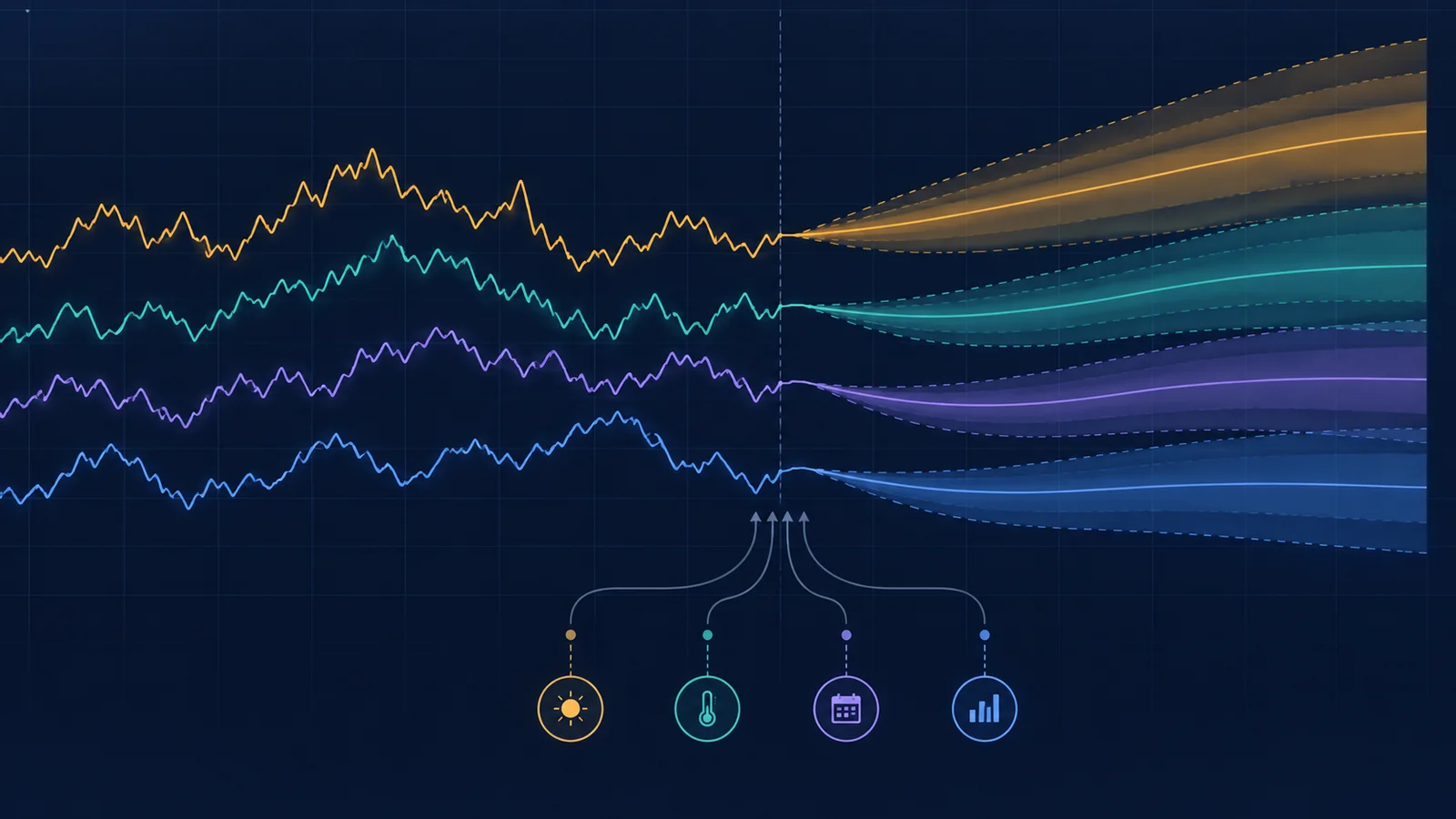
Mistral released Timestral, a family of four probabilistic time-series forecasting models ranging from 5 million to 209 million parameters. The models can forecast one variable or predict related variables jointly. They can also condition results on numeric or categorical covariates from past data or known future values.
Instead of producing a single point estimate, the implementation returns 21 forecast quantiles for each time step. According to the 209-million-parameter model card, the largest model accepts up to 32,768 historical steps and predicts as many as 1,024 steps in one forward pass. It generates longer horizons block by block.
Mistral also released weights for all four sizes on Hugging Face and published standalone inference code for PyTorch on CPUs or GPUs. The code uses the Apache 2.0 license, while the weights use Mistral’s Modified MIT terms. The specialized release follows Mistral’s Large 4 public preview, which introduced a multimodal mixture-of-experts model earlier this month.
Mistral says Timestral-209M ranked first at launch among pretrained, zero-shot models on GIFT-Eval, TIME and fev-bench, using one checkpoint without ensembling. The reviewed public leaderboard pages did not expose Timestral entries or submission records, so the ranking was not independently confirmed. Mistral also reports that an eight-thread server CPU generated a one-day forecast from three weeks of 15-minute observations in 10 milliseconds with Timestral-5M and 140 milliseconds with Timestral-209M. The company did not specify the processor or full test configuration.
Mistral says it trained Timestral in two stages. It began with synthetic data at an 8,192-step context length, then used a mix of real and synthetic data at four times that context. The company said a technical report with full results would follow; none was linked in the reviewed announcement or model card.
More news

Mistral launches Large 4 in public preview

Mistral releases Shieldstral, an open-weights moderation model, with Nvidia AI alliance
Mistral enters embodied AI with Robostral Navigate, an 8B single-camera robot model
 Dmytro Spodarets·Jul 8, 2026
Mistral releases Leanstral 1.5, a small model built for Lean 4 theorem proving
Dmytro Spodarets·Jun 30, 2026