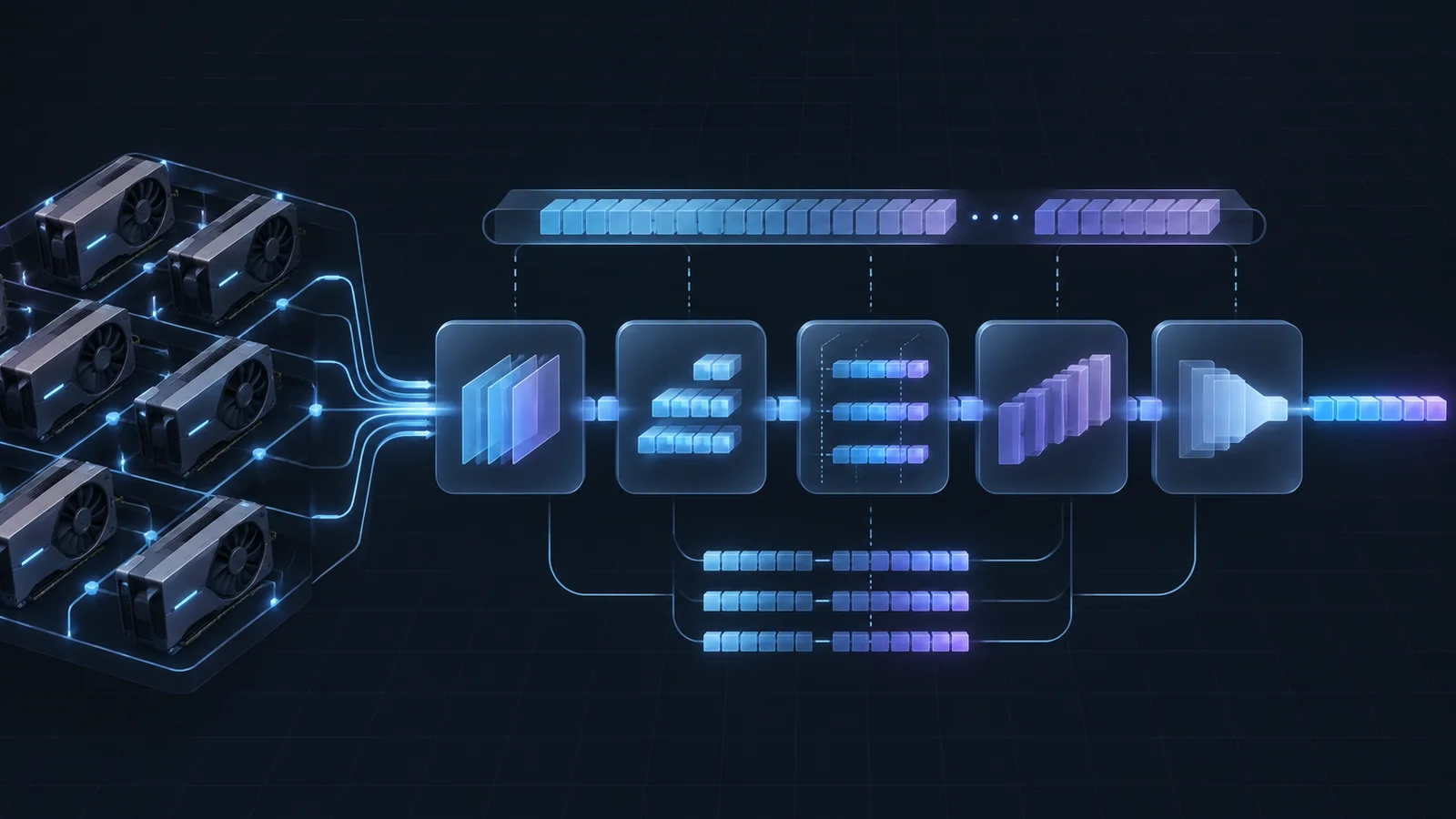
NVIDIA updates DAQIRI for real-time scientific instruments
NVIDIA released DAQIRI v2026.11.00 with packet reordering, direct polling and GPU-memory processing for high-rate scientific instruments.
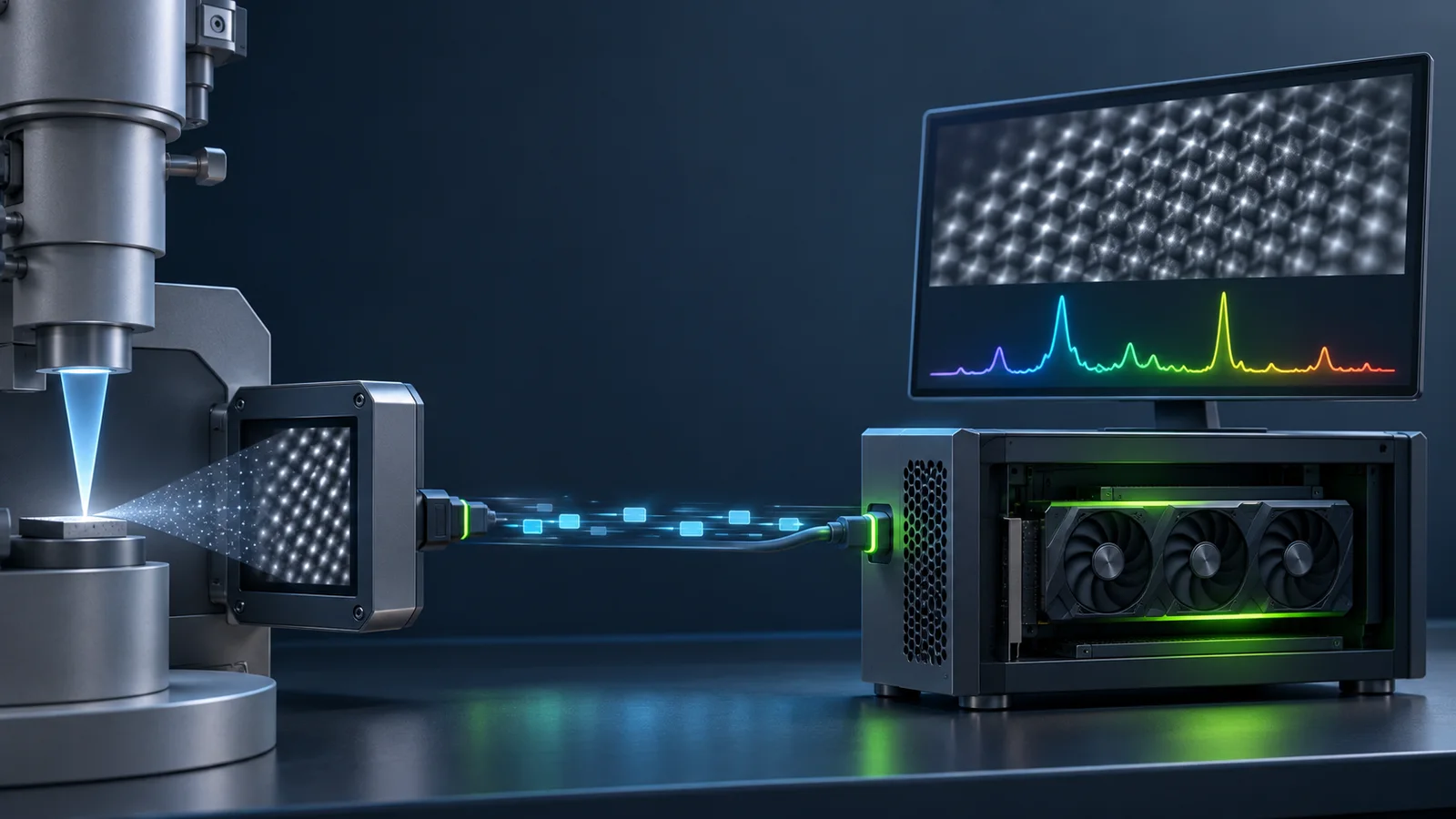
NVIDIA released DAQIRI v2026.11.00, updating its data-acquisition software to move scientific-instrument packets into GPU memory for processing as measurements are captured. The company also described an electron-microscopy workflow at Lawrence Berkeley National Laboratory’s Molecular Foundry, intended to let researchers inspect and adjust experiments before an acquisition run ends.
The release record lists optional hardware packet reordering, direct polling, hardware timestamps and scheduling, expanded RDMA operations, runtime resource management and flexible packet buffers. The release also makes ibverbs the default raw-Ethernet engine when that engine is included in a build.
In NVIDIA’s description of the LBNL workflow, FPGA readout electronics transmit detector packets over Ethernet. DAQIRI places them in GPU memory, where GPU processing assembles and corrects frames before reducing them to electron energy-loss spectra that can be inspected during acquisition.
NVIDIA said the high-dynamic-range camera produces more than 500 gigabits per second, more than 500 times the rate of conventional electron energy-loss spectroscopy streams. It also said computation recovers submicron spatial resolution from detector pixels measuring 5 micrometers across. The available evidence does not independently validate those figures or the comparison baseline. The disclosure also does not identify the camera model or link to an LBNL technical paper describing the measurements.
The optional reordering path uses a supported network adapter to place incoming data directly into ordered CPU or GPU buffers. NVIDIA says it handles repeating packet sequences on ConnectX-7 or newer adapters, while software reordering remains the default. With direct polling, an application thread submits and receives packets without handing them to a separate input-output worker; indirect polling remains the default.
NVIDIA claims ibverbs delivered about twice the per-core throughput of the previous DPDK default for packets up to 1,024 bytes at aggregate rates above 200 Gbps in company tests across DGX Spark, IGX Thor and RTX PRO server systems. A company-published IGX Thor benchmark used a single-host cabled loopback with one 200 GbE cable. NVIDIA reported 198.4 Gbps with 8,000-byte payloads and 194.6 Gbps with 1,024-byte payloads. It reported direct-polling median and 99th-percentile latency of 2.43 and 3.03 microseconds for 64-byte host-pinned packets, and 3.43 and 3.76 microseconds for 8,192-byte GPU packets. No third-party benchmark was available in the research evidence.
The getting-started documentation lists Linux kernel 5.15 or newer for all paths, ConnectX-6 Dx or later for raw Ethernet, RoCE and GPUDirect, and ConnectX-7 or later for hardware reordering. GPUDirect and GPU post-processing require an RTX or data-center NVIDIA GPU; GeForce GPUs are listed as unsupported.
More news
AWS adds distributed KV caching to ElastiCache for self-hosted LLMs
AWS turns on continuous SageMaker inference monitoring by default
NVIDIA and Microsoft expand AI stack across Azure, edge systems and Windows PCs