NVIDIA releases Kumo Relational for database predictions without task-specific training
NVIDIA's Kumo Relational uses labeled examples at inference time to predict outcomes across connected database tables. Its model weights and GPU-oriented code are now available.

NVIDIA released Kumo Relational, a pretrained model for classification and regression across connected database tables. In its base in-context mode, it makes predictions without a task-specific training run. The company also released model weights and inference software for GPU-backed systems.
The model weights are hosted on Hugging Face under the OpenMDW 1.1 license. NVIDIA’s structured-data-models repository and PyPI package provide Apache 2.0-licensed inference code. The package documentation describes a GPU-native library requiring Python 3.11 or newer and PyTorch 2.7 or newer.
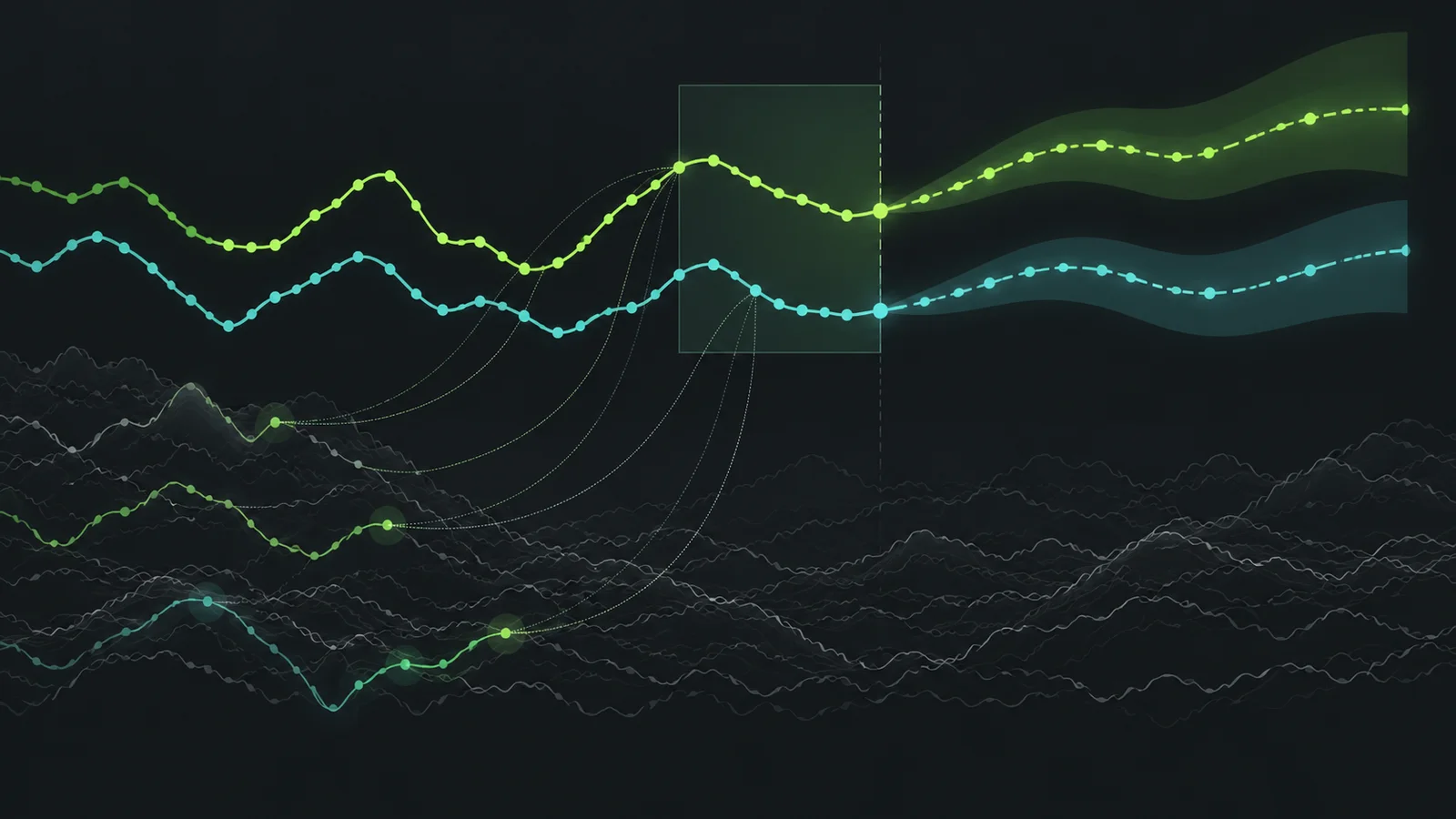
Kumo Relational is separate from Kumo Forecast, NVIDIA’s time-series model. Kumo Relational is based on KumoRFM-2 and works with linked database tables. Rather than flattening a database into one table, it represents records and their primary-key and foreign-key links as a temporal graph.
At inference time, Kumo Relational receives historical examples with known outcomes, each paired with the surrounding records available at that point. It uses those examples as context for a new prediction while keeping its pretrained parameters fixed. That avoids a separate training run for each prediction task, but does not eliminate the need for labeled examples.
The KumoRFM-2 paper says the evaluations drew context examples from training and validation splits, with a cap of 10,000 examples. The released model also supports optional task-specific fine-tuning.
The paper’s authors report experiments on 41 temporal prediction tasks across 15 databases from RelBench V1, RelBench V2, SAP SALT and 4DBInfer. They say KumoRFM-2 outperformed supervised and foundation-model baselines by up to 8%, including an approximately 8% advantage over AutoGluon ensembles on SAP SALT. The opened sources provide no independent replication of those results with the released weights.
That 10,000-example cap narrows the comparison. NVIDIA says task-specific supervised models may outperform the in-context model when very large training sets are available because those systems can use more labeled data than Kumo Relational accepted as context in the reported tests. In the paper’s SAP SALT experiment, the authors report that fine-tuning on the full training set increased average mean reciprocal rank from 0.83 to 0.89.
The release post says the model was pretrained entirely on synthetic relational data, while the paper describes a combination of synthetic and real-world pretraining data. The supplied sources do not reconcile the discrepancy.
More news
NVIDIA introduces Kumo Forecast with optional historical retrieval

NVIDIA releases Cosmos3-H-Dreams for real-time surgical simulation research

NVIDIA details 2.8-trillion-token Indic corpus and open pipeline