NVIDIA releases three synthetic datasets for Nemotron 3.5 Parse
The chart, table and multilingual datasets pair nearly 18.9 million page images with structured labels. NVIDIA also shared a fine-tuning recipe for Nemotron 3.5 Parse.
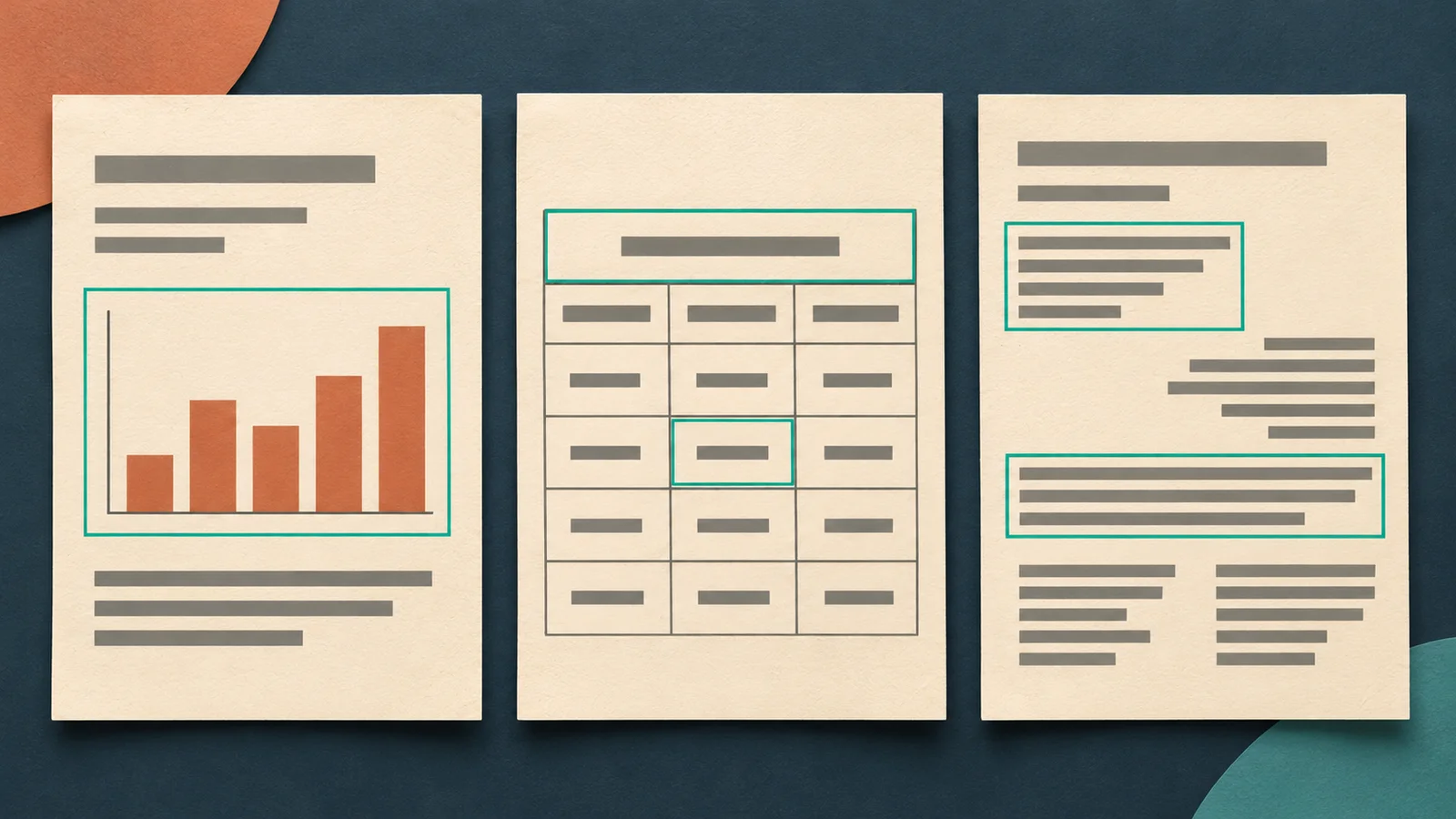
NVIDIA released three synthetic datasets on Hugging Face that it says it used to train Nemotron 3.5 Parse, a model that extracts structured content from page images in reading order.
The dataset cards list 18,887,809 image-and-annotation pairs in total. Developers can stream individual WebDataset tar archives and use the published manifests to check record counts and file checksums. The JSON annotations give each page block’s position in pixels, content type and text or structured output.
Synthetic Charts V1 contains 9,980,000 pairs covering bar, line, scatter, area, pie, matrix and compound charts. Its chart annotations represent chart series and values in Markdown tables and can also describe titles, axes and legends.
Synthetic Tables V1 contains 1 million pairs with varied headers, merged cells and surrounding page text. Its table annotation format supports both HTML and LaTeX-style representations of the same table.
OCR Synthetic Multilingual v2 contains 7,907,809 pairs across 149 language and script entries spanning 28 scripts. Its labels give text, content types and bounding boxes for blocks such as headings, paragraphs, lists and captions. NVIDIA’s release gives no adaptation scores broken down by language or script.
NVIDIA also published a fine-tuning recipe that trains the parser on page images with verified outputs, then uses task-specific checks to reward correct extractions. In its synthetic dental-form test, NVIDIA estimated first-attempt success at 0% for the base model, 95.85% after supervised fine-tuning and 96.58% after reinforcement learning. The test sampled eight answers per form on 256 held-out forms from the same generator and required answers to finish naturally, match exact tooth, procedure and surface entries, and contain no character errors in the normalized visible text.
NVIDIA describes DFlash2 as an optional draft model that proposes up to 32 tokens, or pieces of text, for the parser to check together. In NVIDIA’s benchmark, the company reported processing 7.62 times as many pages per second with one request at a time and 1.52 times as many with 512 concurrent requests, compared with the same parser with speculative decoding disabled. The single-pass test ran 2,078 ParseBench pages on one H200 GPU at BF16 precision and excluded startup and HTTP overhead. NVIDIA’s post credits independent validation work without publishing a separate set of third-party results for that comparison.
All three dataset cards say the files can be read without signing in. They list CC BY 4.0 and say the terms for upstream text and assets still apply.
More news

OpenAI opens Astra for Law requests across ChatGPT Enterprise
Knowledgator reports an 86.0 GLUE development average for EdgeCoder-31M
Lean and Mathlib teams report verifying Claude-assisted Riemann hypothesis proof