NVIDIA says it contributed Vera Rubin rack designs to OCP
NVIDIA says it contributed Vera Rubin rack and compute-tray designs through open MGX, but interoperability and deployment gains have not been independently established.
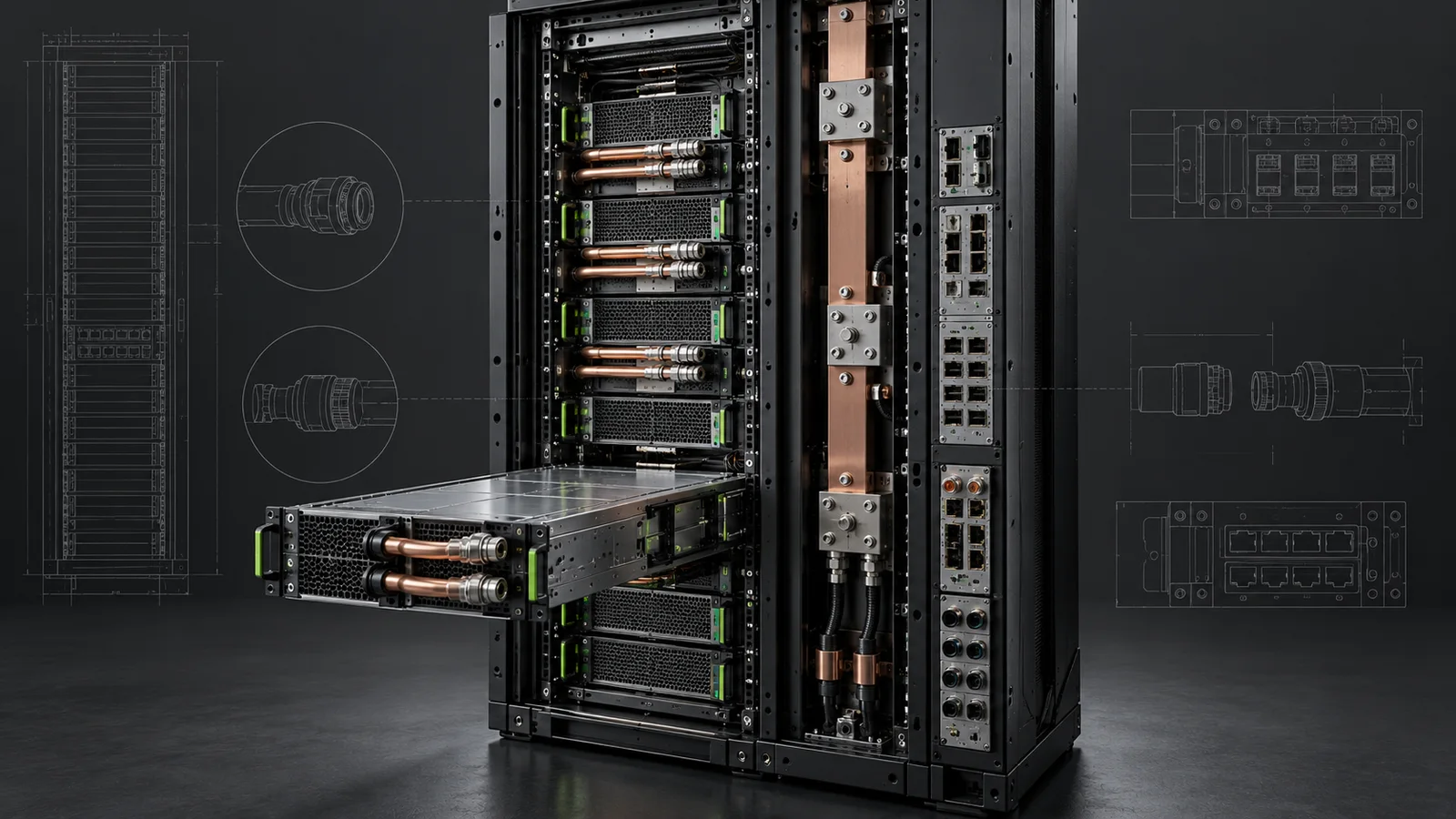
NVIDIA said it contributed Vera Rubin rack and compute-tray designs to the Open Compute Project through its MGX architecture. NVIDIA says the October 12 disclosure gives equipment makers a common set of rack, power, cooling and interconnect interfaces to design around. The reviewed evidence, however, does not independently establish multi-vendor interoperability.
The contribution centers on MGX 1.2. NVIDIA says the architecture adds rack-scale blind-mate liquid cooling and interoperable rack-scale interconnect infrastructure. The design also includes a liquid-cooled 5,000-amp busbar, native support for 19-inch equipment, configurable I/O bays, fanless liquid-cooled compute trays and standardized power and cooling interfaces. According to NVIDIA, it can support rack deployments of up to 250 kilowatts.
NVIDIA says those interfaces are intended to let suppliers design components around shared mechanical, electrical, cooling and connection points. NVIDIA’s broader MGX platform supports both Arm and x86 servers, according to the company. The reviewed records do not include independent tests showing components from different vendors working together under MGX 1.2.
This infrastructure disclosure concerns underlying rack design, a different topic from CoreWeave’s Vera Rubin NVL72 cloud rollout.
NVIDIA also says MGX 1.2 will improve assembly, testing, manufacturing, field service, deployment speed and infrastructure efficiency. The reviewed evidence provides no independent measurements for those outcomes. Nor does it show how many equipment makers, manufacturers or data-center operators are using the new Vera Rubin designs.
Separately, NVIDIA is participating in broader OCP infrastructure work. OCP’s Open Data Center specification, revision 0.7.0, lists AMD, Google, Meta and NVIDIA as authors and contributors. The August 27 specification covers structural, power and cooling design principles for next-generation AI and machine-learning infrastructure on a 2027-2028 planning horizon.
A separate OCP grid-disturbance performance specification lists contributors from Google, Microsoft, Meta and NVIDIA. It sets coordination requirements for hyperscale facilities and utilities during grid disturbances. For specified voltage events, the computational-load component must return to 90% of its pre-fault load within two seconds after voltage returns to the defined normal range.
Those OCP records confirm NVIDIA’s participation in the broader standards work, but they do not identify the exact Vera Rubin files contributed through MGX 1.2. The records also do not establish the files’ repository location, contribution license, revision status or formal OCP acceptance. That leaves the 5,000-amp busbar and 250-kilowatt ceiling as NVIDIA disclosures rather than independently confirmed OCP specifications.
More news

NVIDIA Vera Rubin NVL72 debuts in MLPerf Inference v6.1 as a Preview system

NVIDIA Says Vera CPU Systems Are Shipping, With First Server Delivered to AWS

SpaceX Reportedly Seeks $40 Billion in Debt to Buy Nvidia Chips