AI-designed cysteine proteases cleave peptide targets
Researchers used AI-assisted protein tools to build cysteine proteases that cleaved selected peptide targets in laboratory tests and mammalian cells, though the enzymes remained less active than leading natural proteases.
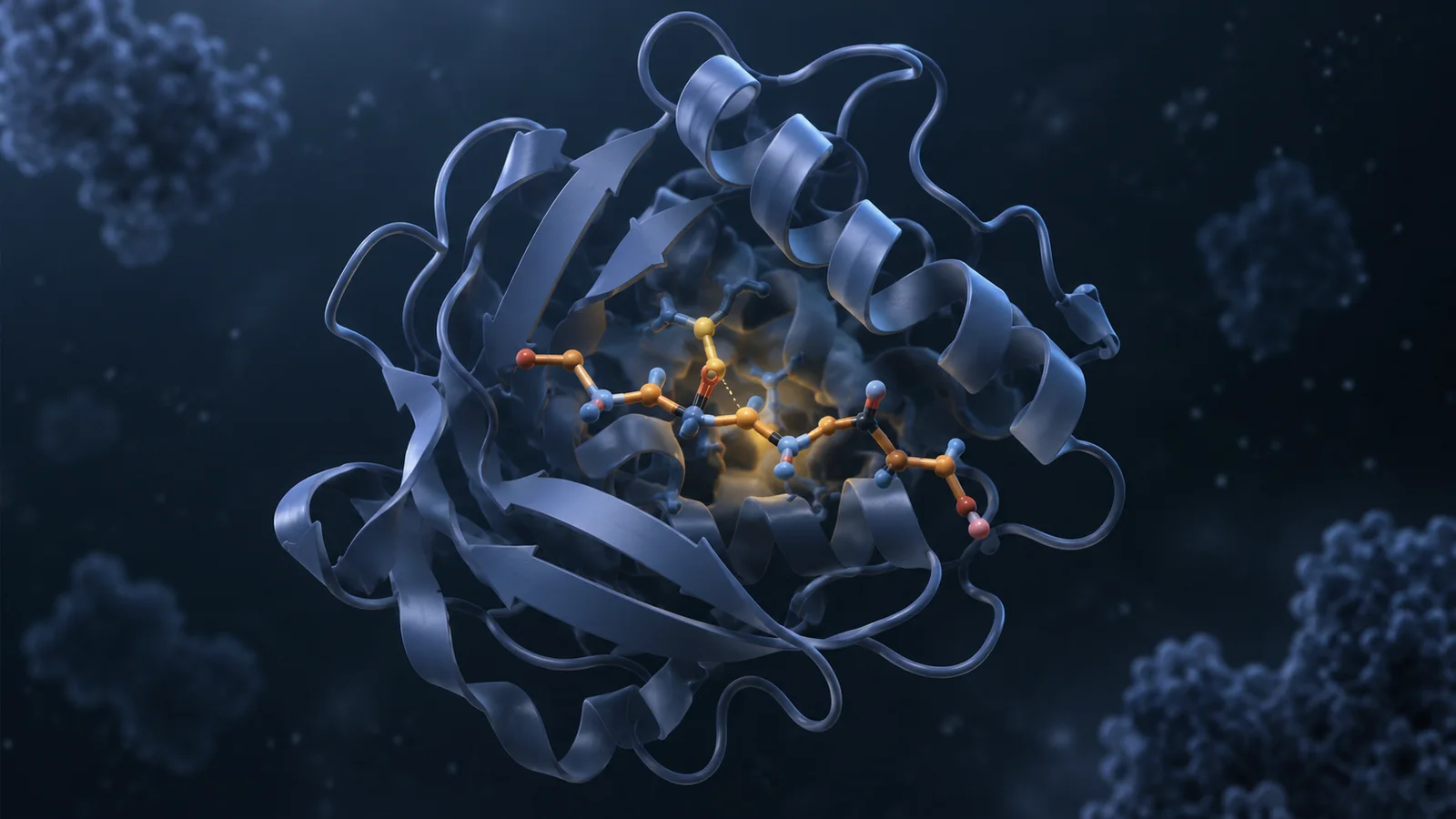
Researchers used AI-assisted protein design tools to build cysteine proteases from scratch that cleaved selected peptide targets in laboratory tests and mammalian cells, according to a peer-reviewed paper.
The work connects computational protein generation to measured catalytic function. Of 69 designs tested, 13 showed cleavage activity, a 19% hit rate. The best initial designs accelerated peptide-bond hydrolysis by as much as 3 × 10^7, or 30 million times, over the uncatalyzed reaction.
The workflow generated protein backbones around a required catalytic site and target peptide. Researchers used RFdiffusion2-MI to generate the backbones, ProteinMPNN with Rosetta constraints to design sequences, and AlphaFold3 predictions to filter candidates for structural and enzyme–substrate agreement. The released design-pipeline repository describes a cysteine–histidine–aspartate catalytic triad and an oxyanion hole that stabilizes the reaction intermediate.
In the designed active site, cysteine acts as a nucleophile. Once activated by the surrounding catalytic residues, it attacks the peptide bond at a selected sequence. Catalysis is a more demanding test than generating a protein that folds into a stable shape: the active-site residues and substrate must be positioned precisely enough to drive an otherwise exceptionally slow reaction.
Structural measurements supported the computational models. Six crystal structures were within 1.2 ångströms Cα root-mean-square deviation of their design models. The designed folds also had TM scores below 0.50 relative to natural proteases, evidence that the researchers did not simply reproduce known natural protease structures. One structure is publicly listed in the RCSB Protein Data Bank as 9YNL.
The designed proteases also cleaved their intended reporter targets in mammalian cells. That experiment used a designed substrate-relocalization reporter in HeLa cells; it did not demonstrate a therapeutic effect or cleavage of an endogenous disease protein.
The enzymes remained less active than the strongest natural cysteine proteases. The authors attributed the gap to imperfect active-site preorganization and substrate positioning.
More news

Black Forest Labs releases FLUX 3 Image Klein weights

Apple study finds tool-discovery gains shift with task complexity

Apple researchers swap free-form agent reasoning for candidate selection