Victoria plans residential-zone ban for new data centres, sets renewable supply rules
Victoria’s plan would bar new data centres from residential zones and make projects fund renewable power, grid connections, water infrastructure and local benefits. The government says applications already under assessment will not face the rules retrospectively.
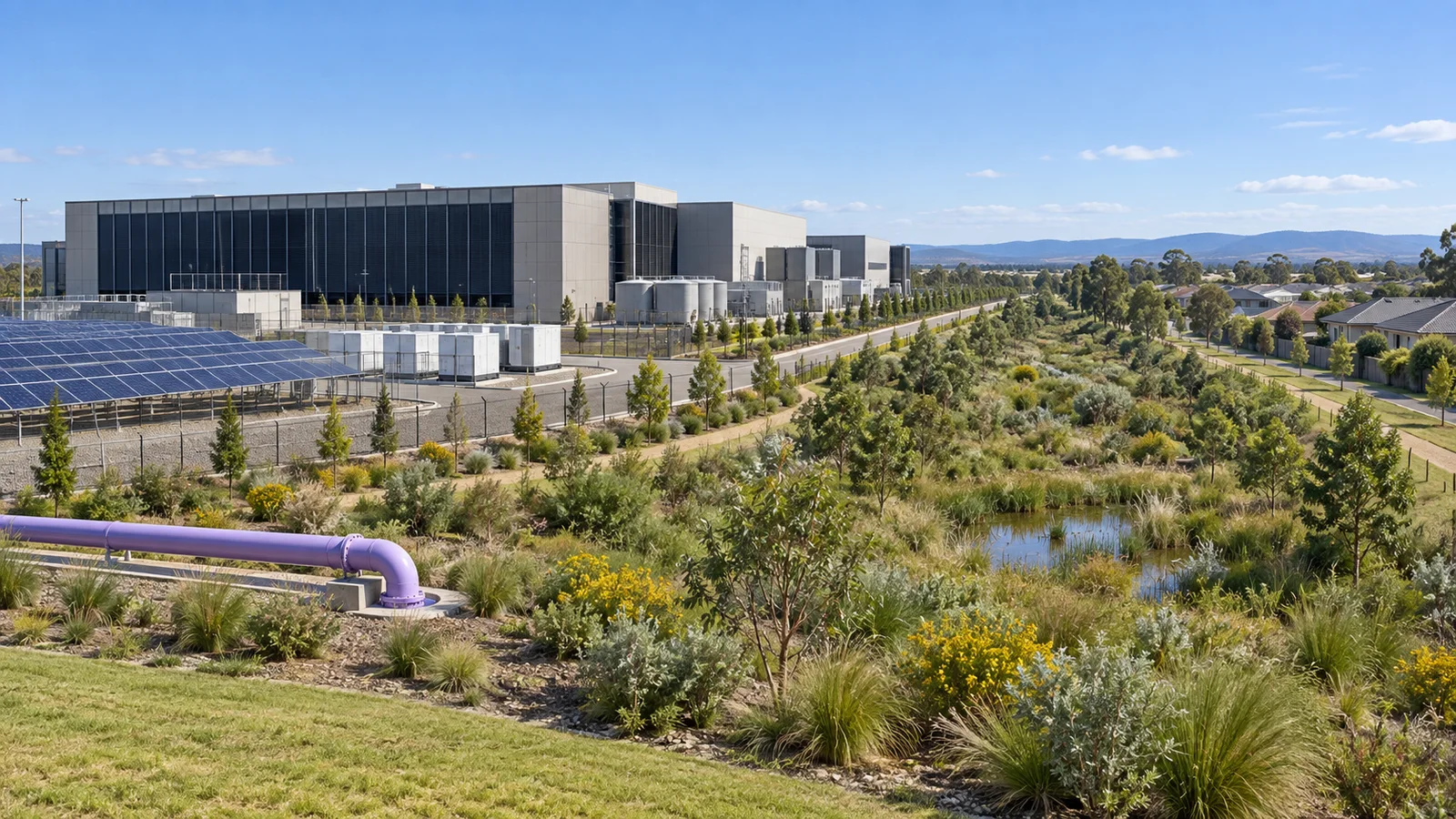
Victoria’s government on Tuesday released a plan for new data centres that would prohibit them in residential zones and require operators to bring new renewable generation and storage to match their electricity demand.
The package would also make new projects pay electricity connection and network-upgrade costs, set conditions on cooling water and commit the government to developing a Local Investment Guarantee for host communities. The government said the rules will not apply retrospectively to applications already under assessment.
The Sustainable Data Centre Action Plan sets a 150-metre buffer between a proposed data-centre building and a residential building. It would also prohibit centres in rural zones unless they are close to and can be served by critical infrastructure such as major transmission lines, substations, renewable generation, batteries or recycled-water infrastructure.
Victoria plans to enforce the measures through a new data-centre category in its planning process, alongside new energy and water referral and notification controls. The plan says these measures build on existing planning, environmental, water and energy frameworks.
For electricity, operators are expected to offset actual operational use by investing in new renewable generation and storage, matching additional demand with additional supply. Projects would have to cover their connection costs and any network augmentation caused by the development, including necessary upstream upgrades. The plan says detailed compliance, verification and firming requirements still need to be finalised alongside Commonwealth standards.
Facilities using water-intensive cooling are expected to use recycled water or another non-drinking source. Where that supply is not available, a project would need an agreement with its water corporation to transition when it becomes available, offset interim drinking-water use through funding or efficiency programs, and reduce that use during restrictions.
The plan sets design water-usage-effectiveness targets of no more than 1.0 for potable water or 1.6 for non-potable water unless a water corporation agrees otherwise. It also calls for public reporting and requires proponents to pay the full cost of water infrastructure needed for their connection.
The government says data centres currently account for less than 1% of potable water drawn from the Melbourne and Geelong networks. Greater Western Water is assessing 19 applications seeking a combined 19,714 megalitres a year, equivalent to about 4% of Melbourne’s supply, according to the plan. It cautions that applications are not approvals and that not every project will proceed.
The Local Investment Guarantee is to be developed with councils, industry and communities. The plan lists local jobs, training, First Nations engagement, local procurement, trees, parks and community facilities among the possible benefits, but does not yet set a contribution formula, minimum amount or enforcement mechanism.
Developers would also have to engage local communities, First Peoples and host councils before and during approval. Immediate neighbours would be notified, application documents posted online and signage displayed at the site. Work in public road corridors would require road-reserve access consent followed by a site-specific traffic-management plan prepared through an accredited traffic-management company.
Victoria says it had more than 50 operating data centres by mid-2026 and that the sector delivered A$5.8 billion in capital expenditure in the previous year. Those are government figures. The plan does not give a commencement date for each new control, and detailed state siting, design and built-form guidance is due to be developed in 2027.
More news

Court lets US intervene, rejects bid to dismiss SpaceXAI pollution suit

OpenAI outlines Patch the Planet role in response to two critical PHP flaws

NVIDIA launches OpenShell architecture for governed AI agents