Vivix develops AI digital twin for float-glass furnace operations
Vivix is developing a float-glass furnace digital twin that combines plant data, Siemens simulations and NVIDIA physics AI on Snowflake and AWS.
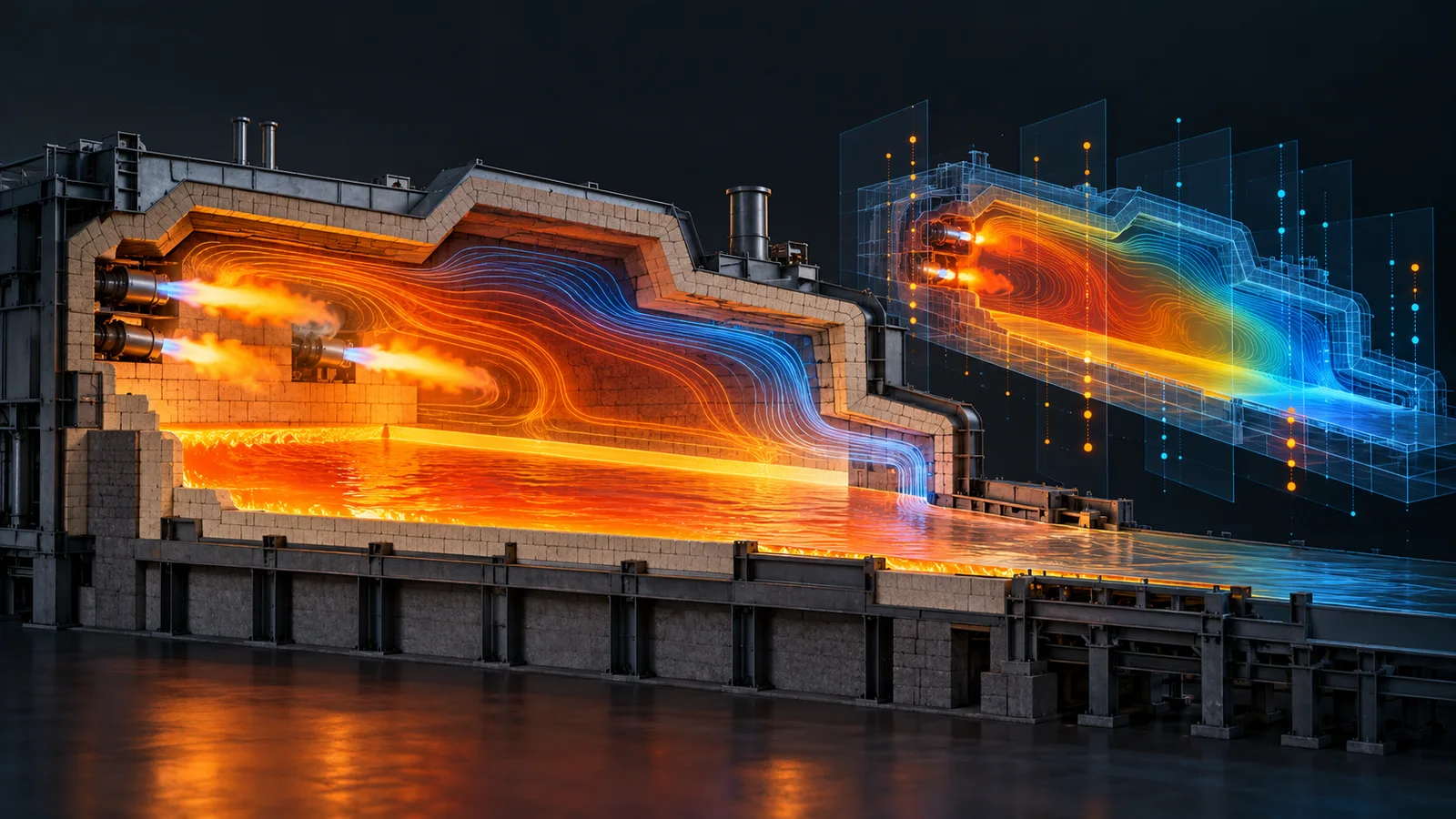
Vivix is developing an executable digital twin for its float-glass furnace with Siemens, Snowflake and NVIDIA. The hybrid architecture brings together plant data, physics simulations and AI models on AWS. It is intended to give operators visibility into conditions that are difficult to measure inside a furnace running at roughly 1,550°C to 1,600°C, but the project participants have not disclosed measured operating results.
The initial scope covers refractory health, combustion efficiency and glass-melting quality. Snowflake said the twin is designed to reconstruct volumetric heat distribution, gas-velocity fields and thermal fluxes across refractory walls, serving as a virtual sensor where direct instrumentation is limited.
High-fidelity multiphysics simulations from Siemens Simcenter form the first layer. They cover processes including fluid dynamics, heat transfer and combustion. Simcenter reduced-order modeling then converts the simulations into smaller executables that can run inside Snowflake. A reduced-order model approximates a complex simulation with less computation, making it more practical to compare predictions with live plant data.
Vivix combines those model outputs with physical sensor readings and other information-technology and operational-technology data in Snowflake. An earlier Vivix case study from HighByte describes Vivix’s data infrastructure: plant telemetry and database data are contextualized at the edge, published into AWS and integrated with Snowflake and other cloud services.
For the AI layer, Snowflake said the project uses NVIDIA PhysicsNeMo to build surrogate models from physics, simulation and observed data. PhysicsNeMo is NVIDIA’s open-source framework for developing physics-AI models and digital twins. Snowflake said results are reviewed through technologies built with NVIDIA Omniverse libraries.
Snowflake said an AI multiagent interface will let operators query the twin in natural language, test what-if operating scenarios and request root-cause diagnostics without first applying a change to the physical furnace. The disclosed material does not say whether the system can change furnace controls directly or whether every recommendation requires operator approval.
The project participants say the system can estimate localized refractory wear, flag emerging hotspots hours in advance, evaluate burner settings and heat distribution, and model glass-bath flow and thermal gradients. They say those capabilities could extend furnace life, reduce natural-gas use and emissions, and produce more homogeneous glass with fewer defects. Those outcomes are stated aims, not disclosed production measurements.
Based on an undescribed pilot, Snowflake said Vivix expects the system to reduce furnace energy consumption by 3% to 5%, extend furnace life by one year and cut the data-collection and analytics cycle by 80%. The post did not provide baseline values, a measurement period, sample size, uncertainty range or validation method for those expectations.
The participants have not disclosed a commissioning date, the number of furnaces covered, model error rates, inference latency or the safety controls governing operational recommendations.
More news
German ministries, NVIDIA sign industrial AI declaration
CoreWeave Says Caterpillar Is Deploying Vera Rubin for Physical AI Training

NVIDIA expands Hyperion in European mobility and robotaxi programs