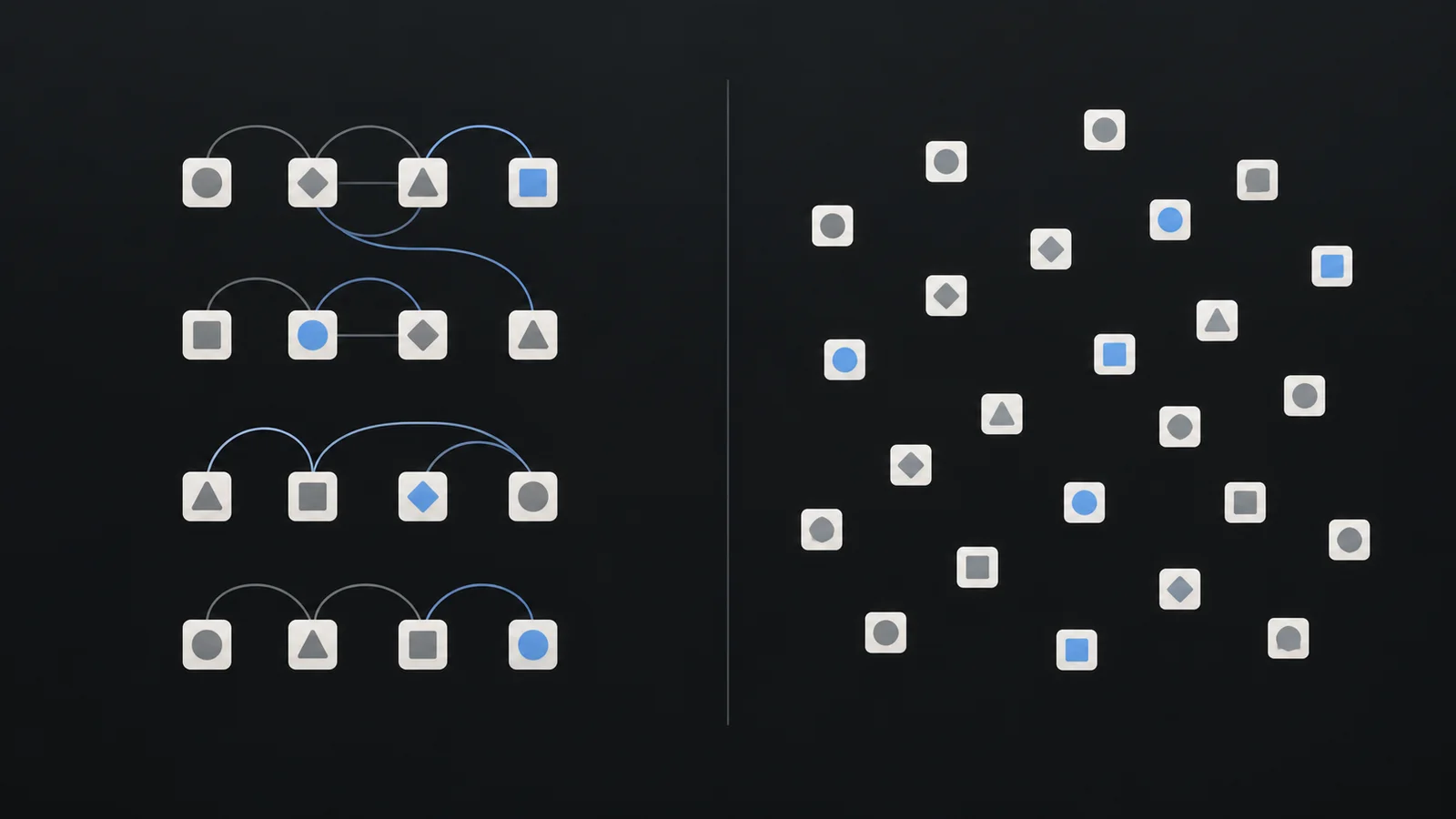
Apple researchers introduce SimpleDesign for joint protein sequence and structure generation
According to its paper, Apple's SimpleDesign jointly generates protein sequences and 3D structures through direct multimodal training, without a separately trained structure tokenizer.
Apple researchers published SimpleDesign, a generative model that learns protein sequences and three-dimensional structures together through a single end-to-end objective. The authors say it trains directly on amino-acid data and continuous atomic coordinates, removing a separate structure-tokenizer training stage from the research pipeline.
The approach simplifies the multi-stage setup used by some multimodal protein-language models, but it does not show that SimpleDesign can produce functional proteins. The researchers evaluated the model using computational sequence and structural measures, without laboratory tests of folding, stability, biological activity or safety.
The SimpleDesign paper describes an objective that combines two tasks. Cross-entropy is used to recover masked amino acids, while mean-squared error trains a continuous velocity field to move noisy coordinates toward a protein structure. Because sequence and structure are corrupted independently, the model can learn either modality from the other and generate them jointly.
SimpleDesign represents protein structures directly as the Cartesian positions of their alpha-carbon atoms. Rather than using a learned vocabulary of structure tokens, it turns those coordinates into model inputs with Fourier features, a linear projection and layer normalization. Its default Mixture-of-Transformer backbone uses separate projections and feed-forward layers for sequence and structure, with joint attention across both. The authors also report that a conventional Transformer with shared parameters was competitive in their ablation tests, identifying the direct multimodal objective—not the specialized backbone—as the main contribution.
The researchers report training for 300,000 steps on 1,807,333 filtered AFESM structures, followed by 50,000 steps on 442,511 filtered SwissProt samples. The two-part schedule covers 2,249,844 sequence-structure pairs. Here, “single-stage” refers to the shared optimization objective and the absence of a separately trained tokenizer, not to the use of a single dataset or training phase.
On an unconditional co-generation benchmark, the paper reports co-designability rates of 0.53 under an scRMSD threshold and 0.74 under an scTM threshold for SimpleDesign with a gamma setting of 0.3. DPLM2 scored 0.30 and 0.46, respectively, while MultiFlow scored higher at 0.76 and 0.80. The results are author-reported computational findings and have not been independently reproduced. The test generated 100 samples at each of five protein lengths ranging from 100 to 500 residues.
The paper measures co-designability by predicting a fold from a generated sequence and comparing it with the model’s generated structure. A sample passes when the self-consistency root-mean-square deviation is no more than 2 angstroms or the self-consistency template-modeling score is at least 0.9. The authors say SwissProt fine-tuning generally improved sequence-structure consistency while reducing FoldSeek diversity, framing the result as a trade-off rather than a universal advantage over specialized geometric systems.
Unlike Apple’s recently announced Mac mini systems for local AI workloads, SimpleDesign is presented as research rather than a released product. The researchers point to drug discovery, enzyme engineering, therapeutic antibody design and de novo protein therapeutics as possible areas of relevance. The paper does not document a production deployment, released model weights or code, a therapeutic candidate, or experimental validation showing that SimpleDesign outputs fold into functional proteins.
More news

Liquid AI releases d1 models for single-pass edge decisions

Google releases EmbeddingGemma 2 for on-device multimodal search

Mistral launches Large 4 in public preview