AWS Publishes Bedrock AgentCore Blueprint for WhatsApp Ordering
AWS released a reference architecture and sample code for a WhatsApp ordering assistant that handles text chats, voice notes and live calls through a shared customer record.
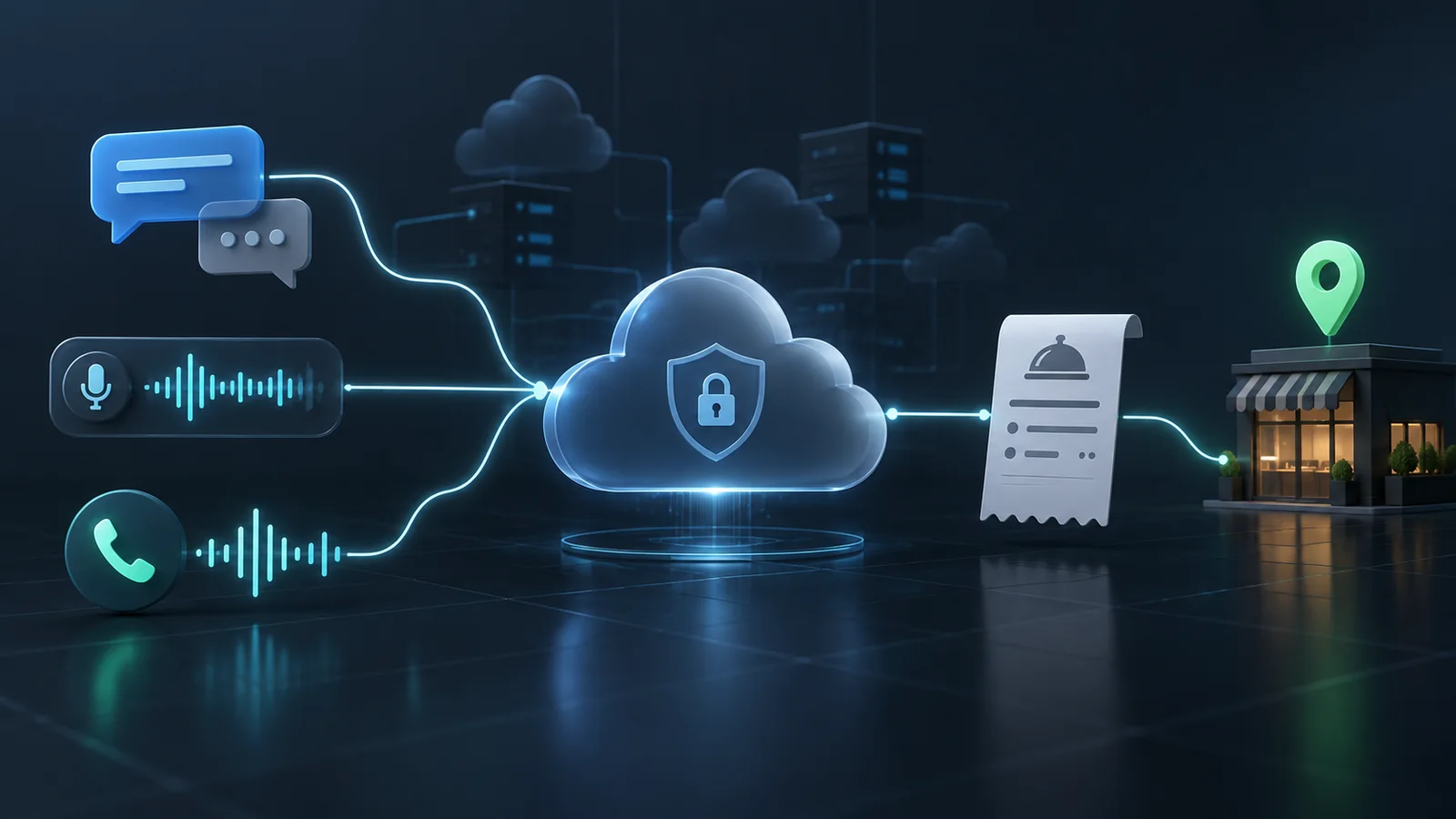
AWS has published a reference deployment for a restaurant ordering assistant that handles WhatsApp text chats, asynchronous voice notes and real-time voice calls through one business number. The design runs three channel-specific containers on Amazon Bedrock AgentCore Runtime while sharing an ordering backend and cross-channel memory.
The accompanying AWS Samples repository provides code and AWS CDK infrastructure for the pattern. The materials describe a reference implementation, not a named restaurant deployment, and report no customer traffic, order accuracy, latency, uptime or conversion results.
Each channel has a separate AgentCore Runtime container. Text conversations use Amazon Nova 2 Lite through the Bedrock Converse API. Voice notes and live calls use Amazon Nova 2 Sonic, which AWS describes as a real-time speech-to-speech model with tool-use support. The voice-note path downloads OGG Opus audio, converts it to 16 kHz PCM, runs a bounded Sonic session without a separate transcription service and returns an OGG Opus voice message.
Incoming webhook events first pass through Amazon API Gateway. An ingest Lambda function verifies the Meta signature, places the event on Amazon SQS and returns an HTTP 200 response before a worker handles slower steps such as media retrieval and agent invocation.
For live calls, the sample uses WhatsApp Calling API signaling and WebRTC. Its call runtime operates inside a virtual private cloud and obtains TURN credentials from Amazon Kinesis Video Streams to relay DTLS/SRTP media while Nova 2 Sonic handles the conversation.
The three runtimes reach restaurant functions through AgentCore Gateway. It exposes menu lookup, cart updates, order placement and location search as Model Context Protocol tools backed by an IAM-authorized REST API, Lambda business logic, DynamoDB tables and Amazon Location Service. MCP gives the agents a common interface for those backend operations. DataPhoenix has separately covered a Cohere study of public MCP tools, which provides ecosystem context but does not evaluate this AWS implementation.
Cross-channel continuity comes from a pseudonymous customer key shared by all three runtimes and AgentCore Memory. The sample generates the key by adding the prefix wa- to the first 16 hexadecimal characters of a SHA-256 hash created from the customer’s E.164 phone number and a secret pepper. AWS says the raw phone number is not stored in memory or session state. AWS also describes the mechanism as customer recognition rather than identity verification and says deployments that require verification can add a step such as a one-time passcode.
AWS CDK provisions the AWS-side stack, including API Gateway, Lambda, SQS, DynamoDB, Amazon Location Service, AgentCore Runtime, Gateway and Memory, container build services, observability, encryption and the VPC path used for calls. A Meta application and WhatsApp account remain prerequisites.
The repository lists English-only operation and deployment in a single AWS Region among the sample’s limitations. It also leaves Meta business verification, App Review, production phone-number registration and display-name review outside the guidance. AWS recommends that production implementers consider adding Bedrock Guardrails.
More news

AWS adds xAI’s Grok 4.7 to Amazon Bedrock
Google Cloud introduces a universal Gemini agent for enterprise work
Microsoft opens Surface AI hardware preorders and releases agent containers