California signs seven data-center bills on power, water and land use
California's new data-center laws add utility cost protections, energy and water reporting, infrastructure-payment rules and tighter conditions for environmental review.
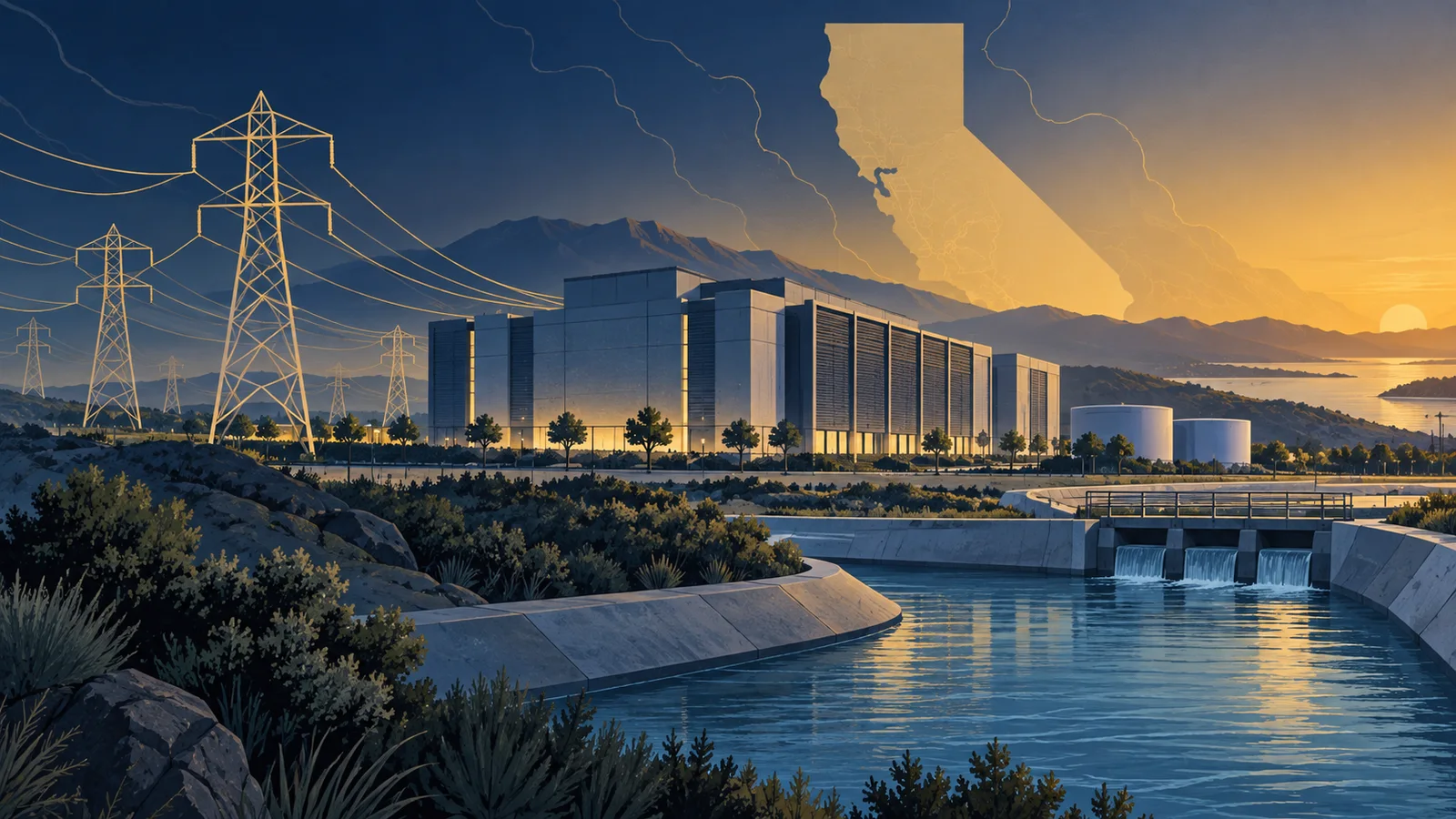
California Gov. Gavin Newsom signed seven bills on September 21 that set new electricity, water and land-use requirements for data centers. The measures include protections intended to keep the cost of serving large new loads from shifting to other utility customers.
The seven-bill package changes what developers must disclose before projects are approved, how they can be charged for generation and grid upgrades, and what they must do to qualify for faster environmental litigation. It does not immediately cut household electricity bills across the board. Several provisions require the California Public Utilities Commission and utilities to design tariffs and cost-allocation methods.
Electricity costs and reporting
AB 2383 directs investor-owned utilities to file transmission-and-distribution and generation tariffs for participating data centers. Community choice aggregators and electric service providers must adopt generation tariffs by January 1, 2028. The applicable generation-demand threshold cannot exceed 25 megawatts.
The generation payment mechanism must last at least 10 years. It can include fees when a proposed center does not complete interconnection, early-termination charges, upfront collateral or prepayment, and minimum payments tied to projected load. Those terms are intended to cover incremental generation costs if a facility uses less power than forecast or exits early.
SB 886 separately requires the Public Utilities Commission to establish or update rules for data-center interconnection and retail electric service by January 1, 2028. For transmission-level connections, data centers must be assigned the cost of applicable transmission upgrades and usage under a methodology the commission will determine. A center that leaves within 10 years or fails to ramp up as expected faces an early-termination charge. Utilities must also publish maps showing where projects could connect without significant, costly and time-consuming transmission upgrades. The transmission-level tariff applies to data centers entering new interconnection agreements on or after January 1, 2027.
SB 1168 is less prescriptive. It directs the commission to assess rate structures that could make data centers bear reasonable transmission, distribution, load-growth and power-procurement costs while reducing pressure on residential customers. The law does not impose a particular surcharge or rate on its own.
Developers also face a new operating-data regime. AB 1577 covers data centers with at least 10 megawatts of electrical capacity. It requires information including peak load, total energy use, power-usage effectiveness, onsite generation and fuel consumption, refrigerants, storage and participation in demand-flexibility programs. Reports begin after energization and continue at least annually. The California Energy Commission must publish the data annually in anonymized, aggregated form and begin assessing data-center load trends in its 2029 integrated energy policy report. Applicants seeking discretionary local approval must also estimate annual electricity consumption, onsite generation and operating sound levels.
Water and project approvals
AB 2469 prevents local governments from approving construction, or an expansion that increases peak water use, until the applicant supplies a water assessment, projected consumption and efficiency measures, and workforce information. Starting January 1, 2028, the application must include a plan for operating under worsening drought conditions. The developer must pay the full cost of water conveyance, treatment, storage or distribution improvements that the water supplier determines are necessary.
Under AB 2619, owners or operators must give water suppliers and city or county licensing authorities good-faith estimates of expected use and water sources before or with an initial business-license application. Renewal applications must disclose the previous year’s total and direct water use and the cooling-system type. The disclosures are made under penalty of perjury. Urban water suppliers must also include unconstrained demand from data centers and other large users in annual water-supply and demand assessments.
SB 887 applies the California Environmental Quality Act to entitlements for data-center development and operation and generally bars those projects from categorical exemptions, with exclusions for certain public, research, national-security and utility facilities. A project can seek environmental-leadership judicial streamlining only if it meets conditions that include paying interconnection and grid-investment costs, avoiding an increase in in-state fossil-fuel consumption, providing four-hour zero-carbon storage sized to forecast peak demand, meeting water-efficiency requirements, pursuing hourly zero-carbon electricity within five years and entering an enforceable community-benefits agreement.
The package governs the physical resources and local approvals associated with data centers. It is separate from Newsom’s September 18 executive order, which accelerates work on independent oversight and asks experts for recommendations that include a possible emergency shutoff mechanism for frontier models.
More news

Court lets US intervene, rejects bid to dismiss SpaceXAI pollution suit
House lawmakers press Treasury over Meta data-center research credits
San Francisco supervisors adopt 45-day data center moratorium