DexEngine preprint reports gains from physics-corrected robot training data
In a three-task simulation, GR00T N1.7 averaged 50% success at held-out placements with physics-corrected data and 5% with uncorrected replays of the same clips, the authors report.
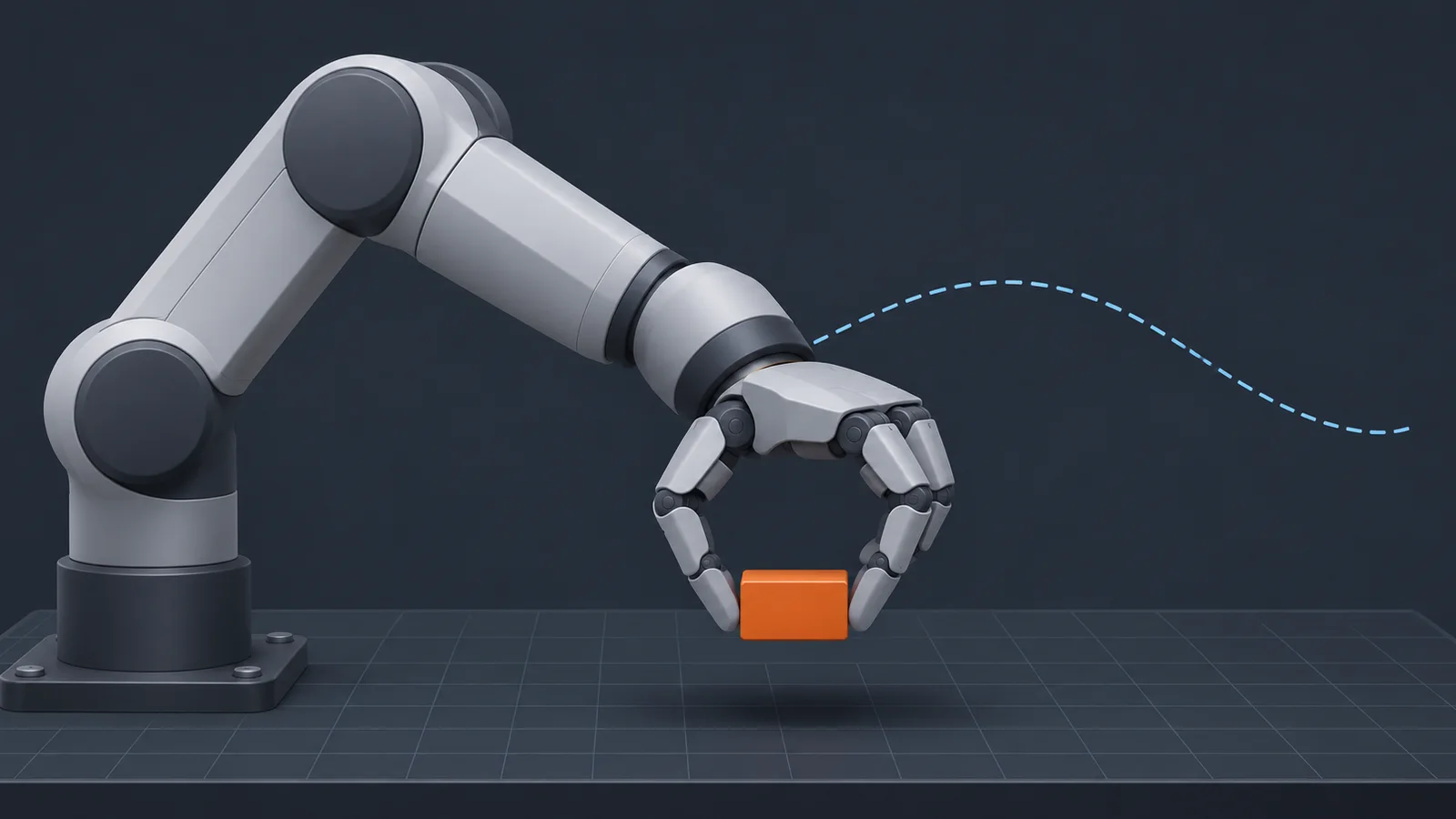
Wongyun Yu and colleagues at POSTECH and RLWRLD introduced DexEngine, a simulation pipeline that turns human hand-object demonstrations into training data for robot arms and hands. In arXiv 2611.33579v1, a preprint that has not been peer-reviewed, the authors report that a robot policy succeeded more often in simulation when trained on physics-corrected data than on uncorrected replays of the same clips.
In the authors’ comparison of training on physics-corrected data and uncorrected replays, GR00T N1.7 averaged 65% success at training placements and 50% at held-out placements with corrected data, versus 6% and 5% with replays. The authors tested pick-and-place, pouring and sweeping with Wuji 2 hands. They fine-tuned the policy for 40,000 steps on corrected data and 140,000 to 199,000 steps on replay data, depending on the task.
Both training sets used the same clips and placements. The authors evaluated 100 scenes per task at each placement level, reusing the training clips at new placements for the held-out tests. At both levels, they kept only scenes that passed a replay of the recorded actions and two more replays with added noise.
DexEngine finds a reachable placement, plans the arm motion and uses reinforcement learning to adjust wrist and finger movements so the robot moves the object through simulated contact. The uncorrected baseline imposed the recorded object path. The authors say about a third of clips became robot data, with fixed-base arm reach ruling out many clips. They also say physics correction remains computationally costly.
In a separate test on a Rainbow Robotics RB-Y1 with two Wuji 2 hands, the authors report that GR00T N1.7 averaged 27% success at held-out placements with mid-training on DexEngine data, versus 0% without it. Mid-training preceded task fine-tuning, where both policies received 40,000 steps using only simulated data. The hardware test used one clip per task and five trials per task at each placement level. Independent replication of either comparison remains unverified.
The paper reports about 65,000 robot trajectories and 325,000 rendered episodes across four hand designs and nine input datasets. The v0 dataset card counts 65,868 trajectories and 329,350 episodes across all nine sources. It lists 18,439 source clips, 59,594 trajectories and 297,985 episodes in the gated release from six sources.
The authors released the data-generation code under Apache 2.0. Dataset access requires signing in and accepting the conditions. The card lists DexCanvas under ODbL 1.0 with share-alike for derived databases, HO-Cap and TACO under CC BY 4.0, HRDexDB under CC BY-NC 4.0 and OakInk2 under CC BY-SA 4.0. It lists HOT3D hand data under CC BY-NC-SA 4.0 and object models visible in the videos under CC BY-SA 4.0 with a no-sale clause.
More news
Zoomlion demonstrates automated loading with an AI excavation robot
Researchers report higher RoboTwin success after tuning about 1.1% of Zero-WAM
XPeng debuts IRON humanoid and targets a second-quarter 2027 release