DARPA names RoboScout and Disruptors Triage Challenge winners
The University of Maryland team earned $1.5 million for a field test pairing robots with medics. The $1 million Data prize rewarded treatment predictions and allocation of scarce medical resources.
DARPA named RoboScout and Disruptors the grand-prize winners of its Triage Challenge. The University of Maryland’s RoboScout won $1.5 million in the Systems track, and Disruptors won $1 million in the Data track. DARPA’s announcement gave the placements and prizes without listing the finalists’ scores.
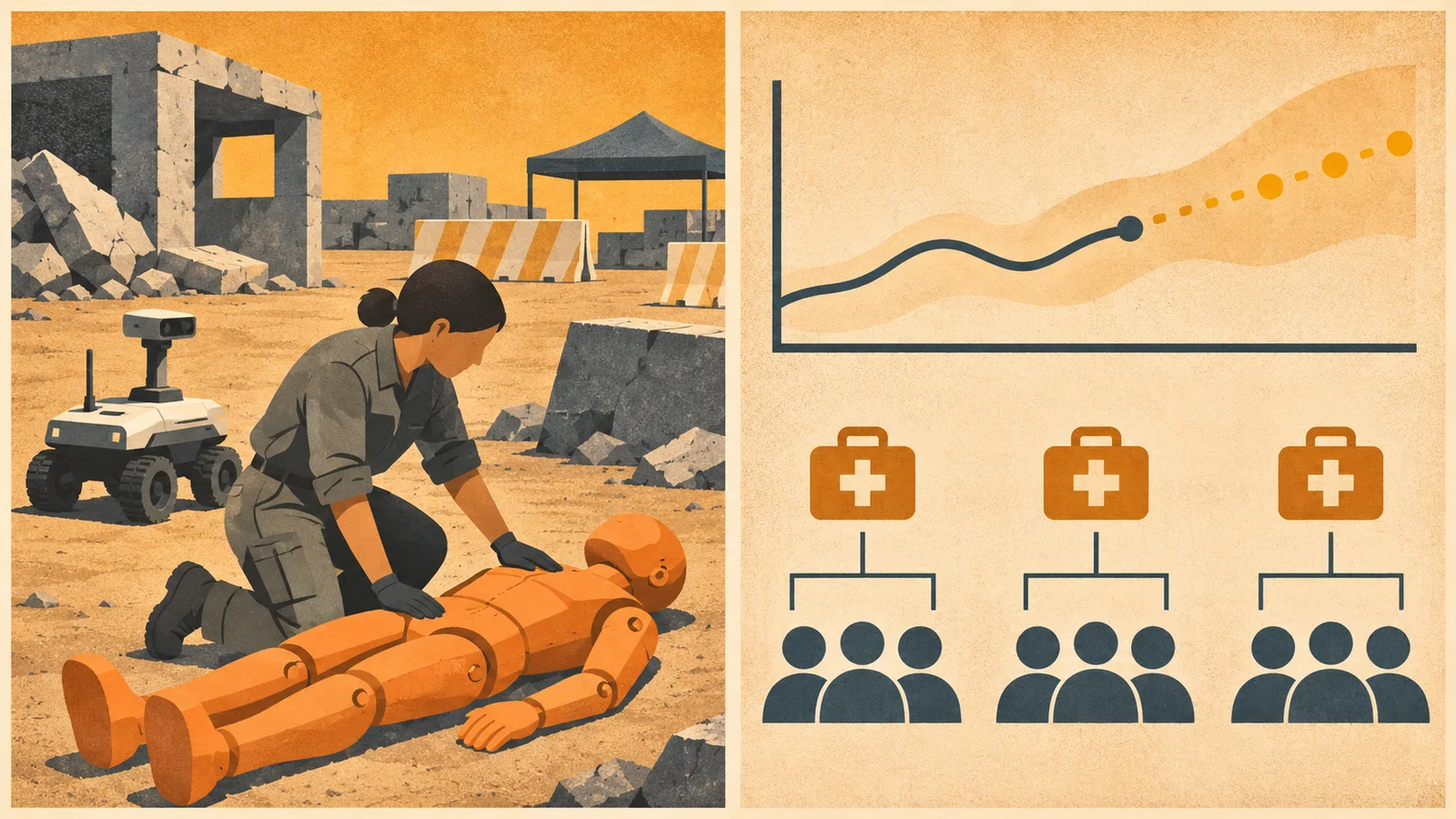
In the Systems finals at Disaster City in College Station, Texas, autonomous drones and ground robots helped medics find and assess casualties in staged disasters, including the aftermath of a tornado at an outdoor market. The Data track tested software on de-identified trauma cases set aside for evaluation and assessed how the software allocated scarce medical resources across simulated groups of casualties.
RoboScout won the Systems championship, where DARPA scored teams on a course that paired robots with medics. Finding casualties and classifying them during initial triage each accounted for 25% of the base score. Both measures rewarded speed and accuracy.
The share of simulated casualties with life-threatening injuries whom medics could treat in time counted for 20%. The rules gave 15% each to correctly ranking casualties for evacuation and correctly choosing whom to evacuate immediately. Teams could earn 15 extra points if their machines operated autonomously for at least 60% of the run.
The University of Maryland said RoboScout’s drones and ground robots used cameras, radar and microphones to find and assess simulated casualties. The university said the system sent the findings to medics’ tablets.
Disruptors won the Data track, where DARPA ranked entries on a combined score across three tasks. First Look and Continuous Alert each counted for 40%. First Look used initial prehospital data to predict whether and when life-saving treatment would occur, and Continuous Alert used incoming hospital data to predict which life-saving interventions would occur in the near term.
Resource Allocation measured how teams assigned limited medical resources across casualties and counted for 20%.
DART took the $500,000 runner-up prize in Systems, and OCA-SENTINEL received $300,000 as the Data runner-up.
More news
Si-Ware announces UT Austin study of infrared sensing for humanoid robots
Close&Safe method limits robot detours to obstructed trajectory segments
TacInno trains robot policies on tactile changes vision cannot explain