Google DeepMind opens PARDIG and SatWeave weather datasets
Google DeepMind opened live feeds and historical archives for PARDIG and SatWeave, two experimental datasets used in its WeatherNext 3 system.
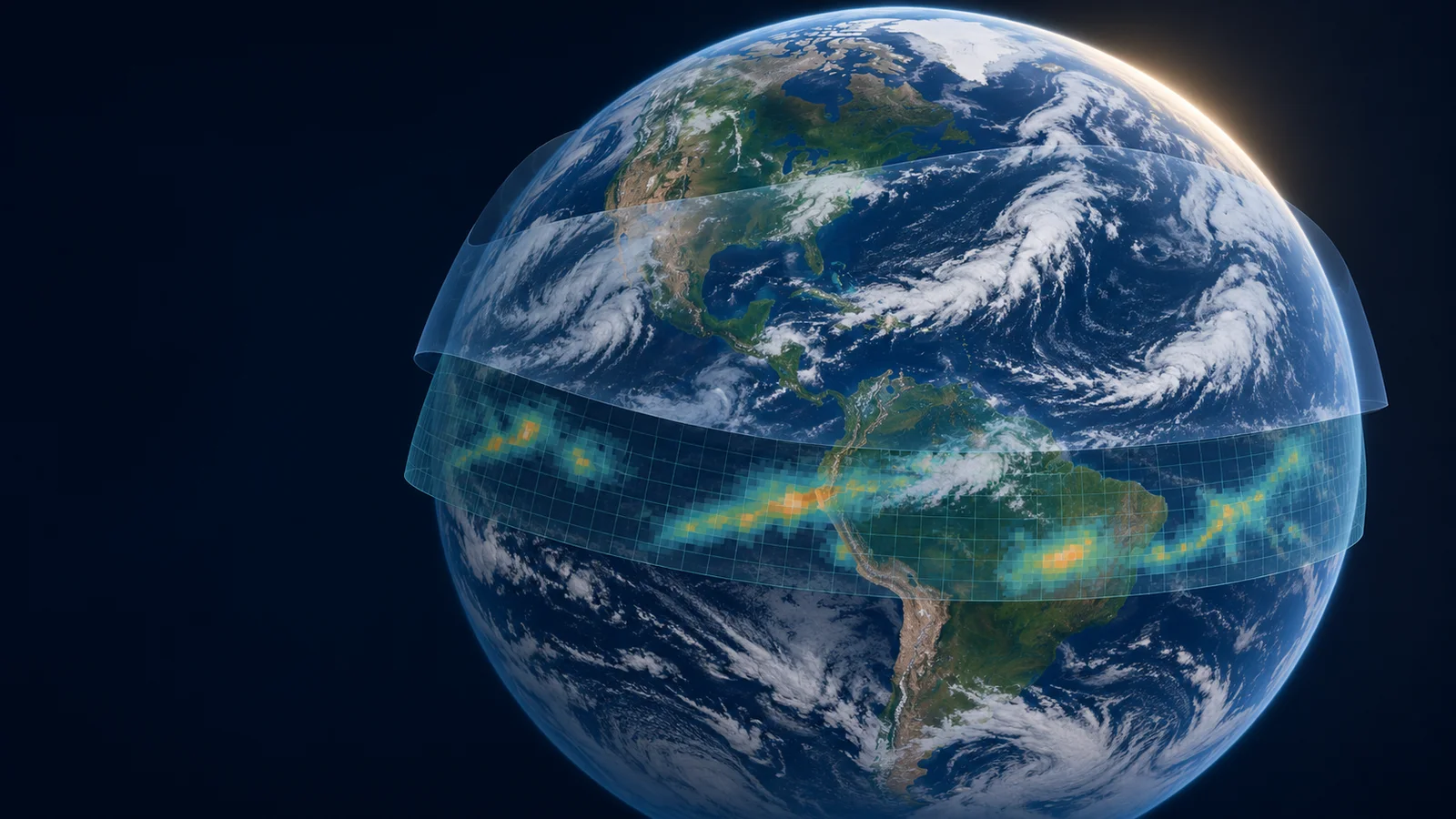
Google DeepMind opened historical archives and live feeds for PARDIG and SatWeave, two experimental datasets used in its WeatherNext 3 weather model.
Researchers and developers can access both datasets through public Google Cloud Storage buckets under the CC BY 4.0 license. Google says anyone with a Google Cloud account can query them without an access-request form. Static PARDIG collections are also available through Google Earth Engine.
SatWeave combines observations from five operational geostationary satellite positions—GOES-East, GOES-West, Meteosat Prime, Meteosat Indian Ocean and Himawari—into a 0.1-degree, or roughly 10-kilometer, mosaic. Google’s SatWeave documentation lists 17 spectral bands: seven reflectance bands and 10 bands measuring brightness temperature across shortwave, water-vapor and thermal-infrared wavelengths.
The SatWeave historical archive spans 2016 through 2025 at 30-minute intervals. Its operational archive covers 2026 onward at hourly intervals, with stated latency of about one hour. The data is stored in Zarr v3 format in the public gs://satweave_1/ bucket. Google says WeatherNext 3 uses SatWeave as a live input to initialize forecasts every hour.
PARDIG—short for Precipitation AI Reanalysis: Densely Inferred GPM—is an AI-generated dataset of global precipitation-rate estimates at 0.1-degree spatial resolution and 15-minute intervals. The model was trained to infer dense precipitation fields from sparse swaths produced by the NASA and JAXA Global Precipitation Measurement mission’s Combined Radar-Radiometer Algorithm, using satellite imagery and European Centre for Medium-Range Weather Forecasts atmospheric fields as inputs. NASA says the GPM Core Observatory carries a microwave imager and a dual-frequency precipitation radar, the radar-and-radiometer observations behind those training targets.
Google’s PARDIG guide describes two variants. PARDIG-NRT covers 2016 to the present and is updated every six hours, with stated effective latency of about two to eight hours. PARDIG-LR is a static long-record archive covering 1999 through 2023. Both are published as Zarr v3 in the public gs://pardig_1/ bucket. Google says WeatherNext 3 used PARDIG as a precipitation training target, rather than as a live forecast input.
In a company-authored evaluation, Google says PARDIG outperformed several global precipitation baselines across the regions and thresholds it analyzed. DeepMind specifically claims more than 30% better hourly detection skill than IMERG-Final for light-to-moderate precipitation. The opened evidence does not include an independent replication of that comparison.
DeepMind presents the releases as building blocks for weather, hydrology and climate research. It says researchers could explore solar-power and wildfire forecasting with SatWeave, and flood, landslide and drought models with PARDIG. Those are proposed applications, not measured downstream outcomes.
Google labels both datasets experimental and says they are not official observations, forecasts, watches or warnings. SatWeave has reduced or missing high-latitude coverage and can contain sensor or mosaicking artifacts. PARDIG estimates poleward of about 67 degrees rely on extrapolation beyond the GPM radar training domain. Google also warns that changing satellite coverage and differences between the two PARDIG variants can introduce non-climatic shifts into long-term records, requiring care when interpreting multi-decadal trends.
More news

Google DeepMind releases AlphaGenome 2 for cell-specific DNA analysis

Google DeepMind rolls out Gemini Robotics 2.5 to partners

Google DeepMind introduces AlphaProof Code with machine-checked libsignal proofs