IBM releases Granite Timeseries Ensemble R1 forecasting framework
IBM's Granite Timeseries Ensemble R1 combines quantile forecasts from four existing Granite checkpoints using uniform probability pooling or optional IQR-based weighting.
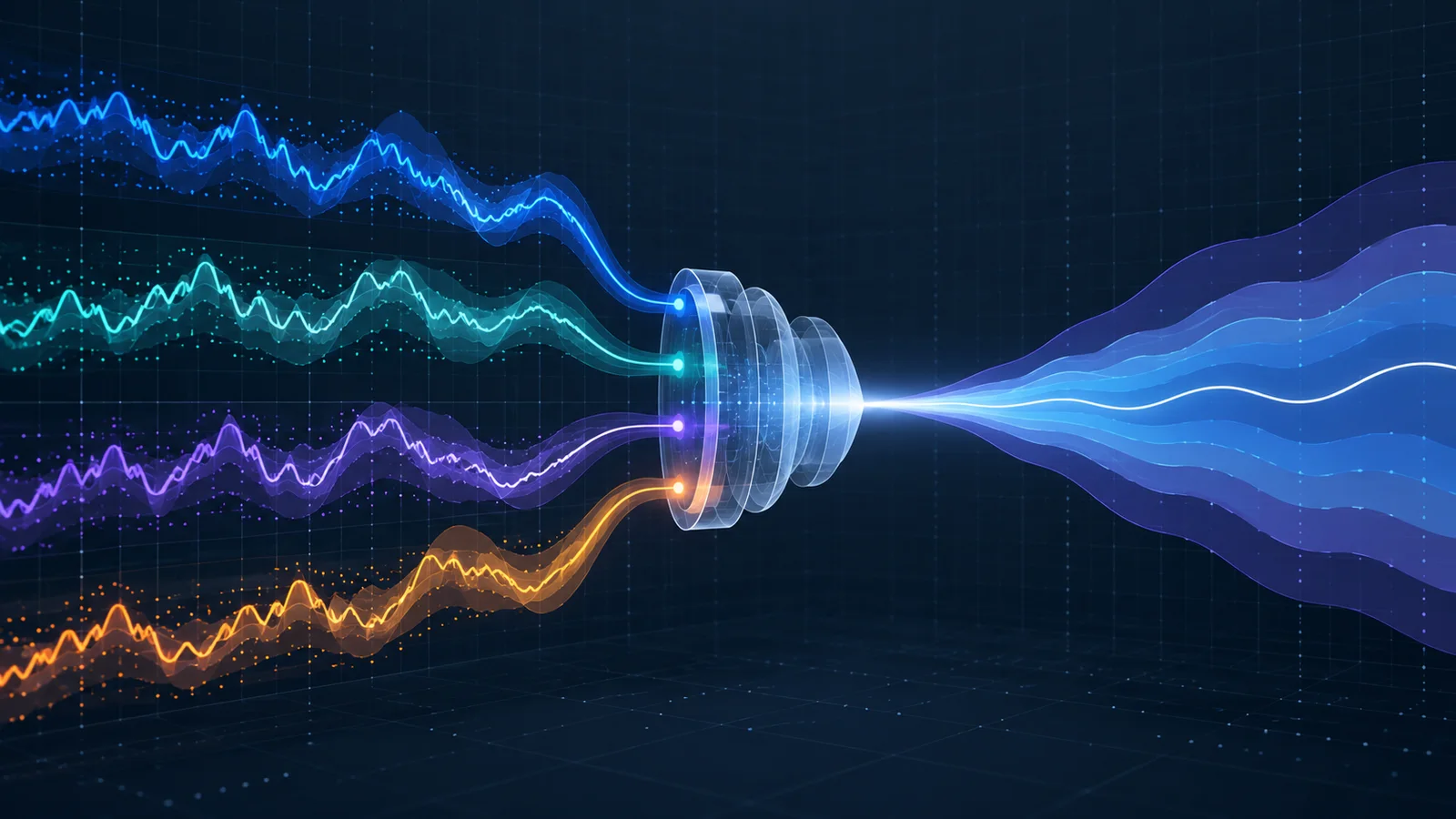
IBM has released Granite Timeseries Ensemble R1, an Apache-2.0 framework that combines probabilistic forecasts from several pretrained Granite time-series models. Rather than merging model weights or introducing another trained checkpoint, the release adds a modular aggregation layer.
The default Granite-only setup loads PatchTST-FM-r1, PatchTST-FM-r2, FlowState-r1.1 and TTM-r3 from their respective Hugging Face repositories at runtime. Compatible models can be added through a common Forecaster interface. The root recipe produces nine quantiles from 0.1 through 0.9, with the 0.5 quantile serving as the point forecast. IBM’s usage instructions require granite-tsfm 0.3.10 or newer.
IBM recommends linear_pool as the default aggregation method. It gives each member equal influence, pools the models’ quantile values in probability space and extracts empirical quantiles without learning combination weights. The optional iqr_weighted method instead uses each member’s interquartile-range dispersion, giving narrower forecast intervals more influence. It applies isotonic regression to keep the output quantiles nondecreasing, but does not fit weights against historical forecast errors.
IBM says it tested both four-member methods across 97 GIFT-Eval dataset configurations. The company reports normalized MASE of 0.6830 for each ensemble, compared with 0.6846 for PatchTST-FM-r2. Its reported normalized CRPS/MWQL is 0.4707 for uniform pooling and 0.4700 for IQR weighting, compared with 0.4672 for PatchTST-FM-r2; lower values are better. The figures were geometrically aggregated after normalization against Seasonal Naive and have not been independently reproduced for this article. IBM dates the displayed standings to September 28, 2026 and says they may change as methods are added.
Running four checkpoints increases memory use and inference latency, according to the model card, while differences in member context lengths and preprocessing can complicate deployment. Multivariate channels are forecast independently. IBM also says neither aggregation method guarantees calibration or robustness under distribution shift, and IQR weighting can favor an overconfident member. The ensemble recipe and Granite TSFM implementation use Apache-2.0, but member weights remain governed by the terms of their own repositories. Optional expanded recipes include IBM Research checkpoints with separate licensing and usage conditions.
More news
IBM releases Granite Switch 4.1 for chat, decisions and speech on one endpoint

IBM and NASA release open-source lunar foundation model
IBM releases Granite TimeSeries PatchTST-FM-r2