IBM and NASA release open-source lunar foundation model
IBM and NASA released an open-source lunar foundation model, nearly two million co-registered data tiles and tools for adapting the system to research tasks across instruments and spatial scales.
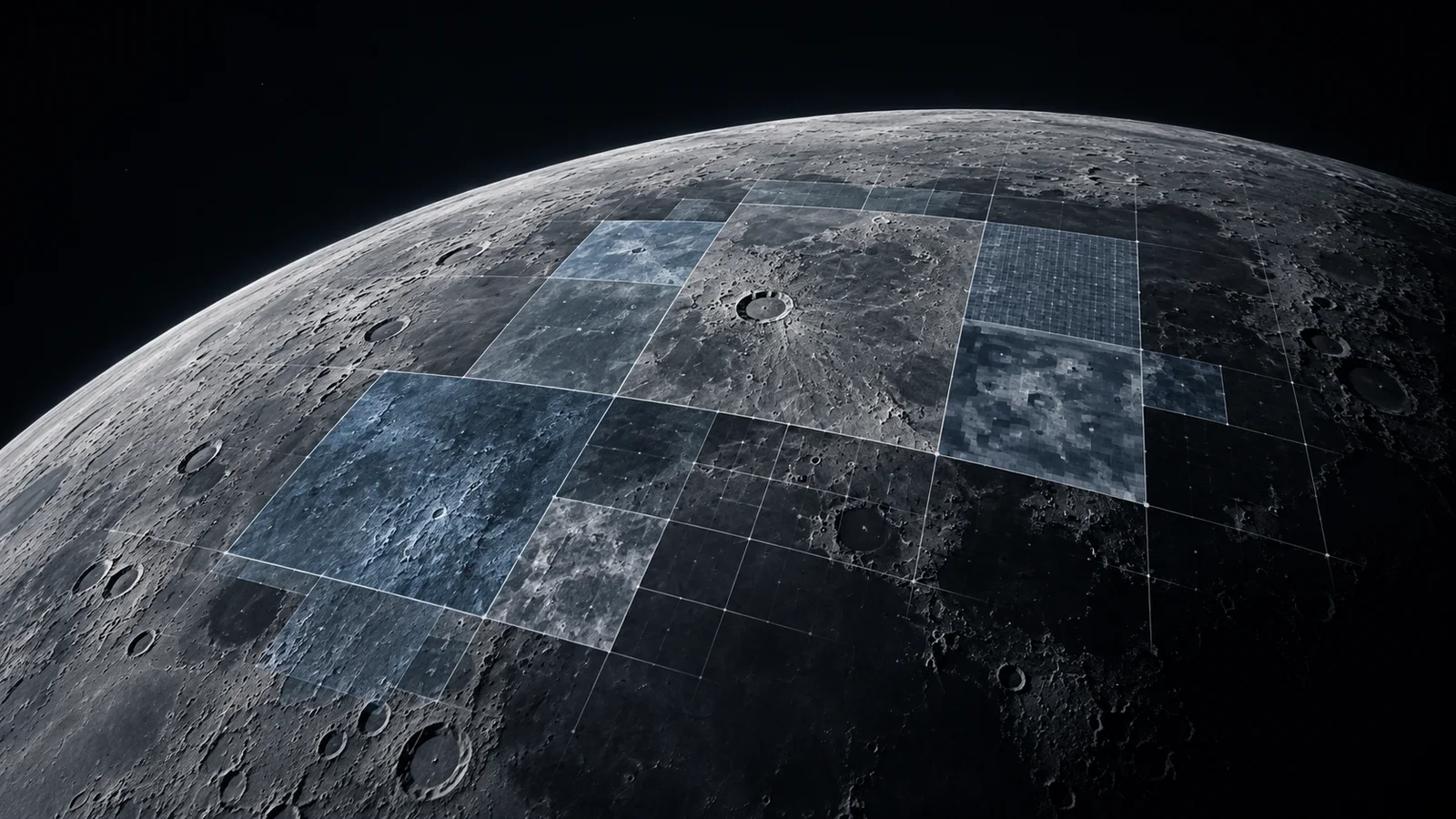
IBM and NASA released the NASA-IBM Lunar Foundation Model, along with downloadable weights and a machine-learning-ready lunar dataset. The model is meant to help researchers analyze observations from multiple instruments and spatial resolutions with a single system. The public package also includes configuration files, downstream benchmark datasets, TerraTorch integration, and code for fine-tuning and inference.
The accompanying SomBench corpus contains 1,963,722 co-registered tile bundles: 963,609 anchored to wide-angle camera imagery and 1,000,113 anchored to narrow-angle imagery. IBM says the dataset combines more than 30 spatially aligned layers from nine instruments across four missions. Source records identify optical, topographic, spectral, radar, thermal and gravity products from NASA’s Lunar Reconnaissance Orbiter, GRAIL and Lunar Prospector missions, as well as Japan’s SELENE/Kaguya mission.
SomBench aligns available measurements to the same ground boundary for each tile. Coarser products are resampled, while native resolution is preserved where possible. The corpus has two tracks at different scales: its 512-by-512-pixel wide-angle tiles, at 100 meters per pixel, span about 51.2 kilometers; its narrow-angle tiles, at 1 meter per pixel, span about 512 meters.
The model card says modality-specific tokenization allows the model to process different observation types. Joint mixed-resolution pretraining teaches one set of weights across the roughly 100-fold scale gap, although the wide- and narrow-angle resolution families remain separate within each sample. The model is designed as a reusable starting point for detection, segmentation and regression in remote-sensing research.
The model and released repository use the Apache 2.0 license. The repository describes a fine-tuning and inference release and explicitly states that pretraining code is not included.
IBM and the joint model card report better results than selected image-model baselines on some benchmarks, but the figures have not been independently validated. For polar ice prospectivity, the card reports a root mean squared error of 0.0293, compared with 0.0377 for SwinV2-B. IBM describes that result as an error reduction of up to 22%. For wide-angle crater detection using half the training data, the card reports mean average precision of 0.2541 versus 0.2313 for SwinV2-B, a result IBM describes as nearly 19% better. The card treats the narrow-angle crater-detection and irregular-mare-patch segmentation results as comparable with the leading baselines because the gaps are smaller than the variation across training runs.
IBM and NASA say the model could shorten analysis for research into polar resources, craters, lunar geology and future exploration planning. These are proposed uses, not demonstrated mission outcomes. The model card says its ice-prospectivity output estimates a knowledge-driven map rather than measuring ice directly. It also says the model has not been validated for operational decisions such as landing-site certification or hazard clearance. Documented constraints include uneven instrument coverage, missing data, resampling artifacts, illumination-driven changes in surface appearance, scarce or imbalanced labels, absolute geolocation uncertainty and site-limited high-resolution pretraining.
More news
IBM releases Granite TimeSeries PatchTST-FM-r2
IBM says DARPA moved its quantum computing plan to Stage C

IBM brings native Qiskit development to Fortran, C++ and Julia