Meta researchers split control from execution in longer AI agent workflows
Meta researchers proposed an inference-time framework that separates task execution from the control of progress, memory and compute across longer AI agent runs.
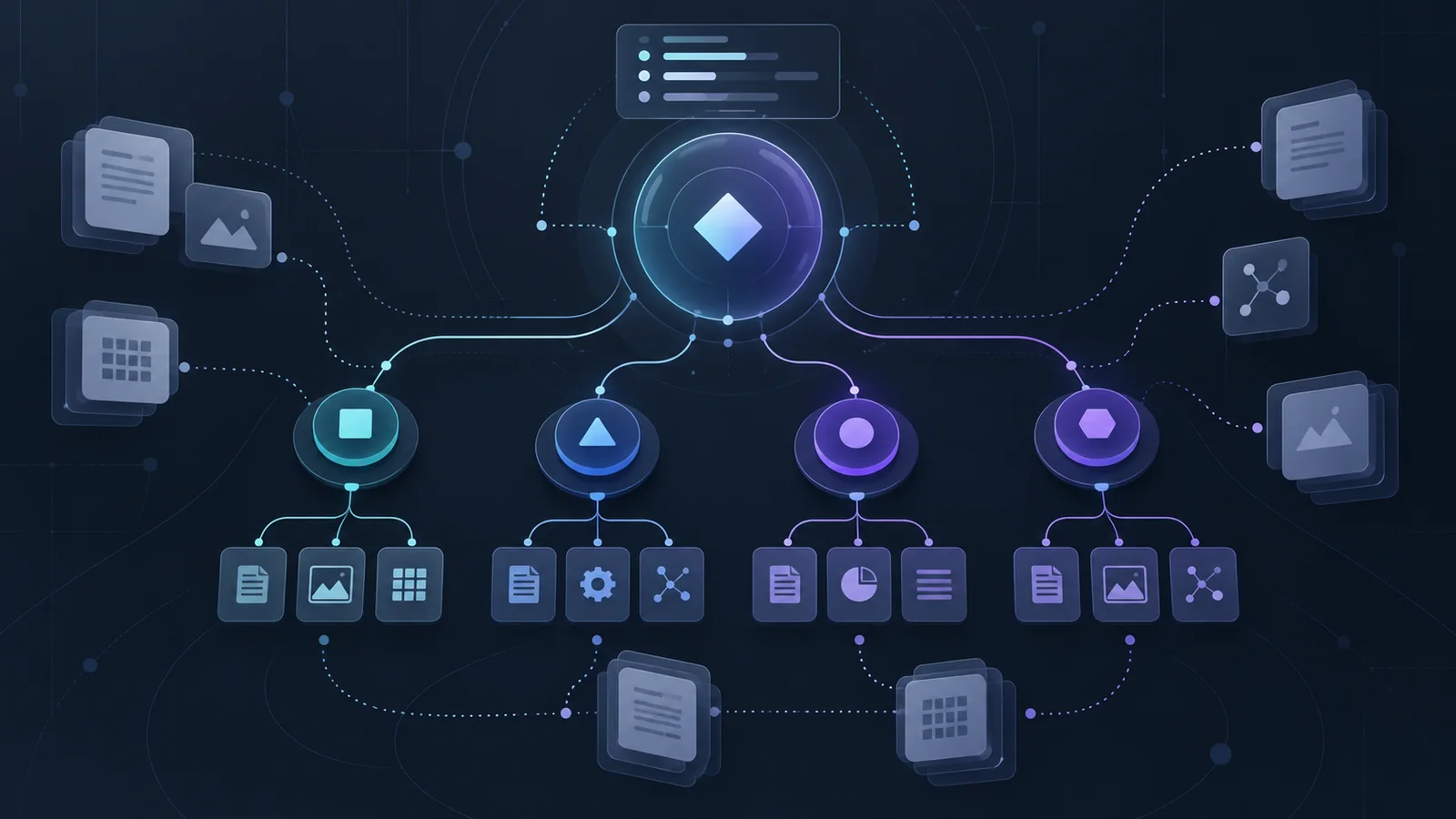
Researchers at Meta Superintelligence Labs proposed an inference-time framework that separates an AI agent’s task execution from a dedicated controller responsible for deciding what work should happen next.
The authors call the design agentic meta-reasoning. They present it as a way to use larger compute budgets across longer workflows without changing or fine-tuning the underlying model. Rather than interleave control decisions with object-level work in one accumulating history, the framework assigns task-level computation to workers and gives a separate controller a recurring deliberation loop.
The loop has four stages. Assess rewrites a compact account of what the run has established and what remains unresolved. Propose generates possible next computations without being told the remaining budget. Evaluate weighs those options against the calls still available. Dispatch sends targeted instructions and selected prior work to one or more workers, or stops and submits an artifact already in memory.
The other central component is persistent artifact memory. Worker outputs and controller notes are stored under stable identifiers. The controller carries only a compact state between cycles, retrieving full artifacts when needed. If a previous artifact is supplied as context for new work, the harness records a dependency edge. The resulting artifact graph shows where the run branched and where later work built on earlier results.
Controller and worker calls draw from the same nominal model-call allowance. The authors caution that equal call limits do not mean equal token cost, latency or floating-point operations: calls differ in length, and systems may stop before using their full allowance. The controller’s four stages also add fixed overhead that can hurt when the available budget is small.
The researchers evaluated the framework with Gemini 3.1 Pro, GPT-5.5 and Opus 4.8 on IMO ProofBench-Advanced, ARC-AGI-2, LongCoT-mini and ProgramBench. They report that the meta-reasoning system produced higher point estimates in all 12 matched comparisons with a Direct Control Agent at the largest tested budgets. On ProgramBench with GPT-5.5, the authors report a 71.5% mean per-problem hidden-test pass rate, compared with 63.7% for their matched direct-control baseline and 58.0% for Codex.
In the authors’ ProgramBench budget sweep with GPT-5.5, the reported score rose from 64.1% at a 400-call allowance to 71.5% at 1,200 calls. Direct control stayed near 64% and used about 18% of the larger allowance. The pattern was not uniform at smaller budgets: with Opus 4.8 and a 400-call allowance, meta-reasoning scored 56.6% versus 62.7% for direct control before leading 67.2% to 65.3% at 1,200 calls.
Those benchmark results are author-reported and have not been independently replicated. The paper also says its matched comparison changes staged control, compact-state compression and selective memory access together, so the experiments do not isolate how much each component contributed. The authors caution that positive point estimates do not establish significance for every difference or generalize to other models, tasks or substantially longer horizons.
More news
Meta's in-training Watermelon model reportedly matches OpenAI's GPT-5.5 on internal tests
 Dmytro Spodarets·Jul 3, 2026
Manus raises more than $500 million after Meta deal unwind

Meta and Sierra Announce Work on Personal Agent Protocol