NetApp makes Novus storage architecture orderable for AI factories
NetApp says Novus separates metadata from data movement, allowing operators to scale concurrency, throughput and capacity independently across large GPU clusters.

NetApp launched Novus, a disaggregated storage architecture for large AI factories, with an initial configuration the company said was orderable as of September 29. It combines Novus Data Director metadata software running on qualified Supermicro infrastructure with ONTAP data services on NetApp AFF A90 systems. The storage launch is separate from NetApp’s Workload Factory AI agents, an AWS-focused automation product with approval gates.
Novus is designed to let operators scale metadata concurrency, storage bandwidth and capacity independently while keeping files in one namespace. The separation targets a bottleneck that can leave costly accelerators waiting for file lookups or data. NetApp says GPU utilization can fall below 30% in traditional architectures when storage cannot supply data fast enough, but the company did not publish workloads or measurement data supporting that figure.
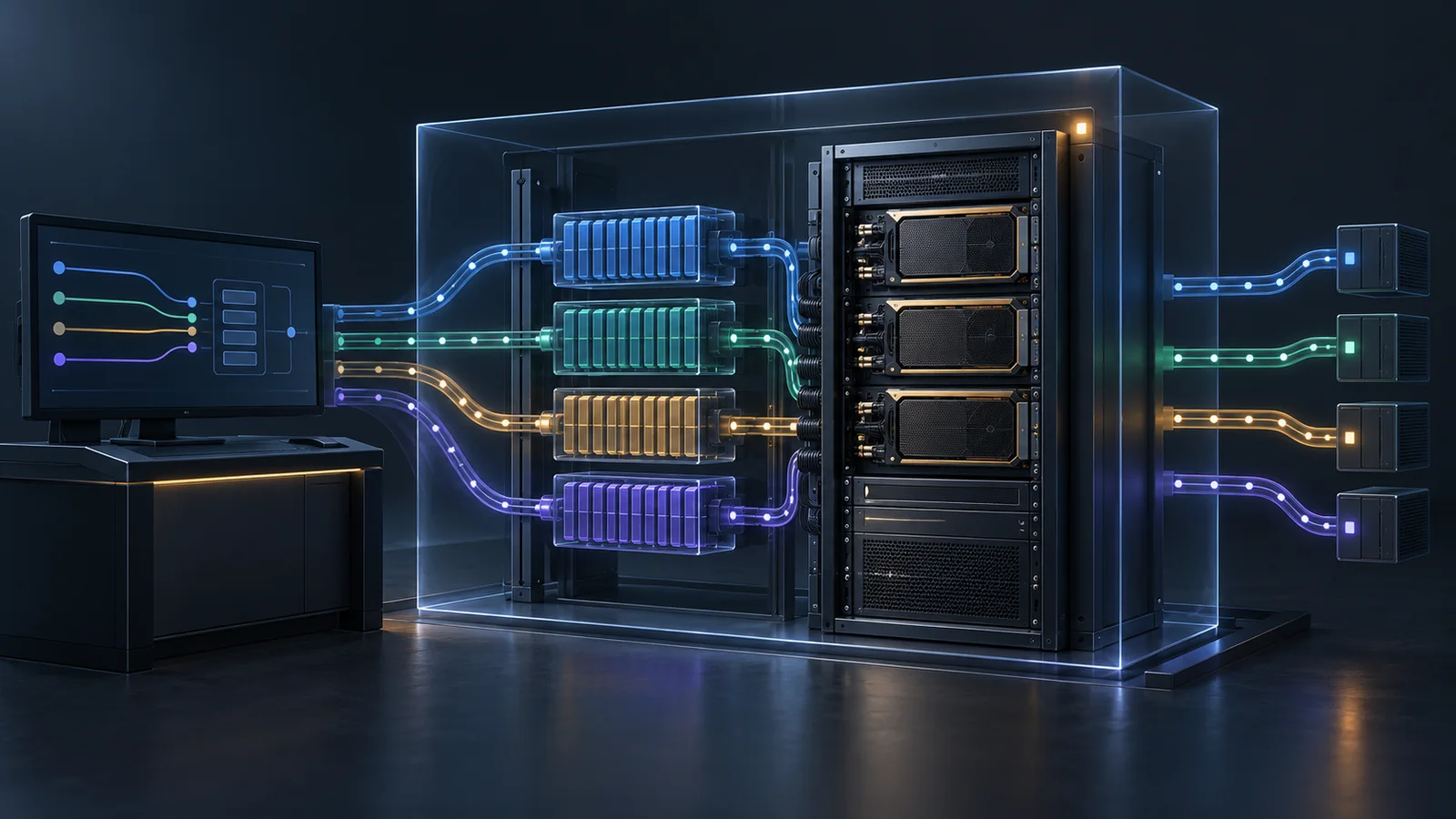
Under the design described by NetApp, Data Director puts metadata in an independently scalable control layer on x86 compute. A client asks that layer for a file layout, then communicates directly with the ONTAP storage that moves the data. As a result, file opens, lookups and layout requests do not share the same controllers and path as large sequential transfers such as model checkpoints.
Novus uses standard in-kernel NFSv4.2 and pNFS Flex Files clients, with nconnect and NVIDIA GPUDirect Storage, rather than a proprietary client. NetApp says storage resources can be federated beneath one namespace, allowing clusters to be added without applications remounting separate systems.
NetApp says the architecture can exceed 100 TB/s of aggregate read throughput in a single namespace. Its example multiplies as much as 2 GB/s for each of 50,000 GPUs to reach 100 TB/s. That is sizing arithmetic, not a disclosed production result. The company also describes Novus as engineered for a zettabyte-scale namespace spanning thousands of storage nodes, but its materials do not identify a deployed zettabyte installation.
NetApp’s announcement says Omdia observed near-linear scaling as ONTAP clusters were added and modeled 100 TB/s of sequential reads, dozens of exabytes of effective capacity and a path to zettascale deployment. No public audit report, tested configuration, methodology or raw results accompanied that statement. NetApp’s AFF A90 specifications list 6.6096 PB of maximum raw capacity for one high-availability pair and 79.3 PB for a 12-pair NAS scale-out configuration, meaning the zettabyte claim depends on federation beyond one documented AFF A90 cluster.
NetApp did not disclose pricing, a minimum configuration, qualified Supermicro model numbers, shipping lead times or regional availability. Although it said the initial architecture was orderable, the announcement also cautioned that statements about unreleased offerings and future plans may change and do not guarantee availability, functionality, pricing or timing.
More news
Iterate.ai launches Lifeboat inference engine for private AI agents

Microsoft previews Fabric data engineering agent and expands Azure SQL tools

Amazon launches $1 billion-plus program for data-center communities