NVIDIA makes cuDSS generally available for GPU-accelerated simulation
NVIDIA has made its cuDSS sparse linear solver library generally available, giving developers C, C++, Python and Fortran interfaces for engineering and scientific simulation software.
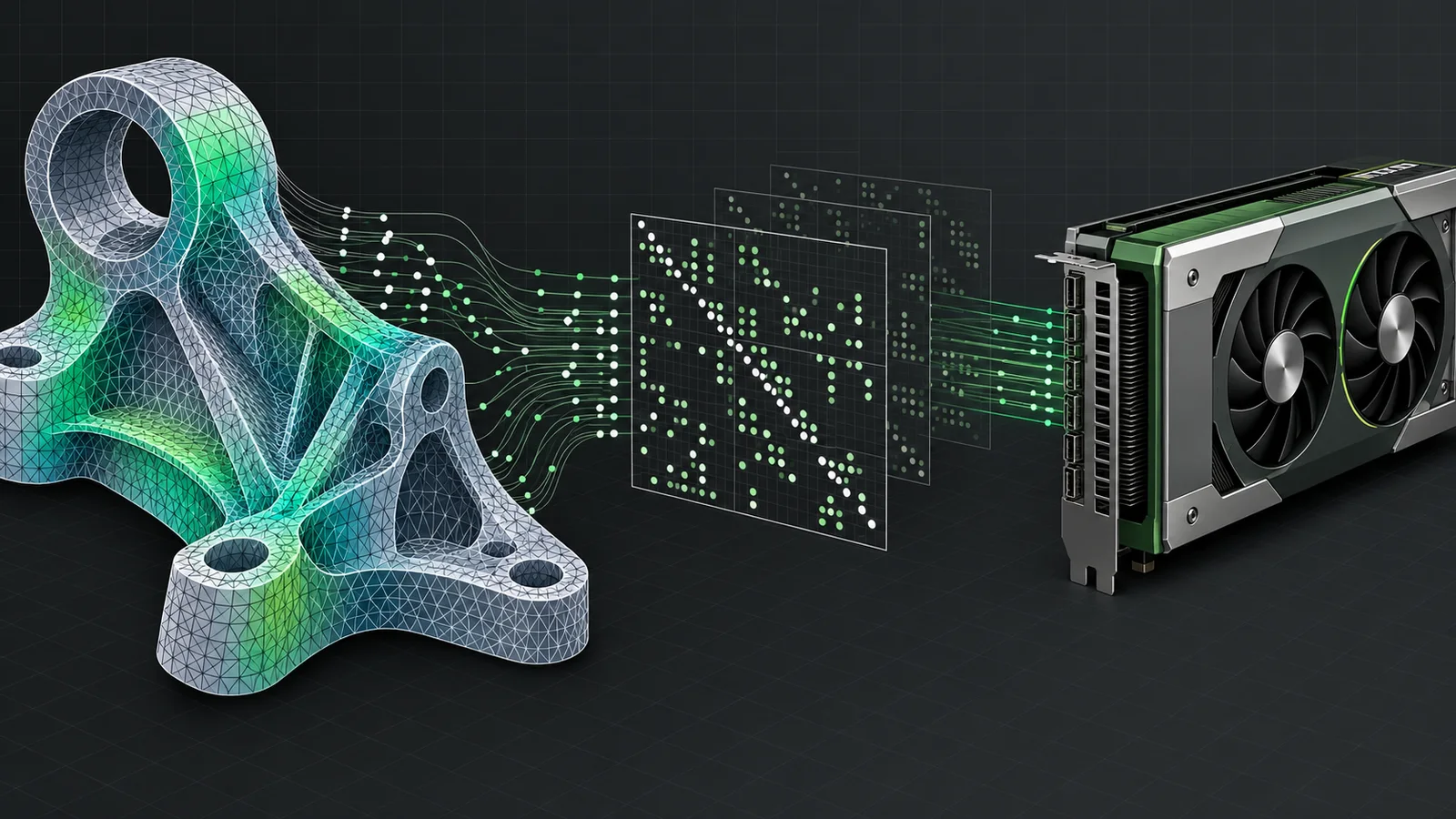
NVIDIA made cuDSS generally available on October 21, moving the previously previewed CUDA-X sparse linear solver to general availability for engineering and scientific simulation software. The company said developers can use the library through C, C++, Python and Fortran interfaces.
cuDSS moves three phases of solving sparse linear systems—analysis, numerical factorization and solving—onto NVIDIA GPUs. Those systems recur in engineering and scientific simulations and can consume substantial computation time.
NVIDIA named six products that are integrating the library: Applied Materials Ginestra, COMSOL Multiphysics, Cadence Celsius, Dassault Systèmes Abaqus, Siemens Simcenter STAR-CCM+ and Synopsys Sentaurus Device. The announcement did not say whether every integration is already generally available. The opened partner sources did not separately corroborate the Cadence, Dassault or Siemens integrations.
For context on NVIDIA’s related engineering software, DataPhoenix previously covered cuPotential for atomic-scale chip modeling.
Two software vendors separately described deployments. Applied Materials said Ginestra uses cuDSS for atomic-level material simulations and claimed computation speeds up to 10 times those of CPU-only runs. COMSOL said cuDSS is fully integrated into the standard solver framework in COMSOL Multiphysics. In one workload, COMSOL reported that a two-GPU system completed a mechanical-polishing model in 2 hours and 9 minutes, compared with 13 hours and 44 minutes and 16 hours and 28 minutes on two tested CPU configurations. These are vendor benchmarks, not independently reproduced results, and their hardware and workload choices limit direct comparisons.
NVIDIA attributed other performance figures to customers and partners. It said ZEISS SMT measured a fourfold speedup for an EUV-lithography plasma simulation in COMSOL Multiphysics, with the full simulation taking six days and 14 hours, and said Dassault Systèmes reported eightfold to tenfold gains in Abaqus structural and electromagnetic solvers. Synopsys separately said an Infineon 3D breakdown simulation in Sentaurus Device ran 12 times faster with cuDSS. None of those figures was independently verified for this article.
NVIDIA’s technical documentation lists single-GPU, single-node multi-GPU and multi-GPU multi-node configurations on Linux and Windows. The getting-started guide requires CUDA 12.x or newer.
The documentation had not fully caught up with the announcement when checked: its index still labeled cuDSS a “Preview” and warned that the API could change. The announcement did not tie general availability to a specific version, price or license change. NVIDIA’s current release notes begin with cuDSS 0.8.0, list breaking API changes and document known limits, including unsupported matrices with more than 2^31 rows or columns.
More news

Hugging Face launches SimReady Central with more than 2,000 robotics assets

NVIDIA broadens Isaac robotics stack with runtime, datasets and humanoid reference platform

NVIDIA launches RTX Spark PCs, schedules demos in six cities