OpenAI releases 722 math manuscripts at varied verification stages
OpenAI has published 722 mathematical manuscripts across 372 result families on GitHub, while warning that the work remains at different stages of verification.
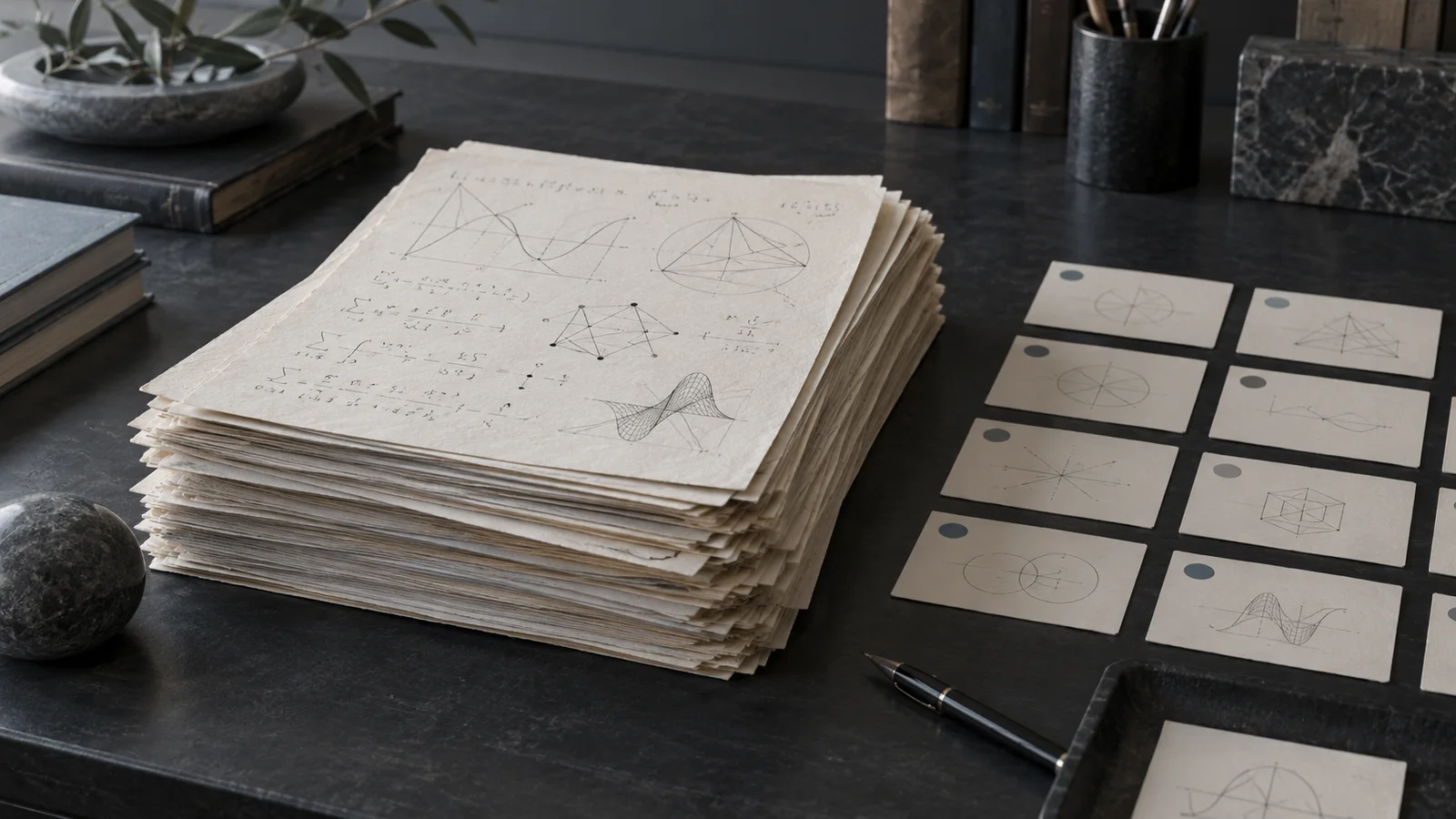
OpenAI published a public GitHub repository on October 6 containing 722 mathematical manuscripts organized into 372 result families. The release makes a large body of claimed results available for scrutiny, but publication alone does not establish that the mathematics is correct.
The repository README defines a result family as a group of related papers. A family can include a principal result, companion arguments, consequences or alternative proofs. The README says the collection includes PDFs, source files, citation information and build instructions, plus separate catalogues for formal proofs written in Lean, a system that checks whether a proof follows from stated definitions and assumptions.
OpenAI says the vast majority of the results came from a common procedure using an unreleased internal model. The company says it posed about 4,000 problems to the model and that each resulting item used an average equivalent of roughly three hours of ChatGPT Pro thinking compute. It also released abridged reasoning summaries for 10 selected result families, not the entire collection.
The catalogue attributes claims across number theory, geometry and theoretical computer science to the model-assisted work. Examples include a zero-free half-plane for Dirichlet L-functions, bounds for planar unit-distance problems and a result concerning the Unique Games Conjecture. These are OpenAI’s descriptions of the manuscripts, not independent confirmation of the results.
OpenAI’s caveat is explicit: the README says the collection includes results “at different stages of verification” and that some results without formalization could have issues. It also says not every manuscript has been formalized. A separate formalization catalogue identifies papers with a formalized main result and records its review status as “unchecked.”
Lean artifacts can show that machine-checkable proofs were released for some papers, but their presence alone does not verify every informal theorem statement, premise, citation or claim of novelty across the collection. None of the sources reviewed for this story provides independent, item-by-item validation of all 722 manuscripts.
Earlier DataPhoenix coverage examined narrower claims and review boundaries. In one case, researchers reconstructed part of a claimed Navier–Stokes result but deferred a residual-correction stage needed to assess the full argument. That case shows how an individual claim can receive partial outside scrutiny; it does not validate the separate claims assembled in this repository.
OpenAI says it will revise and correct the catalogue over time. The repository materials do not identify the internal model credited for most of the collection or specify its architecture, weights or release date.
More news
OpenAI forms independent mathematics advisory group with nine researchers
OpenAI says unreleased Astra model cracked ten decades-old math problems
Fudan researchers reconstruct part of OpenAI Navier–Stokes work, defer key step
OpenAI says its GPT-5.6 Sol Ultra model proved the 50-year-old Cycle Double Cover Conjecture
 Dmytro Spodarets·Jul 10, 2026