OpenAI says its models improved AMD production chip designs
OpenAI says AMD used model-generated circuit changes in a design sent for manufacturing and in future production files, while new RISC-V tests showed gains that the company says still fall short of production evaluation.
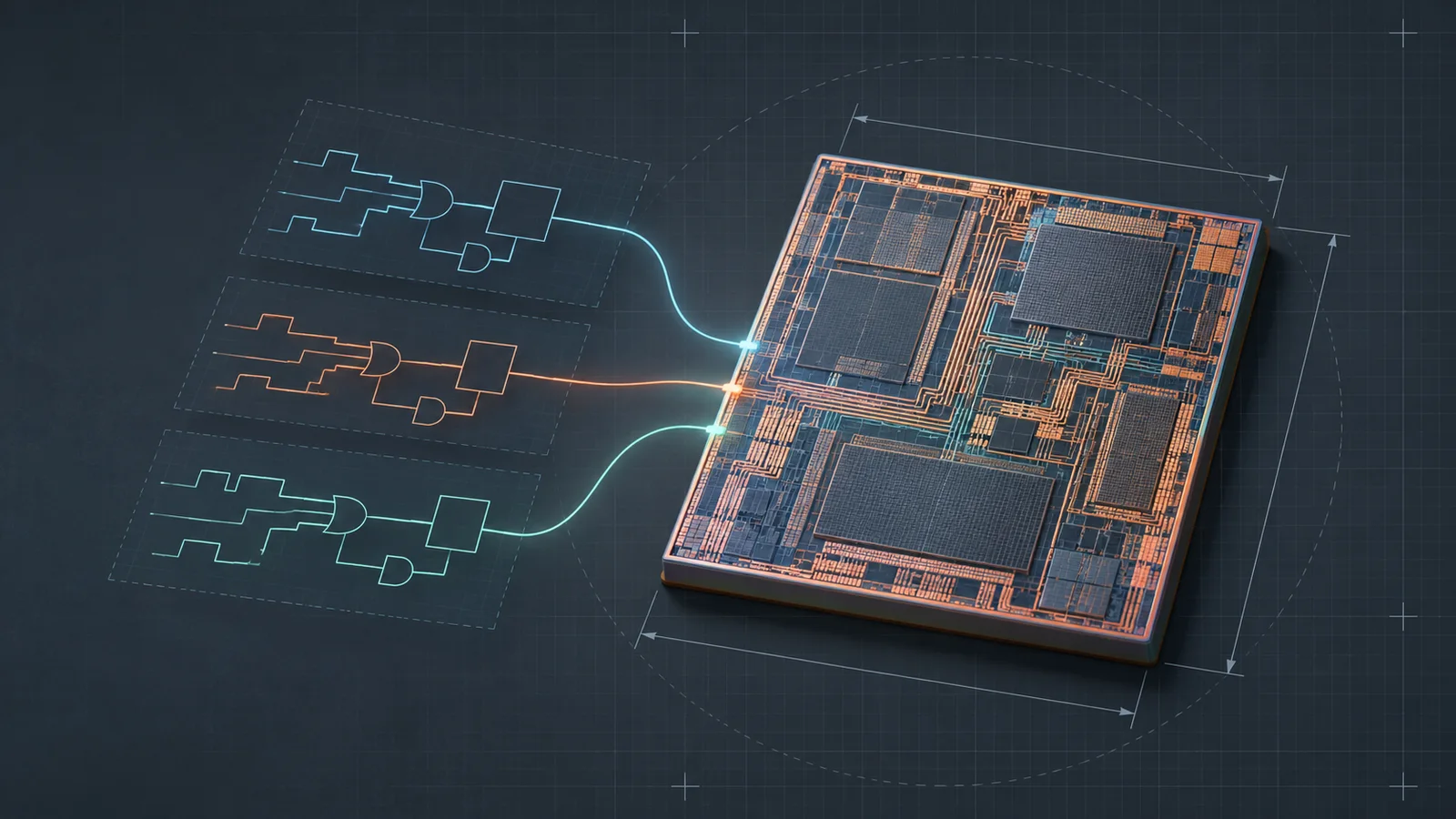
OpenAI said AMD incorporated model-generated circuit changes into a recent chip design sent for manufacturing and added other changes to production design files for future versions. The chip-design results published by OpenAI would put the company’s model output in a major chipmaker’s production workflow, though AMD has not independently confirmed the specific use.
OpenAI said the work produced power, performance and area gains of as much as 14% over heavily optimized baselines on AMD flagship GPU intellectual property. It also said AMD verified single-digit percentage gains across key blocks of an upcoming next-generation flagship CPU. The company characterized the GPU effort as roughly one year of progress completed in less than five months, but did not publish the underlying AMD benchmark data, baseline definitions or per-block results needed to independently test those figures.
The models rewrote SystemVerilog register-transfer-level descriptions, which specify how a circuit moves and transforms data from one clock cycle to the next. OpenAI said Synopsys tools checked whether each rewrite behaved like the original design and measured trade-offs among power, performance and silicon area. Synopsys separately announced a multi-year agreement with OpenAI in September to develop GPT-Synopsys and license electronic-design-automation tools, but that announcement did not verify the AMD-specific results.
OpenAI also evaluated its models on PicoRV32 and Ibex, two open-source 32-bit RISC-V processor cores. Across 9,881 scored runs, models either optimized existing circuit code or designed a core from written requirements. A design scored zero if it failed simulation checks or exceeded 16 times the original core’s area; passing designs were ranked using instructions completed per clock cycle multiplied by an estimated maximum clock frequency, then normalized against the best observed throughput.
At a comparable budget of about 112,000 tokens per run, OpenAI said GPT-6.2 Astra achieved the highest average score on both cores, while GPT-6.1 Sol outscored GPT-5.6 Sol on both. All five tested models scored higher at that token budget when designing from written requirements than when optimizing existing code, according to the company.
OpenAI cautioned that the specification-based task could reward incomplete processors that omitted features such as performance counters or additional instructions. It said tighter area limits, mandatory features and timing checks after physical synthesis would make the test more representative of production chip design. The company did not identify the exact core revisions, full hidden workloads, complete correctness suite or all run-level distributions required to reproduce the evaluation.
AMD and OpenAI had already announced a multi-year agreement covering multiple generations of AMD GPUs and broader technical collaboration. OpenAI’s latest release did not identify the affected AMD products or blocks, the foundry, the manufacturing stage or when chips containing the claimed changes might become commercially available.
More news

OpenAI launches GPT-6.2 Astra and Sol across ChatGPT Work, Codex and the API

NVIDIA packages Nemotron model and chemistry data for science agents

OpenAI says GPT-6 Astra helped develop a candidate lattice proof for the Standard Model