Researchers present Pinal for natural-language protein design
A Nature paper details Pinal, a two-stage model that turns descriptions of protein functions into structural tokens and amino-acid sequences, backed by computational screening and selected laboratory tests.
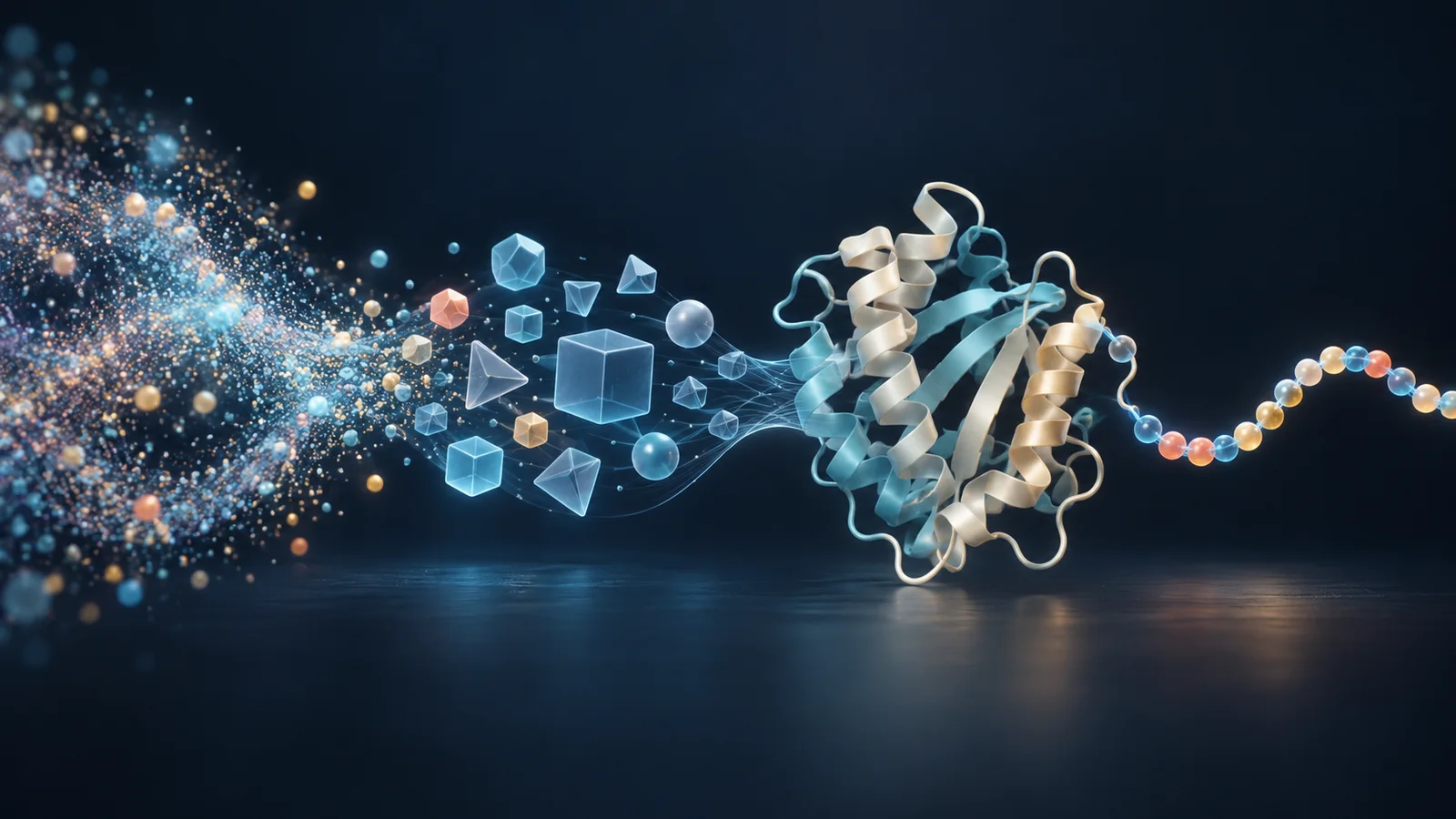
Fengyuan Dai and colleagues presented Pinal, a system for generating candidate proteins from natural-language descriptions in a peer-reviewed Nature paper published October 21. Users can state a desired protein function in ordinary language, and the system produces candidate amino-acid sequences. Its reported performance, however, rests on computational screening and selected laboratory tests.
The authors describe Pinal as a 16-billion-parameter foundation model trained on 1.7 billion synthetically annotated protein-text pairs. Its input can express a desired function without requiring users to specify every geometric or sequence constraint. The paper evaluates prompts across 17 categories derived from Swiss-Prot annotations, including protein names and disruption phenotypes.
Generation happens in two stages. First, a component called T2struct encodes the prompt and generates discrete 3Di tokens representing local structural environments. SaProt-T then combines those structural tokens with another representation of the same prompt to predict an amino-acid sequence. The released inference workflow can sample multiple proteins for one description and rank them by probability per token.
For the computational evaluation, the authors used ProTrek to measure how closely candidates aligned with their requested descriptions and ESMFold to estimate structural confidence. Across the 17 prompt categories, they report that top-ranked designs beat a random baseline on ProTrek alignment and that median ESMFold pLDDT values were typically above 80. Those scores are screening proxies, not direct evidence that a generated protein performs the requested function.
The researchers also tested selected candidates from four functional classes: a fluorescent protein, a polyethylene terephthalate hydrolase, an alcohol dehydrogenase and a metabolic H-protein. For the fluorescent-protein task, 29 filtered candidates went to experimental validation. The characterized pinalGFP produced excitation and emission spectra, although size-exclusion chromatography showed a complex profile dominated by higher-order multimers.
The screening process differed by task. For the PET-hydrolase experiment, confidence and alignment filters reduced the pool to 2,416 candidates. The top 94 were screened for esterase activity, and pinalPETase36 advanced to PET-hydrolysis testing. In the alcohol-dehydrogenase experiment, five of eight selected diverse candidates were active. For the H-protein task, 20 candidates were selected after filtering; 14 were soluble in an initial screen, and five showed experimentally confirmed activity.
The authors report that the best designed H-protein, without iterative experimental optimization, produced a 1.7-fold higher product titre than the native Escherichia coli H-protein in a multi-enzyme carbon-dioxide-fixation pathway. A 500-nanosecond molecular-dynamics comparison suggested a possible structural explanation, but the simulation did not experimentally confirm the mechanism.
The results do not establish a success rate for arbitrary prompts. Each laboratory task used a different filtering and selection process, and the opened sources contain no independent reproduction. The authors’ public repository provides inference and evaluation code, usage instructions, trained weights and four checkpoints for further testing.
More news

Google proposes wake-sleep cycle for continual-learning language models

Liquid AI releases LFM3 family for on-device multimodal AI
IBM links two Nighthawk quantum processors with four meter-scale L-couplers