ResolveAI launches SRE-1 and puts Primary On-call in paging path
ResolveAI launched its 27-billion-parameter SRE-1 model and made Primary On-call generally available, placing an AI agent ahead of engineers in the production-alert paging path.

ResolveAI launched SRE-1 and made Primary On-call generally available on November 18, putting an AI agent ahead of engineers in the production-alert paging path.
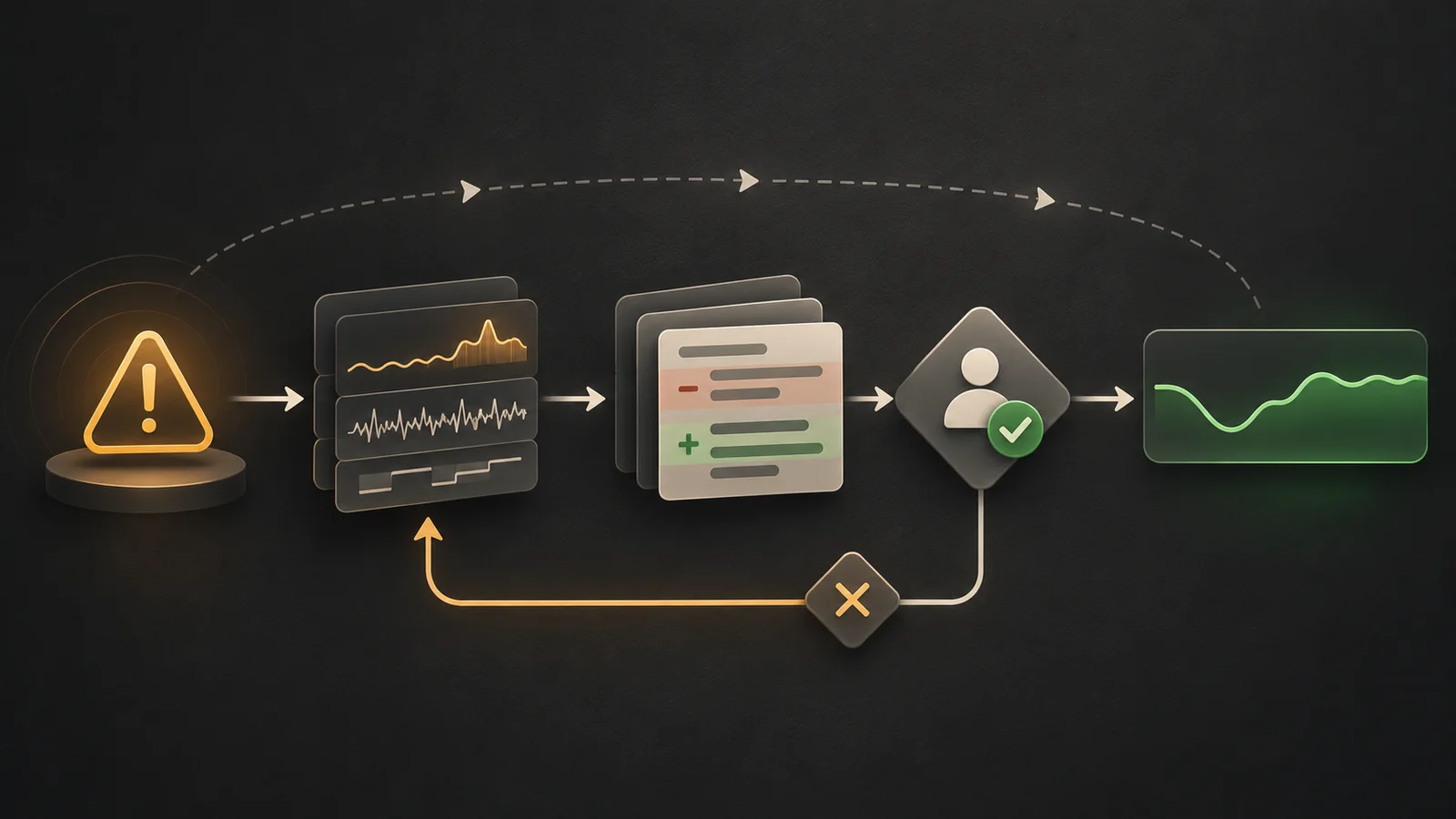
Primary On-call receives a page first and investigates telemetry, infrastructure, code and operational knowledge. It then closes the alert, mitigates the problem when customer policies permit or escalates it to a human with evidence and a proposed fix. ResolveAI says existing paging-system timeouts remain a backstop: if the agent does not decide within the configured window, the engineer is paged as usual.
SRE-1 is a 27-billion-parameter dense model that ResolveAI says it post-trained with reinforcement learning from released Qwen3.8-27B weights. The model is available only through ResolveAI’s platform, not as separately released weights. Its role is to trace an alert to a causal chain by querying a customer’s live systems instead of relying only on general training data.
ResolveAI’s technical paper says the main test used 49 difficult live-production cases, each run five times. ResolveAI reports that reinforcement learning raised the pass rate for a single investigation from 6.9% to 38.8%, while a five-investigation ensemble reached 71% and matched the strongest frontier model it tested at 37% lower cost.
The results come from ResolveAI’s own evaluation and have not been independently reproduced in the available evidence. The paper says answers were graded against reference causal chains by LLM judges calibrated with on-call engineers, with 0.8 as the passing score. It also says 14 of 6,615 test rollouts were excluded because of harness or serving errors and cautions that the company’s internal production environment cannot establish representativeness on its own.
ResolveAI separately claims its complete system solved about twice as many incidents as the general-purpose coding agents it tested across 178 production-alert investigations, with root-cause scores 15% to 25% higher on the hardest third. ResolveAI also says Primary On-call handles up to 80% of paged alerts without human escalation and that customers report a tenfold improvement in mean time to resolution and root-cause accuracy of up to 95%. Those figures have not been independently verified, and ResolveAI did not disclose customer-level denominators, observation periods or incident-severity mix.
ResolveAI is offering a staged rollout. In shadow mode, the agent records the decision it would have made while the existing on-call rotation stays active; customers can later enable it for selected alert rules. The Primary On-call product page says actions are checked against the production baseline, recovery is monitored and decisions are retained in an audit trail.
In ResolveAI’s announcement, Salesforce software engineering principal architect Bhupesh Patel said a dark launch closed more than 70% of his team’s paging alerts without waking an engineer. ResolveAI did not provide Salesforce-owned measurement data. It also has not disclosed pricing, service-level commitments or a detailed public matrix of mitigations that can run without engineer approval.
More news

Apple job listing outlines work on general-purpose AI agents

Google adds background computer use to Gemini for Mac
OpenAI details Codex workflow for ChatGPT performance regressions