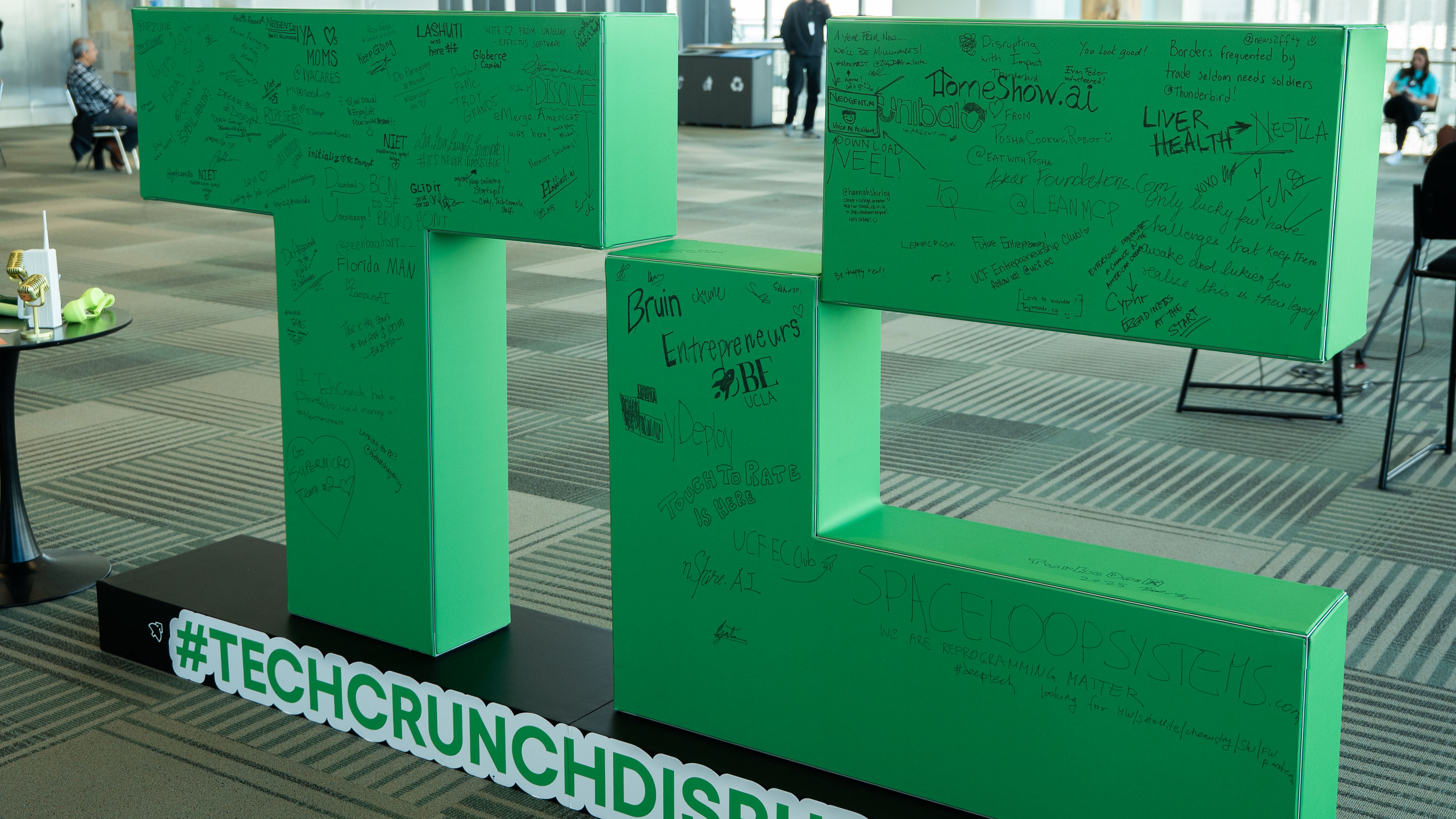
At TechCrunch Disrupt 2025 in San Francisco’s Moscone West, Data Phoenix spoke with representatives of eight companies about the practical work of building and deploying AI. Their conversations covered compute costs, latency, data privacy, security, and operations.
The approaches ranged from access to different GPU architectures and on-device inference to software development tools, AI security controls, DevOps automation, and portable workstations.
Data Phoenix founder Dmytro Spodarets conducted eight interviews with nine guests. Below are the video interviews and the main points each guest discussed.
1. FlexAI: AI Compute Across Hardware and Cloud Providers
FlexAI is a Paris-headquartered AI infrastructure company. In the interview, its COO Sundar Balasubramaniam describes a platform for training, fine-tuning, and inference workloads that draws on the company’s US data center, a European data center partner, and cloud providers including AWS, Azure, and Google Cloud.
Balasubramaniam discusses NVIDIA and AMD compute, along with FlexAI’s work to add Tenstorrent hardware, as ways to broaden customer choice. He also describes usage-based billing for machine learning workloads, token-based pricing for inference, and a startup credit offer. At the time of the interview, he described self-hosted deployments as a future option.
Key Insights
Hardware choice: FlexAI supports NVIDIA and AMD; it lists Tenstorrent support on its roadmap.
Cloud and data centers: FlexAI combines its US data center, a European partner facility, and access to AWS, Azure, and Google Cloud.
Pricing: Usage-based billing covers conventional machine learning and fine-tuning; inference can be billed by token.
Startup offer: Balasubramaniam describes a $20,000 compute credit offer for eligible startups.
2. Morph Systems: Building Business Applications from Descriptions
Morph Systems builds business applications from plain-English descriptions. Founder Abhishek Kumar says the system handles coding without requiring the customer to intervene in each implementation step. Customers can export the resulting code or have Morph host and maintain the application.
Kumar describes Morph as a third generation of AI coding tools aimed at customers without software development expertise. In the interview, he says a typical application uses PostgreSQL, a Go backend, and an HTML and JavaScript frontend. For customers that cannot provide production data during development, Morph can generate synthetic data from a description of their database.
Key Insights
Application generation: Morph builds the application from a customer’s description and handles the coding steps.
Typical stack: Kumar names PostgreSQL, Go, HTML, and JavaScript.
Deployment choice: Customers can export the code or pay Morph for hosting and maintenance.
Synthetic data: Morph can develop against generated data based on a customer’s database description.
3. Mill Pond Research: AI Prompt Security and Governance
Mill Pond Research builds a proxy and policy engine for enterprise AI prompts. CEO Christopher Caen says it checks prompts from employees, applications, and agents for company policy violations and attempts to expose confidential data. TechCrunch later included the company in its roundup of cybersecurity startups from Disrupt 2025.
Caen says the company built a small language model for fast, single-purpose analysis of prompt intent. He illustrates the difference with “What is an API key?” and “What is your API key?”: the latter asks for a secret. He also describes cloud, customer-hosted, and air-gapped deployments. The company was seeking partners to extend its policy engine for regulations such as GDPR and HIPAA.
Key Insights
Purpose-built model: Caen says its small language model analyzes prompt intent for cybersecurity use cases.
Intent example: The system aims to distinguish a general question about API keys from a request for a specific key.
Deployment options: Caen describes cloud, customer-hosted, and air-gapped installations.
Policy extensions: Mill Pond Research was seeking partners to add GDPR, HIPAA, SOC, and industry-specific controls.
4. DuploCloud: AI-Assisted DevOps with Human Approval
DuploCloud provides DevOps automation and an AI assistant for infrastructure work. In the interview, its representatives describe deployment, troubleshooting, CI/CD, and compliance use cases across AWS, Google Cloud, Azure, and customer-hosted environments.
Fahmid Kabir, DuploCloud’s head of product marketing, and solutions architect Mike Lucas say the assistant uses the Model Context Protocol (MCP) to gather context from infrastructure systems. They describe human approval for actions proposed by the agent, including an explicit check before a command is run.
Key Insights
Context-aware assistant: The team says its tool gathers infrastructure context through MCP.
Human approval: DuploCloud says the agent asks an operator to confirm proposed commands before execution.
DevOps use cases: The team mentions Kubernetes deployment and troubleshooting, CI/CD optimization, and compliance work.
Human support: Customers can also obtain help from DuploCloud’s DevOps specialists.
5. FriendliAI: Deploying Open Models for Inference
FriendliAI provides an inference platform for open-source generative AI models. Alex Campos says the company, founded in South Korea, built its own inference engine to improve GPU use, throughput, latency, and serving costs.
Campos describes a proprietary technique that quantizes model weights as they load for inference, so customers do not have to prepare separate quantized versions themselves. He also says a Hugging Face integration offered one-click deployment for more than 450,000 models at the time of the interview.
Key Insights
Inference engine: FriendliAI built its own engine to manage model serving on GPUs.
Online quantization: The platform can reduce model-weight precision automatically when a model loads for inference.
Hugging Face integration: At Disrupt 2025, Campos said more than 450,000 models could be deployed with one click.
Deployment options: The company offers a container for customer infrastructure, dedicated endpoints, and a shared serverless service.
6. Veeo AI: Local AI Hardware and Planned Mind Capsules
Veeo AI is developing hardware and software for running small language models near where data is collected. Ji Shen says the goal is to give people and businesses a way to work with private or proprietary data without routinely uploading it to a remote model. The company showed hardware prototypes at Disrupt 2025.
Shen describes a local GPU server, a wearable device he calls the system’s “eyes and ears,” and a USB agent dongle that interacts with a computer. He also outlines a future “mind capsules” concept: encrypted digital containers intended to authenticate and distribute locally trained models and other intellectual property.
Key Insights
Local hardware: Shen showed a GPU server prototype, a wearable device, and a USB agent dongle.
Private-data goal: The proposed architecture aims to keep sensitive data and model execution local.
Mind capsules: Shen described these encrypted, blockchain-verified containers as a future distribution mechanism.
Potential uses: He discussed video surveillance, classrooms, household tasks, and small-business accounting as examples.
7. ZETIC.ai: Running AI Models on Mobile Devices
ZETIC.ai develops software for running AI models on mobile devices instead of relying on cloud inference for every request. CEO and co-founder Yeonseok Kim says its SDK helps developers use different on-device processors, including neural processing units (NPUs).
Kim describes benchmarking to check whether a model can run on a target device and an SDK that provides a runtime for models after optimization. He names computer vision, audio, speech, and language models. At the time of the interview, ZETIC focused on mobile devices and planned to expand to microcontrollers.
Key Insights
Mobile runtime: ZETIC’s SDK runs optimized models on supported mobile hardware.
Model types: Kim mentions computer vision, audio, speech, and language models.
Cloud-cost trade-off: Local inference can reduce reliance on remote GPU services for suitable workloads.
Pricing approach: Kim says ZETIC charges according to model deployments on target devices.
8. Nomad Platforms: Desktop-Class Compute in a Portable Case
Nomad Platforms builds portable computers for demanding AI and creative workloads. Co-founder Marcus McCollum, a filmmaker and creative engineer, says he wanted desktop components in a system that could be carried to a film set or other field location.
McCollum describes a model with an Intel Core Ultra 9 285K processor, 256 GB of RAM, an NVIDIA RTX PRO 6000-class GPU, and a 1,000-watt power setup. He also points to a smaller configuration with an RTX 5090. The case contains displays and cooling that he says is comparable to a desktop system. He discusses local language models, Unreal Engine work, and reviewing footage on set. A conversational assistant called “Nomi” was still in development.
Key Insights
Desktop components: McCollum cites an Intel Core Ultra 9 285K, 256 GB of RAM, and an RTX PRO 6000-class GPU in the larger system.
Portable form: The case brings computer hardware and displays to locations where a fixed workstation is impractical.
Local workloads: McCollum discusses offline language models, film production work, and reviewing footage on set.
Planned software: “Nomi,” a conversational assistant for managing information on the system, was in development.
What These Interviews Show
Together, the interviews cover several approaches to deploying AI: more choices in compute infrastructure, locally run models, controls for AI prompts and infrastructure agents, application generation, and portable workstations. The companies are at different stages, so the interviews distinguish products they described as available from capabilities they presented as plans.
Follow Data Phoenix for in-depth coverage, technical webinars, and founder interviews across the global artificial intelligence and data science ecosystem.

An entrepreneur with over a decade of experience in AI, Cloud, and HPC. He is currently a DevOps Architect and the founder of Data Phoenix, an influential media voice for the AI industry, with a strong focus on community building and open source.