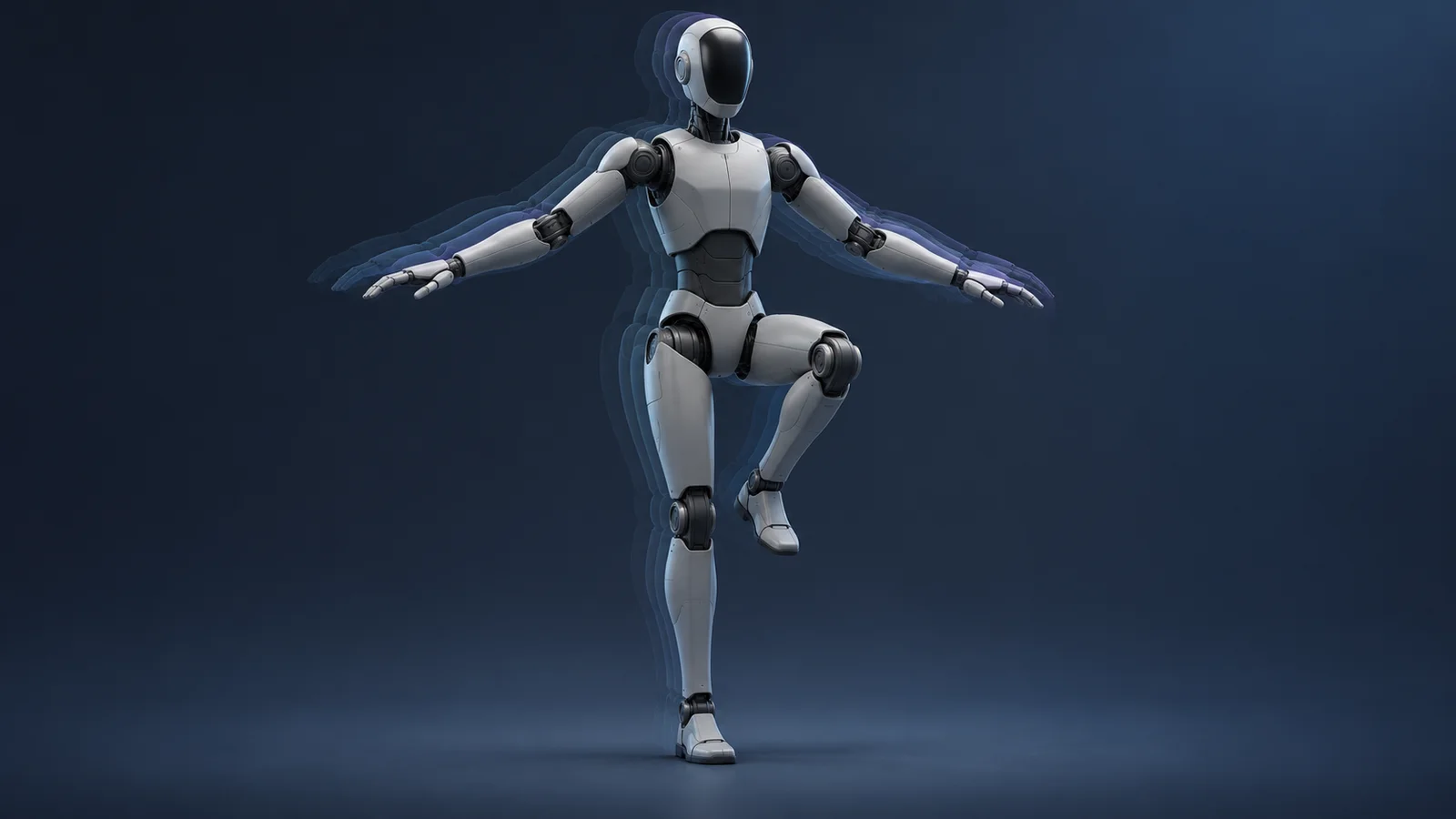
Close&Safe method limits robot detours to obstructed trajectory segments
Close&Safe is a motion-planning method for robot manipulators that preserves feasible portions of an intended end-effector path and confines avoidance detours to blocked intervals.
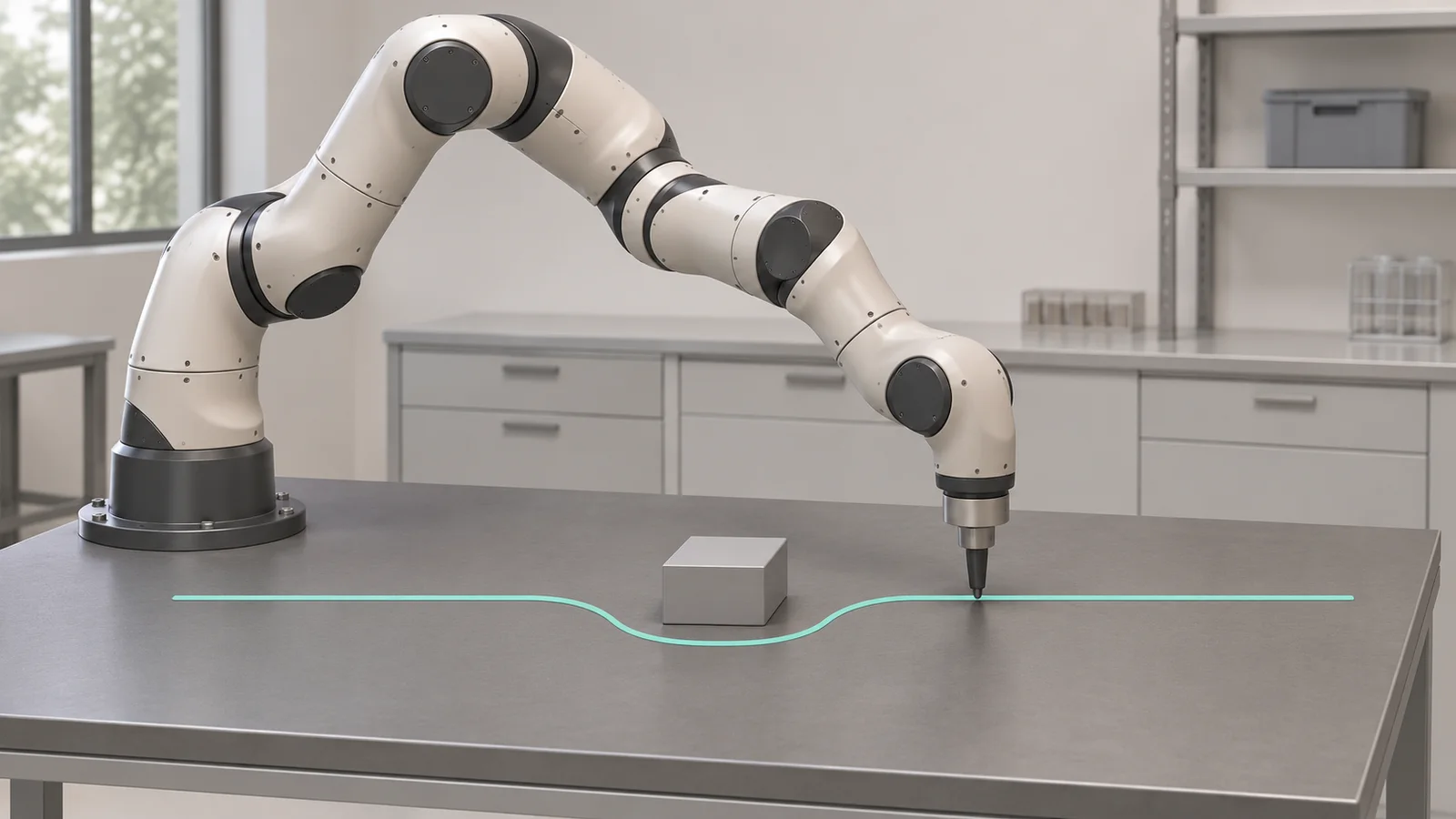
Abhigyan Singh, Manthan Goyal, Fares Abu-Dakka and Ravi Prakash describe Close&Safe, a motion-planning method designed to keep a redundant robot manipulator on its nominal end-effector trajectory wherever that path remains feasible. According to the authors, it changes only intervals where no collision-free robot configuration can reproduce the required tool pose.
The approach targets prescribed-trajectory work such as wiping, polishing, welding and surface inspection, where the path itself defines the task. In the authors’ simulated comparison, Close&Safe was the only evaluated method to traverse the full nominal path in all four scenarios. They also reported preserving 73% of a cleaning stroke and 78% of a mannequin-scanning path on two physical Franka tasks with stationary obstacles. The findings come from an arXiv preprint submitted to IEEE ICRA 2027; the arXiv record does not establish acceptance or independent replication.
Close&Safe first determines whether an obstruction is reducible. If the robot can use its redundant joints to avoid a collision while maintaining the exact end-effector pose, it leaves the task path unchanged. If no configuration can satisfy the pose and avoid collision, the interval is classified as irreducible and becomes eligible for repair.
For each repair interval, the method identifies safe entry and exit configurations, then samples a bounded corridor near the obstacle boundary in configuration space — the space of all possible joint configurations. Retained samples are connected in a directed nearest-neighbor roadmap, and A* search selects a detour based on joint travel, end-effector deviation and clearance. The chosen points are pushed outward to the requested clearance, connections are recursively checked, and the detour is spliced back into the original trajectory before time parameterization.
The paper’s four simulated Franka scenarios covered three 111.4-centimeter table-cleaning paths involving a vase, a stationary second arm or both, plus a 120.4-centimeter wall-spraying path. The authors reported task-preservation scores of 68.4%, 57.8%, 52.4% and 75.0%, with minimum clearances of 17.6, 13.1, 14.1 and 13.7 millimeters. They defined preservation as the share of 500 evenly spaced checkpoints matched within 5 millimeters and 5 degrees.
The comparison included TrajOpt, CollisionIK and two Neural-JSDF controllers. The authors said they tuned each baseline for 30 trials per scenario while keeping Close&Safe’s parameters fixed. They reported the best seed for the stochastic baseline and the mean for Close&Safe. Across the three cleaning scenarios, Close&Safe averaged 59.5% preservation, according to the paper, compared with 45.6% for the strongest baseline that remained collision-free in every case.
For the hardware tests, the team recorded two nominal trajectories by kinesthetic demonstration and perceived obstacles with an Intel RealSense D435i. A jug and fixed mannequin arm obstructed the cleaning task; a raised arm on the fixed mannequin obstructed the scanning path. The obstacles remained stationary during execution. The authors also state that the preservation metric measures spatial coverage only, the repair does not retain the demonstrated velocity profile, planning time and projection distance remain empirically set, and moving obstacles were not evaluated.
More news
TacInno trains robot policies on tactile changes vision cannot explain
A2-VLA tests unfamiliar tools before steering robot policy
Reasoning on Call triggers agent review during robot tasks