TacInno trains robot policies on tactile changes vision cannot explain
TacInno uses future tactile changes unexplained by vision and actions as an auxiliary training target, then removes that target machinery while retaining tactile input at deployment.
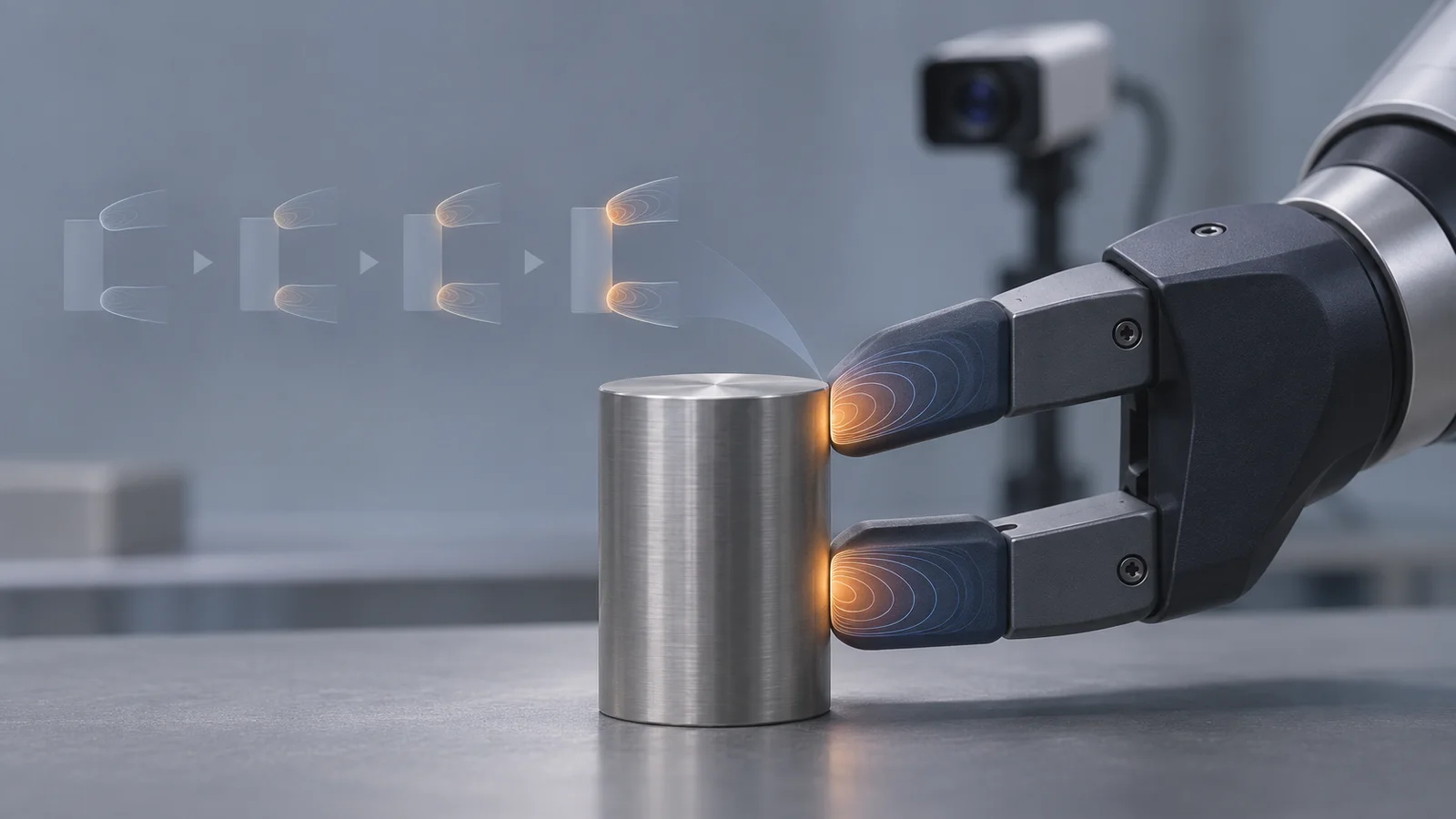
TacInno’s researchers introduced a method to train contact-rich vision-language-action policies to predict the part of future tactile change that current touch, camera observations and executed actions do not explain. In their version 1 preprint, the authors call that residual signal “tactile innovation.” The design makes the signal an auxiliary training target without adding a tactile-innovation code module to the deployed action path.
The tokenizer and two auxiliary prediction heads are used for training and then removed. The deployed policy still needs tactile sensing: it retains a 60-token branch that encodes three recent tactile observations.
TacInno first trains an encoder-decoder tokenizer on short future sequences. The encoder and decoder both receive the visual observations and all executed actions in a 15-step window, encouraging the tokenizer’s compact code to represent contact changes those conditions do not already capture. The resulting 16-bit target consists of four discrete tokens with 16 possible values each.
During policy training, four code queries predict that future-derived target from the available visual, proprioceptive and tactile features. An attention mask prevents action tokens from attending to those code queries, making the code an auxiliary target rather than an extra input used to produce actions. The tokenizer, code-prediction head and contact-state prediction head are discarded for deployment.
The authors report an 87.5% average closed-loop success rate for TacInno-VLA across six UniVTAC simulation tasks, compared with 76.8% for SimpleTouch, the strongest visuo-tactile baseline by average in their main table. Each policy used the same 50 demonstrations per task and was evaluated over 100 episodes per task with identical random seeds. TacInno-VLA scored at least 75% on each simulated task in that comparison.
In four real-world tasks on a Franka FR3 equipped with a vision-based tactile sensor, the authors report a 70.5% average for TacInno-VLA, versus 61.5% for SimpleTouch and 58.5% for FTP-1. Each policy used the same 45 teleoperated demonstrations per task and was tested in 50 trials per task. TacInno-VLA’s reported task-level rates were 88% for wiping a board, 38% for inserting a plug, 74% for lifting a can upright and 82% for unscrewing a cap.
The paper’s ablations connect those results to the training target and continued tactile input. Removing the code-prediction loss reduced the reported real-world average from 70.5% to 47.5%. In a separate tactile-off test, replacing touch input with a fixed no-contact frame cut Lift Can success from 88% to 0% and Lift Bottle success from 78% to 4%.
These results come from an author-reported arXiv preprint and have not been independently replicated. The paper does not provide confidence intervals or statistical-significance tests for the main comparisons, and its real-world evaluation is limited to four tasks, one robot setup and 50 trials per task. It also does not report deployment latency, compute or resource measurements, so removing the auxiliary training machinery does not establish zero tactile-processing cost.
More news
A2-VLA tests unfamiliar tools before steering robot policy
Reasoning on Call triggers agent review during robot tasks
ECHO uses interaction history to adapt humanoid whole-body control